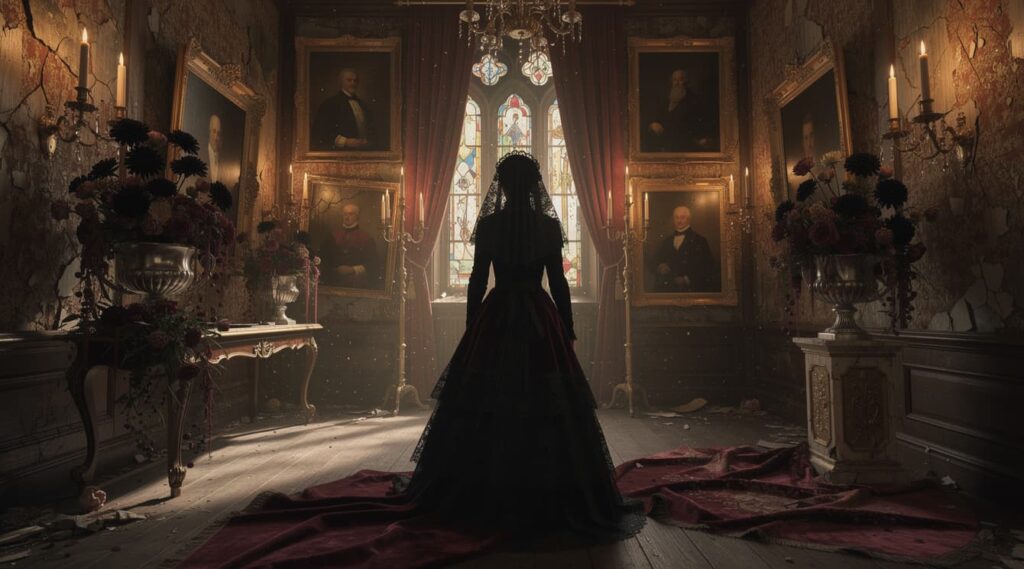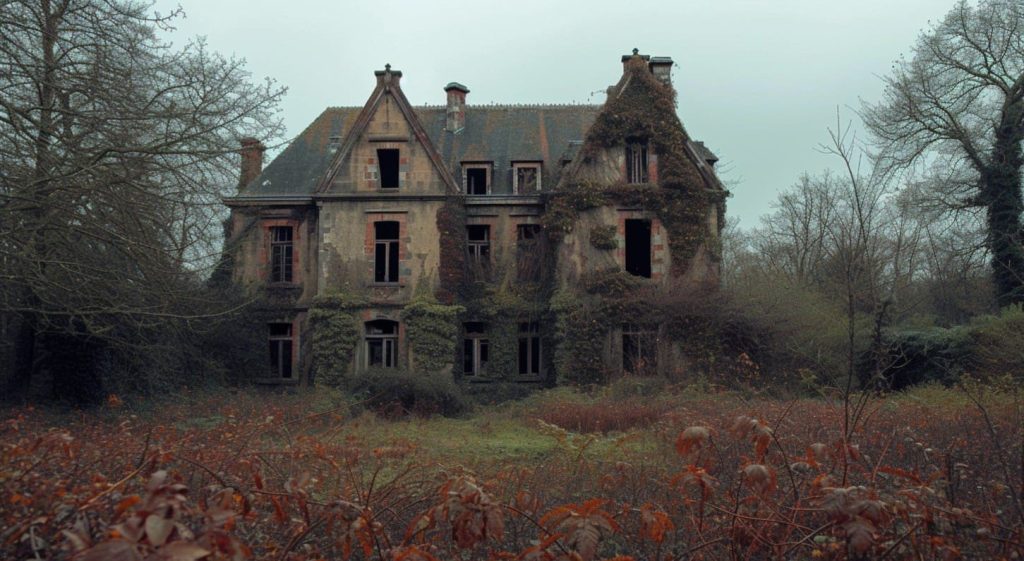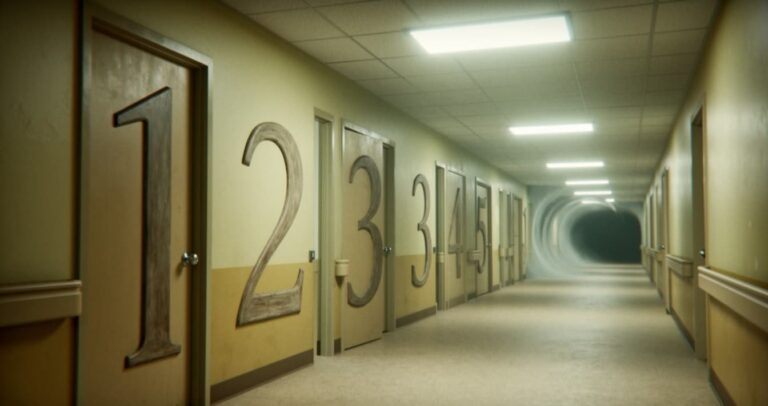

Backrooms Ending Explained: so you just rented or bought the digital copy and watched “Backrooms” and you’re sitting there in your hall thinking… Wait, what did I just see? You’re not alone. This is one of those endings that doesn’t hand you a bow-tied resolution. It hands you a question mark and expects you to sit with it. So let’s actually sit with it. Here’s everything that happens, and here’s what it means.
And to be fair, it’s not like the movie was ever trying to make this easy on you. From the opening minutes, “Backrooms” leans into ambiguity as a feature, not a flaw, trading jump scares for the kind of slow, patient dread you can’t quite shake once the credits roll. So if you walked out with more questions than answers, that’s not you missing something.
*Heads up: We are diving straight into the deep end of the plot from here on out. If you haven’t watched the movie yet and want to go in clean, bookmark this page, go stream it, and come back when you finished. Consider this your official spoiler warning!
TL;DR, Quick Takeaways
- Clark (Chiwetel Ejiofor) finds a portal to the Backrooms in his furniture store’s basement and can’t stop going back, even after it kills his own employees.
- Then you’ve got his therapist, Mary (Renate Reinsve), who goes in after him to play hero, only to end up completely out of her depth in a nightmare tailored just for her.
- Clark is killed by Pirate Clark, a monstrous “Still Life” duplicate built out of his own denial and self-image.
- Mary manages to break away using an old childhood token, but her “rescue” turns out to be a trap when Async pulls her out just to throw her into lockdown for questioning.
- The final shot reveals a Still Life copy of Mary already sitting inside the Backrooms, meaning the dimension kept a version of her even though she made it out.
- Director Kane Parsons has confirmed the events aren’t a dream, but has deliberately left the meaning of that last image open, and a sequel is basically expected.
Wait, How Did This Even Become a Movie?
Before we get into the heavy spoilers, we need to talk about the backstory here. It actually changes the way you look at the whole movie. The whole thing actually started out as a viral YouTube series by Kane Parsons (aka Kane Pixels). He took the classic internet creepypasta about “noclip-ing” out of reality into a never-ending nightmare of yellow wallpaper and buzzing lights, and turned it into a web phenomenon. Parsons posted his first Backrooms short in January 2022 at just 16 years old. By the time A24 handed him the keys to a feature film, he was around 20, making him the youngest director in the studio’s history.
You can feel that YouTube-horror DNA all over this movie. It’s slow, it’s atmospheric, and it trusts silence way more than jump scares. And it clearly worked, because “Backrooms” became A24’s biggest hit of all time, pulling in well over $367 million worldwide off a reported $10 million budget. Which is absolutely wild when you think about it, because that weekend instantly made him the youngest director in history to ever land a number one movie both here and across the globe. That’s not a small thing for a guy who was still figuring out college applications a year or two earlier.
So What’s the Actual Plot Here?
Let’s get everyone on the same page. Clark (Chiwetel Ejiofor) owns a struggling furniture store, and honestly, his whole life is fraying at the edges. His marriage is falling apart, his business is bleeding money, and he’s leaning hard on alcohol to get through the day. He’s seeing a therapist, Dr. Mary Kline (Renate Reinsve), who’s carrying her own baggage, including unresolved trauma tied to her mother’s mental illness and the recent demolition of the childhood home she grew up in.
Then Clark finds a door in the basement of his store. It shouldn’t be there. He goes through it anyway, and on the other side is an endless, maze-like dimension made of drab yellow wallpaper, buzzing lights, and rooms that go on for what feels like forever. This is the Backrooms. And once Clark starts going back, again and again, he can’t stop.
He’s not alone in this at first, either. Clark brings his assistant manager Kat (Lukita Maxwell) and her boyfriend Bobby (Finn Bennett) along on one of his trips into the space, and both of them meet grisly ends down there. Instead of that being the wake-up call you’d expect it to be, Clark does the exact opposite of what any sane person would do: Instead of running for the exit and locking the door behind him, he literally chooses to stay behind and make the maze his new permanent address.
Eventually Mary follows him in, trying to pull him out. That’s really the engine of the whole back half of the movie: a therapist walking into her patient’s literal nightmare to try to save him, only to discover the place doesn’t work the way either of them expected.
What Exactly Are the Backrooms, According to This Movie?
Here’s where the film gets genuinely clever, and it’s worth slowing down on this part because it’s the key to understanding everything that happens later. The Backrooms aren’t just an empty maze. They’re framed as something closer to the subconscious of the modern world, a space that holds onto fragmented, distorted memories from everyone who’s ever passed through it. Whoever enters leaves something of themselves behind, whether they want to or not.
That’s where the “Still Life” entities come in. These are the disfigured, human-like figures that show up throughout the film, and they aren’t monsters in the traditional sense. They’re duplicates, failed attempts by the Backrooms to recreate real people out of memory. The deeper someone goes, the more material the dimension has to work with, and the more accurate, and more disturbing, its copies become. Clark actually demonstrates this himself at one point, cutting into one of these copies to show it feels no pain, which tells you these things aren’t quite alive in any way we’d recognize.
Behind all of this sits Async, short for the Async Research Institute, a shadowy organization that stumbled onto the Backrooms back in the late 1980s while it was still in the business of manufacturing MRI machines for hospitals. There’s a nice bit of thematic symmetry buried in that detail, actually: an MRI machine is built to map the inside of the human body, and Async ends up applying that same instinct to mapping a dimension that behaves an awful lot like a human mind. Once Async realized what it had found, it pivoted its entire operation toward exploring the place, which it internally calls “the Complex.”
That corporate thread runs quietly under the whole film without ever hijacking it, which is a smart choice. The movie actually opens on it, in fact: before we meet Clark or Mary at all, we get a found-footage cold open dated 1990, following an Async researcher who’s gone deeper into the Backrooms than he should have. He’s narrating into a camcorder, clearly lost, when something starts stalking him. The footage cuts out, and we learn it’s being replayed on a screen, watched by a room full of Async scientists, their reflections visible in the glass. It’s a short scene, but it plants two important ideas early: Async has known about this place for decades, and whatever they’re doing down there hasn’t gotten any safer.
Who Is Pirate Clark, and Why Does He Matter So Much?
Alright, this is the detail that makes the ending click, so pay attention. Clark’s furniture store runs cheesy local commercials with him dressed as a pirate mascot, hawking deals for the store. It’s small, almost throwaway detail early on. It is not throwaway later.
Deep inside the Backrooms, Mary eventually catches up with Clark in a warped recreation of his old home, a space the dimension specifically built out of his own memories. And guarding him, looming at nearly ten feet tall, is a Still Life entity wearing that same pirate costume.
That costume isn’t a random creepy visual. That’s the whole point. Clark spent the entire movie clinging to a version of himself that refused to take responsibility for his divorce, his failing business, and his drinking. That mascot, cheerful, hollow, performative on the surface, is basically Clark’s public-facing self-image made physical, and the Backrooms built it monstrous because that’s exactly what it’s been protecting all along: his refusal to look at himself honestly.
What Happens at That Dinner Table Scene?
Before Clark dies, the film gives us one of its most unsettling sequences: a forced “family dinner” that Clark sets up for Mary, deep in the Backrooms, surrounded by Still Life entities sitting around the table like props in a play he’s directing. Clark makes Mary repeat something close to their earlier therapy sessions, where she’d played the role of his ex-wife in a roleplay exercise meant to get him to actually process his alcoholism and his broken marriage instead of just talking around it.
Except now, in the Backrooms, Clark isn’t looking for therapy anymore. He’s looking for absolution. He wants Mary to tell him none of it was his fault. And when she finally breaks and tells him the truth instead, that he’s the reason his life fell apart, not his ex-wife, not bad luck, that’s the exact moment things go wrong for him. He’s spent this whole film wanting a witness to validate his denial, and when the one person who could give him that finally refuses, the space around him stops protecting him.
How Does Clark Actually Die?
This is the part people leave the theater debating, and it’s also the part worth correcting if you’ve seen it described elsewhere as something vaguer. Clark doesn’t die because the environment simply falls apart around him. Pirate Clark, the Still Life built in his image, is the thing that kills him directly, and it isn’t subtle about it. The creature turns on him mid-scene and kills him, tearing into him the way it already tore into Kat and Bobby earlier in the film.
The symbolism still holds, and honestly it’s stronger this way, not weaker. Clark spent the whole movie treating the Backrooms as an escape hatch from his real problems, and it’s not an accident that the thing he built down there to protect his ego is the exact same thing that ends up destroying him. He dies in the room the space built specifically for him, killed by the version of himself he refused to let go of. That’s about as thematically on-the-nose as horror movies get, in the best way.
What Happens to Mary?
After Clark dies, Mary has to get out, and the film doesn’t make that easy either. Pirate Clark turns on her next, and she’s chased through a sequence of rooms that the Backrooms constructs from her own life, pulling directly from the childhood trauma she’s spent years discussing only in the third person with her own patients. Her mother’s home, torn down in real life not long before the events of the film, gets rebuilt around her here, room by room.
She survives because of a small detail the film plants earlier and pays off later: a piece of broken concrete she’d kept in her office, stamped with her own childhood handprint, a memento from the driveway of the house she grew up in before it was demolished. She uses it to fight the creature off, buying herself enough time to get away, before ducking into a passage the creature can’t fit through.
Just past that point, she stumbles into what turns out to be a trap of sorts, an Async operation waiting near the exit. A team in hazmat suits gases her and pulls her out, though “rescue” might be a generous word for what happens next. She’s restrained and taken into an interrogation room, where a researcher named Phil (Mark Duplass) explains, without going into much detail, exactly what Async is and what it’s been doing down there for decades. He admits he doesn’t fully know what happens to a person after they’ve been that deep in the Backrooms, which is not the reassuring thing to hear after everything Mary just survived. Given the organization’s whole history of keeping its research quiet, Mary’s actual fate afterward is left deliberately murky. She survives the Backrooms. Whether she survives Async is a very different question.
What’s the Deal With the Final Shot?
Here’s the moment that’s going to stick with you. While Mary sits in that Async interrogation room in the real world, being questioned, the camera cuts back into the Backrooms. It shows a near-perfect replica of that exact same room, same yellow walls, same flat fluorescent light. And sitting in the same chair, in the same posture, is a Still Life version of Mary. Same expression. Except she’s got extra eyes, and that particular wrongness of something built from memory instead of grown from life.
That’s the whole thesis of the movie laid out in one final image. The Backrooms doesn’t need Mary to stay trapped inside it to keep a piece of her. It absorbed her the whole time she was down there, and it’s already assembling its own version of her, one step behind the real thing. Mary made it out physically. But there’s a copy of her sitting in an endless yellow room that isn’t going anywhere.
Okay, But What Does This Actually Mean?
A few layers worth pulling apart here.
A movie about denial
First, this is a movie about denial and what happens when you finally stop being able to run from something. Clark treats the Backrooms as an escape from his failing marriage and his drinking, and the space responds by building him a version of himself he can’t outrun, and eventually can’t survive. Mary, on the other hand, holds out longer specifically because she doesn’t treat the dimension like an escape. She goes in as a professional doing her job, treating it almost like another difficult case file, right up until the rooms start pulling memories she’s kept locked away for years.
How trauma actually works
Second, there’s something going on here about how trauma doesn’t stay buried, it just waits to be rebuilt somewhere you didn’t expect. The film treats the Backrooms less like a haunted place and more like a reflection. You don’t get attacked by something foreign down there. You get confronted by a distorted version of exactly what you already are, or what you’ve been avoiding.
None of this stops with Mary
Third, and this one’s a little chilling if you sit with it: the ending implies none of this stops with her. Async’s own quiet, decades-long research suggests she’s just one data point among many test subjects the institute has run through over the years. The dimension keeps whatever it copies. What happens to the original person afterward barely matters to it once a version of them already exists inside.
It’s worth pointing out how differently the film treats Clark and Mary’s respective breaking points, too, because that contrast is really the emotional backbone of the whole back half. Clark’s arc is about a man who’s had every opportunity to face his problems head-on and consistently chooses not to, right up until the choice is made for him. Mary’s arc is quieter and arguably sadder, because she’s spent her entire career helping other people do the exact thing she can’t do for herself. The Backrooms doesn’t really punish her the way it punishes Clark. It just… keeps her, the same way it keeps everything else that passes through it long enough to leave a mark.
Why Does the Ending Feel Ambiguous on Purpose?
If you left the theater unsure whether you’d been watching Mary or her double for the last stretch of the film, that’s intentional. Parsons has said directly that the events in the film aren’t a dream, but he’s deliberately left the exact meaning of that final cut open to interpretation. The structure supports multiple readings without forcing you into one, and it’s built that way specifically so future installments could follow either version of Mary, or neither, depending on where the story goes next.
That kind of restraint is rare in studio horror, honestly. Most films this size would feel pressure to spell out exactly what happened in a tidy epilogue. This one trusts you to sit with the discomfort instead, which lines up with what critics have pointed to as the reason the movie landed the way it did: it’s more interested in unsettling you intellectually than jump-scaring you.
Quick Character Guide
Since the cast is small but everyone matters to how the ending lands, here’s a fast rundown of who’s who.
- Clark (Chiwetel Ejiofor) is the furniture store owner whose life is falling apart before the Backrooms ever enters the picture. His divorce, his failing business, and his drinking are the real horror the film is built around, and the Backrooms just gives all of that a physical shape.
- Dr. Mary Kline (Renate Reinsve) is Clark’s therapist, someone used to helping other people process trauma while keeping her own locked away. Her mother’s mental illness and the recent demolition of her childhood home are the wounds the Backrooms eventually digs into.
- Kat (Lukita Maxwell) is Clark’s assistant manager, and one of the first people he brings into the Backrooms. She doesn’t make it out.
- Bobby (Finn Bennett) is Kat’s boyfriend, along for the same trip, and he meets the same fate she does.
- Phil (Mark Duplass) is the Async researcher who interrogates Mary after she’s pulled out of the Backrooms. He’s not a villain in any cartoonish sense, more like a company man who’s spent years normalizing something he probably shouldn’t have.
How Did Critics and Audiences Actually Respond?
For a movie built on internet lore and a first-time teenage director, the reception was remarkably strong. Backrooms landed a Certified Fresh score on Rotten Tomatoes in the high 80s among critics, with reviewers specifically praising how well it translates the internet’s fascination with liminal spaces into something that actually functions as a horror film rather than just a mood board. Audiences were a little more split, settling in the mid-70s, with some viewers going in expecting a straightforward monster movie and getting something slower and more psychological instead.
That reception lines up with the box office numbers, too. Early tracking had Backrooms opening somewhere in the $20 to $30 million range domestically. Instead, it opened above $80 million domestically and grabbed the biggest opening weekend in A24’s history, eventually pushing past $367 million worldwide against a reported $10 million budget. For context, that’s not just a hit, it’s the single biggest theatrical release the studio has ever put out, ahead of prior A24 successes that had been considered runaway hits in their own right.
Is There Going to Be a Sequel?
Almost certainly, yes, and honestly this was the plan from the start. Parsons has said continuing the story has been his intention since 2022, long before A24 was even involved, and that a single film was never going to be enough space to get to what he considers the true heart of the idea. Given how the ending leaves both the captured Pirate Clark and the newly formed Still Life Mary sitting in Async’s hands, there’s clearly more mythology waiting to be unpacked, particularly around Async and however many other people the institute has run through that place over the decades.
Worth knowing too: an extended cut, “Backrooms: Everything Must Go Edition,” already hit theaters on July 3, 2026, adding roughly 15 to 16 minutes of new post-credits footage specifically for longtime fans of Parsons’ YouTube series. That’s a pretty clear signal this world isn’t done expanding anytime soon.
Backrooms Ending Explained: Quick FAQ
- What killed Clark in Backrooms?
- Pirate Clark, a Still Life duplicate built out of Clark’s own denial and self-image, kills him directly during the forced dinner scene, right after Mary refuses to absolve him of blame for his failed marriage.
- Who are Kat and Bobby?
- Kat (Lukita Maxwell) is Clark’s assistant manager, and Bobby (Finn Bennett) is her boyfriend. Clark brings them into the Backrooms early in the film, and both die there before Mary ever gets involved.
- What is Async in Backrooms?
- Async is a shadowy research institute that discovered the Backrooms in the late 1980s while still operating as an MRI equipment manufacturer. It has spent decades secretly exploring and mapping the space, referring to it internally as “the Complex.”
- What does the final shot of Mary mean?
- It shows a Still Life duplicate of Mary already sitting inside the Backrooms, meaning the dimension began copying her the entire time she was trapped there. Mary escapes physically, but a version of her remains behind.
- Is Backrooms based on a real place?
- No. It’s based on the “Backrooms” internet creepypasta and Kane Parsons’ YouTube web series, both of which are fictional.
- Will there be a Backrooms sequel?
- Nothing is officially confirmed, but Kane Parsons has said a multi-film story was always the plan, and the ending sets up threads involving both the captured Pirate Clark and the Still Life version of Mary.
Conclusion
“Backrooms” isn’t the kind of horror movie that wants to scare you with a monster jumping out of a closet. It wants to sit with you in the discomfort of realizing the thing chasing you might just be an unflattering reflection of yourself, one the universe is patient enough to rebuild, wrong, forever. Clark couldn’t face that, and it killed him. Mary barely could. And by the time that final shot lands, you’re left wondering which version of her actually made it out.
About the Author.
Hi, I’m Vansh, the founder of Vibe On Cue. I track the absolute best ways to experience cinema, from the biggest Hollywood Blockbusters and upcoming release dates to the finest details of PVOD & Streaming and pristine Blu-ray & 4K physical media. And when the credits roll, I break down the narrative with deep-dive Ending explained guides. If you live for the full life cycle of film, stick around and explore the site!!!