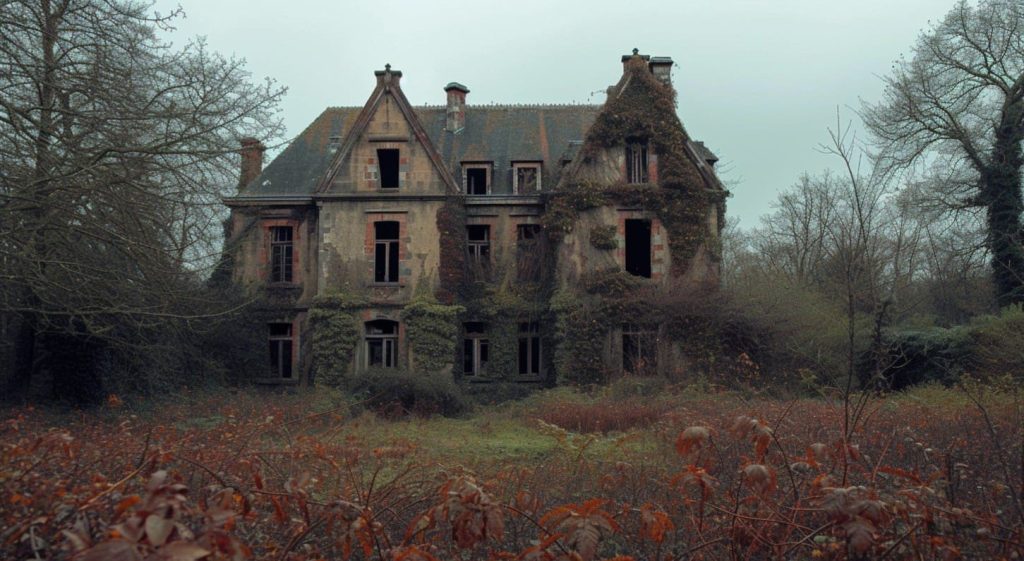

Echo Valley Ending Explained: If you just finished Echo Valley and you’re sitting there going “wait, hold on, back up” yeah, that’s the correct reaction. This one sneaks up on you. For most of its runtime it plays like a quiet, grief-soaked character study about Kate (Julianne Moore), a horse farm owner in rural Pennsylvania who’s barely keeping it together after losing her wife, and her troubled daughter Claire (Sydney Sweeney), whose chaos keeps crashing into Kate’s life like an unwelcome distraction she can’t afford to ignore.
When Claire shows up on the farm one night covered in someone else’s blood, it sets off a chain of events involving a menacing local dealer named Jackie (Domhnall Gleeson) and Kate’s steady, loyal friend Les (Fiona Shaw) one that spirals way beyond what any of them, or you, see coming.
You settle into that rhythm, and then somewhere in the final act, the movie reveals it was never just a character study at all, it was a thriller wearing a character study’s clothes, and the tragedy was doing a lot more narrative work than you gave it credit for. Here’s the thing about this ending: it’s not ambiguous in the way people keep saying it is. It’s not a “make up your own mind” kind of finish. It’s a puzzle box that clicks shut, and once it does, basically everything you thought you understood about the first ninety minutes needs to be re-filed under “actually, that was a lie.”
The movie plays fair about it, too if you go back and watch the early scenes again, the cracks are there. You just don’t notice them the first time, because you’re watching everything through Kate’s eyes, and Kate herself has no idea she’s being played.
That’s really what makes this one worth unpacking. It’s less a whodunit and more a “why did I fall for that” the kind of ending that makes you want to talk it through with someone the second the credits hit. So let’s walk through it properly what happens, why it happens, and what it all means for Kate by the time the credits roll.
Heads Up: We are jumping straight into the deep end of the plot twists now. If you hate spoilers, close your eyes and turn back. (Or, you know, go watch the movie and come right back)!
TL;DR, Quick Key Takeaways
- Kate buries what she believes is her daughter’s dead boyfriend, Ryan, to protect Claire except Ryan is very much alive.
- The real body belongs to Greg, a local addict who overdosed on fentanyl-laced drugs that Ryan was dealing.
- Claire manipulated her own mother into disposing of a corpse and covering up a drug death, using grief and guilt as leverage.
- Kate eventually turns the tables, staging a barn fire and framing the dealer, Jackie, for everything.
- The film ends with Kate reclaiming control of a situation that had been used against her the entire time.
So what’s actually going on with Kate at the start?
Before any of the crime stuff kicks in, you need to sit with where Kate is emotionally, because it explains every terrible decision she makes later. She’s grieving her wife, who died suddenly in a riding accident on their farm. She’s alone, behind on repairs, and forced to go crawling to her ex-husband for $9,000 just to fix a collapsed barn roof. That ex-husband doesn’t miss the chance to lecture her about how she keeps throwing money at their daughter with nothing to show for it.
That daughter is Claire, who’s been in and out of rehab for years and shows up at the farm with her boyfriend Ryan in tow. Almost immediately you can feel how thin the goodwill is. Claire’s presence is never just a visit, it’s always attached to some new emergency. This time it’s drugs. She’s tossed a stash belonging to a dealer named Jackie into a river out of pure spite during a fight with Ryan, and now Jackie wants what he’s owed, one way or another.
There’s a small, quiet detail worth sitting with here: the farm itself is called Echo Valley, and it was something Kate built with her late wife, not something she’s running for money. It’s the last physical thing tying her to the life she had before Patty died, which is exactly why she can’t walk away from it even as it drains every dollar and ounce of energy she has left. When Jackie corners Claire on the property and starts roughing her up over the missing drugs, Kate steps in and threatens to call the police, the first sign of just how far she’s willing to go to keep her family, however fractured it is, in one piece.
Richard, Kate’s ex-husband, is barely in the movie, but his handful of scenes do a lot of quiet groundwork. He’s remarried, financially comfortable, and clearly done playing rescuer for Claire. His lecture to Kate about “enabling” their daughter isn’t wrong, exactly, it’s just coming from someone who’s already emotionally checked out of the situation. That contrast matters.
Kate is the one who stayed tethered to Claire’s chaos, year after year of rehab stints and relapses and disappearances, while Richard got to opt out. By the time Claire shows up bloody on the farm, Kate isn’t just reacting to one crisis she’s reacting to a decade of being the only parent who never gave up, and that history is exactly why Claire knows precisely which buttons to push.
Why does Kate agree to help bury a body?
This is the moment the film hinges on, so it’s worth being precise about it. Claire vanishes with Ryan for a few days, then comes back to the farm alone, covered in blood that isn’t hers. She tells Kate a story and it shifts as she tells it. First it’s an accident: they fought, she pushed him, he hit his head. Then, once Kate reassures her that an accident wouldn’t be her fault, Claire “corrects herself” and admits it was self-defense, that Ryan turned violent and she hit him with a rock.
Kate doesn’t call the police. She doesn’t hesitate for long, either. She tells Claire to strip off her clothes, checks the body wrapped up in the back of Claire’s car, and drives it out to a nearby lake herself to dump it. Why would any parent do this? Because Kate has already lost one person she loves without warning, and the idea of losing her only child, even a child who’s put her through hell for years, is unbearable.
She’s not thinking like someone weighing evidence. She’s thinking like someone terrified of losing what’s left of her family. That’s the emotional trap Claire is exploiting, whether she fully admits it to herself or not.
Watch how deliberately the scene is staged, too. Claire doesn’t just tell Kate a story once and sticks with it; she tests the waters first with the more sympathetic version, the accident, and only escalates to the more damning self-defense version once she’s sure her mother isn’t going to bail on her. It plays like grief and panic in the moment, but on a second watch it reads a lot more like someone feeling out exactly how much their audience will believe.
Kate never asks the follow-up questions a more suspicious person would. She’s not naive, she’s just out of room to be suspicious. She’s already decided, before Claire even finishes the story, that she’s not losing this daughter too.
Is the Body actually Ryan’s?
No and this is where the film really starts pulling its sleight of hand. After Kate disposes of the body and even hands over the $9,000 from her ex-husband to pay off Claire’s debt to Jackie, Claire disappears again without a word. Days of silence go by. Kate, increasingly unsettled by what she’s done, uses an iPad that Claire had logged into earlier to track her daughter’s location.
When Kate finally shows up at the address she’s tracked Claire to, she finds her daughter very much alive standing next to Ryan, who is also very much alive. Kate demands to know whose body she buried in the lake if Ryan is standing right in front of her. Claire and Ryan don’t answer. They run.
That’s the gut-punch moment, and it recontextualizes everything that came before it. Claire didn’t need her mother to cover up an accidental killing. She needed her mother to make an actual dead body, one that had nothing to do with her disappear, and she used grief, guilt, and love to get it done without ever explaining what was really at stake.
So who did Kate actually bury?
The body belongs to a local man named Greg, who overdosed on fentanyl. Ryan had been cutting his drug supply with fentanyl to stretch it further and make more money, and Greg was one of the people who paid the price for it. That overdose is a serious problem for Ryan, for Claire by association, and especially for Jackie, whose product it ultimately traces back to. A body connected to a fentanyl death is the kind of thing that brings real police attention, the kind none of them can survive.
So Claire came up with the plan: let Mom handle it. She knew exactly how far Kate would go if she believed her daughter had killed someone in self-defense. She staged the story, staged the blood, and staged her own disappearance and reappearance to sell it. It’s manipulative in a way that’s almost hard to watch, precisely because Claire’s fear and desperation play as genuine the moment you believe her right alongside Kate, which is exactly the point.
It’s also worth noting how much smaller Ryan’s role in all of this is once you know the truth. For most of the film he reads as a liability, a boyfriend dragging Claire further into danger, someone she needs protecting from. In hindsight, he’s less a victim of the situation and more an active participant in the cover-up, willing to let his own girlfriend fake his death and manipulate her grieving mother rather than face the consequences of what his dealing actually caused. He never confronts Jackie himself, never goes to the police, never does anything that would put him at real risk. He lets Kate absorb all of it instead.
Why does Jackie start threatening Kate?
Once Jackie puts together that Greg’s body and the fentanyl trail leading back to his own operation has essentially vanished thanks to Kate, he doesn’t back off. He escalates. He shows up at the farm again, this time to extort her, dangling the fact that she disposed of a body over her head as leverage. At one especially chilling point, he drugs Kate with a needle just to make sure she understands who’s really in control here.
That scene is a turning point for how the film treats Kate, and it’s worth pausing on. Up to that moment, she’s been reactive absorbing hit after hit, adjusting her plans around what other people force onto her. Getting physically overpowered and drugged in her own home is the moment she stops being able to pretend this is manageable through good intentions and quiet compliance. She’s not just protecting Claire anymore. She’s fighting for her own safety, on her own land, against a man who’s made it very clear he’ll hurt her if it’s convenient for him.
To maintain cover, Jackie moves into the apartment above Kate’s barn, posing as a newly hired farmhand. It’s a genuinely tense stretch of the film Kate is now sharing her own property with the man blackmailing her, having to act normal around him while quietly working out how she’s going to survive this.
What makes this stretch land is how differently Jackie carries himself compared to earlier in the film. When he’s threatening Claire or shaking down Kate for money, he’s volatile and physical. Once he’s living on the farm, he shifts into something almost domestic and pleasant, chatting with Kate over chores, playing the helpful hired hand. It’s unsettling precisely because he’s good at it.
He’s not just a thug, he’s someone who’s learned how to make people comfortable right up until the moment he isn’t. That contrast is doing a lot of quiet work to set up why he underestimates Kate so badly later on. He’s used to people being scared of him. He’s not prepared for someone who decides to stop being scared.
How does Kate turn the tables?
This is where Echo Valley shifts from “grieving mother in over her head” to something closer to a revenge thriller, and it’s the most satisfying stretch of the movie. Kate, with help from her close friend Les, decides she’s not going to keep absorbing consequences for a mess she didn’t create. She and Les quietly retrieve Greg’s body from the bottom of the lake and plant it back where police are more likely to find it, tied to evidence that points at Jackie rather than at her.
Kate then sets her own barn on fire. It looks, on the surface, like an insurance play gone wrong, or an act of desperation. But it’s calculated. She leaves signs of arson deliberately, knowing it’ll draw police scrutiny to the property Jackie has been using as cover, and to the body that’s now been positioned to implicate him instead of her.
Les deserves real credit here, even though the film never makes a big speech about it. She’s the one person in Kate’s orbit who isn’t asking anything of her, not money, not forgiveness, not a cover story. She carries a kind of steady, unhurried warmth that stands out against everyone else’s chaos, and it’s telling that when Kate finally needs a real ally to pull off the hardest thing she’s ever done, it’s not her ex-husband or her daughter she turns to.
It’s the friend who’s been quietly showing up the whole time. Without Les helping move the body and corroborate the timeline, Kate’s plan doesn’t have a leg to stand on.
Does Jackie get caught?
Yes, and it’s largely his own arrogance that seals it. When police first question him, he denies knowing Kate at all, claiming he never worked at the farm. That’s a mistake, there’s a bank statement showing payments to him, plus a witness who confirms he was living and working there. Once that lie falls apart in front of investigators, Jackie starts scrambling to change his story, which only makes him look guiltier.
He was so confident in his own leverage over Kate that he never seriously considered she’d have the nerve, or the plan, to turn it back on him. That overconfidence is exactly what brings him down.
It’s a satisfying beat because of everything you’ve watched him do up to that point. This is a guy who intimidated a grieving woman, drugged her against her will, and moved into her home to keep tabs on her, all while treating her like she had no options left. The idea that his own paper trail something as mundane as a bank statement is what unravels him feels almost like poetic justice.
He spent the whole film assuming Kate was the vulnerable one in the relationship. He never accounted for the fact that vulnerable people can still plan, and that grief doesn’t always make someone weaker.
What happens to Kate and Claire by the End?
By the final scenes, Kate has pulled off something genuinely remarkable: she’s dismantled the trap her own daughter set for her and redirected all of it onto the person actually responsible for the drugs and the death in the first place. It’s not a clean, happy resolution Kate has committed real crimes along the way, and the film doesn’t pretend otherwise but she ends the story with agency, which is something she didn’t have at the beginning.
As for Claire and Ryan, they’re last seen fleeing together, unwilling to face what they set in motion. The film doesn’t give you a tidy scene of mother and daughter reconciling, and honestly, that tracks with everything we’ve just watched. Kate spent the whole movie being used by the people she loves most. The ending doesn’t erase that. It just finally gives her the upper hand.
Okay, but what’s the movie actually about underneath all this?
Strip away the body-in-the-lake plotting and Echo Valley is really about how far protective love can be twisted before it turns into complicity and how long someone can keep excusing that twisting before they finally push back. Kate spends most of the film absorbing blame, debt, and danger that were never really hers to carry, because saying no to her daughter feels, to her, like losing another person she can’t afford to lose.
The ending doesn’t resolve that tension so much as it hands Kate a different kind of power: not the power to fix her family, but the power to stop being the only one who pays for it.
There’s also something quietly pointed in how the film treats addiction. It never frames Claire as a villain in the way Jackie is a villain; she’s someone whose choices have consequences for everyone around her, but the film keeps circling back to the fact that those choices come out of real damage, not simple selfishness.
That’s part of why Kate keeps forgiving her, and part of why it’s so easy for an audience to keep forgiving her too, right up until the moment we learn just how far the manipulation actually went. The movie isn’t interested in a clean verdict on who’s to blame. It’s more interesting in showing you how someone ends up carrying blame that was never fairly split to begin with.
If you’re interested, you can check out our Obsession ending explained here!
Wrapping It Up!
Echo Valley works best if you let yourself get fooled the first time through trusting Claire’s story the way Kate does, feel the same relief and dread she feels, and then let the rug-pull hit you the way it’s supposed to. It’s a film about grief curdling into desperation, and about a mother finally figuring out that protecting someone isn’t the same as letting them use you. By the end, Kate hasn’t gotten her family back. But she’s gotten herself back, which might be the more honest ending anyway.
If you’re the type who likes to rewatch with the twist already in your back pocket, this one holds up well for a second pass. You’ll catch Claire’s tells a lot faster, and Kate’s early scenes read completely differently once you know what’s actually coming.
It’s not a film built around jump scares or a big violent set piece; the tension is almost entirely in watching someone you care about get quietly taken advantage of, and then watching her finally stop letting it happen. That’s a harder thing to pull off than a twist for its own sake, and it’s the reason this ending sticks with people well after the credits finish rolling.
FAQ: Most Googled Ones!
Is Ryan actually dead in Echo Valley?
No, Ryan is alive the entire time. Claire fakes his death to manipulate Kate into disposing of a different body.
Whose body does Kate Bury?
It belongs to Greg, a local man who died of a fentanyl overdose connected to Ryan’s drug dealing.
Why doesn’t Kate call the police when Claire shows up covered in Blood?
Kate is still grieving her wife’s death and can’t bear the thought of losing Claire too, so she acts to protect her instead of thinking it through.
How does Kate get back at Jackie?
She and her friend Les reposition Greg’s body and stage a barn fire to redirect police suspicion onto Jackie instead of herself.
Do Kate and Claire Reconcile by the End?
No. Claire and Ryan flee together, and the film ends without a reconciliation scene between mother and daughter.
Is Echo Valley Based on a True Story?
No, it’s an original screenplay written by Brad Ingelsby, not based on real events.
About the Author.
Hi, I’m Vansh, the founder of Vibe On Cue. I track the absolute best ways to experience cinema, from the biggest Hollywood Blockbusters and upcoming release dates to the finest details of PVOD & Streaming and pristine Blu-ray & 4K physical media. And when the credits roll, I break down the narrative with deep-dive Ending explained guides. If you live for the full life cycle of film, stick around and explore the site!!