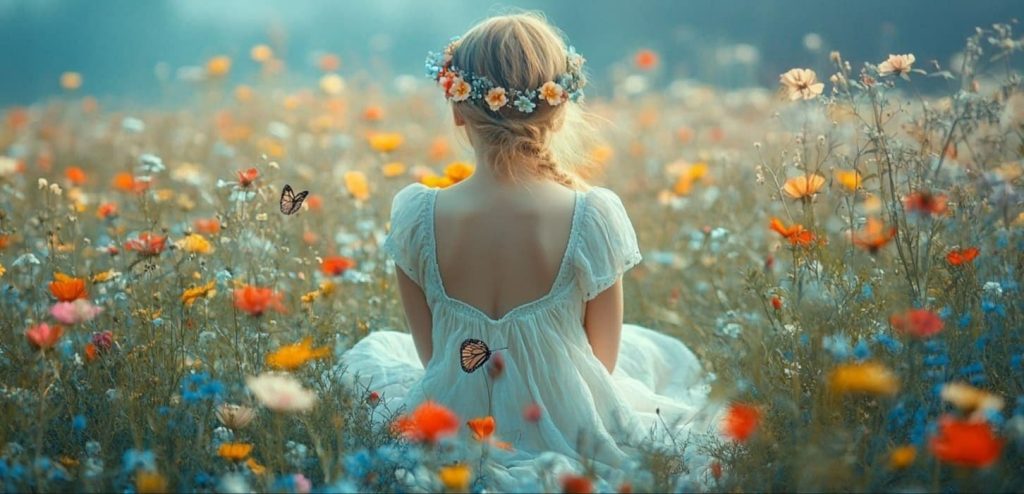

Midsommar Director’s Cut ending Explained: Horror usually relies on the dark to trigger our fight-or-flight response. We expect the monsters to hide in the shadows, waiting for the safety of night to rip away our security. But when Ari Aster dropped Midsommar in 2019, he pulled off a brilliant, subversive trick: he left the lights completely on.
The first time you watch the film, you’re overwhelmed by the blinding, sun-soaked folk aesthetic of the Hårga commune. The screen is filled with pastoral fields, smiling faces, and pristine white tunics covered in beautiful embroidery. But by the time the credits roll, the true horror sets in. You aren’t terrified of a monster in the closet; you’re deeply unnerved by how comforting a pagan cult looks when your real-life support system is entirely rotten.
While the theatrical version plays like a surreal folk-horror breakup movie, the 171-minute Director’s Cut shifts the entire weight of the narrative. The restored 24 minutes don’t just add flavor, they completely weaponize the final act, shifting the film from a standard horror narrative into a devastating psychological trap. In this comprehensive Midsommar Director’s Cut ending Explained, Let’s break down what actually happens at the climax of the Hårga festival, how the extended scenes change Christian’s fate, and why Dani’s final smile is far more twisted than it appears.
*Spoiler Alert: Seriously, if you haven’t watched this movie yet, close this tab immediately. We are diving into full, unfiltered details, and you absolutely do not want to find out what a “human bear-kabob” looks like from a random corner of the internet. Go watch it first: we promise to keep the lights on and the cliffs clear until you get back.
The Setup: What Leads Dani to the Hårga Festival?
Before we can look at the ashes of the finale, we have to understand the massive emotional deficit Dani (Florence Pugh) is operating under. The film opens not in the sunny fields of Sweden, but in a suffocating, blue-tinted American winter. We witness one of the most devastating, visceral depictions of grief in modern cinema; Dani’s bipolar sister kills herself and their parents via carbon monoxide poisoning. The image of the parents asleep in bed with tubes taped to their faces sets an emotional baseline of pure horror.
Stranded in a vacuum of sudden, agonizing isolation, Dani clings desperately to her boyfriend, Christian (Jack Reynor). The problem is that Christian has wanted to break up with her for months. He is emotionally bankrupt, toxic, and surrounded by a group of friends who view Dani as an emotional anchor dragging down their social life. He lacks the courage to leave her, choosing instead to punish her with cold indifference.
When Christian hides the fact that he and his anthropology buddies are traveling to a remote ancestral commune in Sweden for a summer festival, Dani accidentally finds out through a casual conversation. To avoid a messy confrontation and mask his own guilt, Christian offers a half-hearted, last-minute invitation. They travel to the Hårga commune not as a healing couple looking to rebuild, but as a dying relationship walking directly into a psychological meat grinder.
Character Arcs Uncovered: Dani’s Rise vs. Christian’s Fall
Once inside the sunlit fields of Hälsingland, the power dynamic of our two leads completely flips. Dani begins the film on the absolute floor of human vulnerability. She is a woman trapped in her own mind, panicking in airplane bathrooms, running into the woods to hyperventilate, and constantly muffling her cries so she doesn’t annoy her indifferent boyfriend. Christian begins in a position of complete control, acting as the arbiter of her emotional sanity while withholding the basic affection she needs to survive.
By the final act, this dynamic is entirely inverted. Dani’s journey becomes one of radical, albeit dark, empowerment. Instead of resisting the alien environment, she leans into it. She participates in the community’s baking rituals, learns the rhythmic language of the local women, and is ultimately crowned the May Queen after surviving an exhausting, drug-fueled dance marathon. For the first time, she is the center of universe that celebrates her existence.
Christian, meanwhile, undergoes a pathetic, static decay. His complete lack of emotional empathy, his lazy attempt to steal Josh’s thesis topic out of pure intellectual vanity, and his ultimate inability to protect Dani render him entirely powerless. He doesn’t evolve; he just strips away his pretenses until his core selfishness is laid bare. By the time he is paralyzed, stripped naked, and stuffed into a wheelchair, he has lost every ounce of the unearned agency he held over Dani in America. Dani’s psychological ascension is built entirely on top of Christian’s total structural collapse.
The Anatomy of the Final Sacrificial Climax
The entire film builds toward the final ninety-year ritual: the sacrifice of nine human lives to purge the Hårga commune of its collective sins, negative energies, and ancestral weights. The commune operates like a closed ecosystem, and just like any ecosystem, it requires a violent balancing of the books to stay alive.
The math of the sacrifice is meticulous, calculated long before the Americans ever stepped off the plane:
- Four outsiders who have crossed into the commune’s territory (Mark, Josh, Connie, and Simon).
- Four Hårga members who represent the community’s own skin in the game (Two elders from the Ättestupa, and two volunteers who willingly step into the fire, Ingemar and Ulf).
- The ninth sacrifice must be chosen directly by the newly crowned May Queen, serving as her ultimate act of execution and alignment with the tribe.
When Dani finds Christian paralyzed and mute after his forced participation in a bizarre fertility ritual, the illusion of her old life completely shatters. She is led to the ceremonial platform and forced to choose between a local Hårga volunteer and her paralyzed boyfriend. With a cold, deliberate nod, she chooses Christian.
Christian is sewn into the hollowed-out carcass of a slaughtered brown bear; a creature that traditionally symbolizes a vessel for old, negative burdens and beastly vices in northern folklore. He is placed inside the yellow, triangular sacrificial temple alongside the macabre corpses of his friends. As the temple is set ablaze, the Hårga commune begins to scream and wail in unison. They aren’t just watching a fire; they are physically mimicking the agony of the dying volunteers burning inside, absorbing the pain so the community can start fresh.
The Director’s Cut Focus: The Missing 24 Minutes Explained
If you’ve only watched the theatrical release, you’re missing the exact psychological gears that drive Dani to fire up that temple. The theatrical cut frames the ending as a sudden burst of manic revenge, but the Director’s Cut restores crucial sequences that fundamentally alter how we view the final moments, making her choice feel like an absolute inevitability.
The most vital addition is a haunting nighttime sequence involving a river ritual. The community gathers under the dark sky to watch a young Hårga boy named Bror offer himself up to be drowned as a sacrificial offering to the water spirits. He is loaded with heavy stones and pushed toward the edge. At the very last second, just as the boy is about to plunge into the icy depths, the community “saves” him, stating that his willingness to die is enough to satisfy the gods for now.
This scene completely recontextualizes Christian’s execution at the end of the film. It establishes that the Hårga’s ultimate currency is absolute emotional and spiritual investment. They do not value half-measures. Christian views the commune through a detached, cynical, and opportunistic lens, he’s an academic tourist trying to extract value from them for a thesis without giving anything of himself. Dani, conversely, completely surrenders her emotional reality to the tribe. The Director’s Cut proves that Christian didn’t just die because he was a bad boyfriend; he died because he remained an unfeeling parasite in a world that demands total submission.
Unmasking the Christian’s Systematic Gaslighting
Another major benefit of the Director’s Cut is that it significantly expands the domestic arguments between Dani and Christian following the horrific Ättestupa cliff scene. In the shorter version of the film, Christian just looks lazy, clumsy, and mildly insensitive to his girlfriend’s obvious panic attacks.
In the Director’s Cut, however, his behavior is upgraded to a form of psychological warfare. We watch him systematically gaslight Dani in real-time. When she confronts him about his cold behavior or his secret thesis plans, he actively undermines her memory of events, twists her words to make her feel guilty for being upset, and subtly convinces her that she is losing her mind just so he doesn’t have to deal with her trauma. He makes her apologize for things he engineered.
By restoring these scenes, Ari Aster masterfully alters the audience’s moral compass. When Dani finally stands before the yellow temple and watches the bear effigy burn, the extended cut makes the audience feel a toxic, intoxicating sense of catharsis. We aren’t just watching a horror movie climax; we are watching the ultimate, fiery eviction of an abusive partner. Aster manipulates us into cheering for a brutal human sacrifice because Christian’s emotional abuse was put on such vivid, exhausting display throughout the extra 24 minutes.
Secret Visual Details Embedded in the Frame
Aster doesn’t just tell his story through dialogue; he maps out the entire trajectory of Midsommar using deep, hidden visual foreshadowing that rewards hyper-observant viewers and punishes those who look away.
- The Opening Tapestry: The very first frame of the movie is a seasonal mural that literally illustrates the narrative roadmap from left to right. If you pause the film here, you can see the dark, winter grief of America, the journey across the ocean, the arrival in Sweden, and the final sunlit Maypole dance. The ending was painted on the wall before the story even started.
- The Bedroom Painting: Hanging right above Dani’s bed in her bleak American apartment is a painting by famous Swedish artist John Bauer titled Stackars lilla bisse (Poor Little Bear). The painting depicts a young girl wearing a golden crown kissing a giant, sad bear on the nose. It is a direct, unmistakable prophecy of the film’s closing frame where May Queen Dani stands over the bear-suited Christian.
- The Recycled Trauma in the Trees: During the final act, as Dani is carried around on her massive floral throne as the May Queen, look closely at the tree line in the background. The foliage and leaves subtly warp and shift to match the shape of Dani’s late sister’s face, complete with the exhaust tube taped to her nose. This proves that Dani hasn’t actually escaped her past; the Hårga are actively recycling her grief and weaving it into the environment to keep her emotionally dependent on them.
The Historical Reality of the Ättestupa Ritual
When the two Hårga elders fling themselves off the high cliff in the first act, it sets the moral paradigm for the entire third act. It is a shocking introduction to cultural moral relativism. If the American characters can accept the cliff-jumping as a valid cultural tradition, they lower their defenses enough to eventually accept the burning temple. But how accurate is this to real history?
In the film, the characters are told that this is a sacred, ancient tradition designed to celebrate a life fully lived before the elder becomes a burden to the tribe. However, if you look at the historical consensus among Scandinavian historians and archaeologists, there is almost zero concrete evidence proving that ancient Norse societies actually practiced mandatory senicide via cliff-jumping.
Renowned Swedish runologist and Uppsala University professor Henrik Williams has pointed out in historical discussions surrounding Norse myths that the concept of the Ättestupa is largely a folkloric myth popularized in Icelandic sagas written centuries after the Viking age, and later weaponized during the 17th and 18th centuries in Swedish cultural storytelling to contrast their modern civility with a fictionalized, brutal past. Aster deliberately uses a cultural myth passed down as absolute historical truth within the movie. It shows how easily a closed, smiling society can normalize extreme, ritualized violence under the guise of “preserving tradition.” If you control history, you control what is considered moral.
Decoupling the Outsiders: Why Josh and Mark Had to Die?
The deaths of the supporting characters aren’t just random slasher tropes designed to keep the body count high; they are calculated, symbolic executions based entirely on how these individuals violated the Hårga’s sacred, fragile ecosystem.
Take Mark, for instance. His entire presence in Sweden is defined by a complete lack of awareness, cultural ignorance, and vacuity. The turning point for his fate occurs when he casually and mindlessly urinates on an ancient, dead tree structure, unknowingly desecrating the very ancestral site that holds the sacred ashes of the commune’s dead elders.
The Hårga’s punishment for this absolute disrespect is horrifyingly literal. He is lured away, slaughtered, and skinned. Later in the film, a villager literally wears Mark’s face as a mask, and his hollowed-out head is stuffed with straw. The message from the cult is clear: since Mark acted like a brainless, hollow scarecrow who couldn’t respect the past, they transformed him into one.
Josh’s execution follows an equally calculated, symbolic logic, but his sin is rooted in intellectual entitlement rather than mindless ignorance. As an anthropology student, Josh views the Hårga not as a living community of human beings, but as a career-making thesis topic to be extracted. Despite being explicitly forbidden by the elders, his academic arrogance drives him to sneak out into the sacred temple at night to take secret photos of their most private, guarded text, the Rubdradj.
The Hårga view individual desires and outside intrusion as a malignant cancer to their collective harmony. Consequently, Josh is brutally murdered and buried directly into the dirt of the structure he violated, left with only his bare foot sticking out above the soil. It is a grotesque poetic justice: the very foot he used to step into a sacred space where he didn’t belong becomes a permanent, literal part of Hårga’s landscape. Their deaths were treated by the cult leaders not as senseless murders, but as routine, necessary environmental maintenance to keep the commune pure and safe from outside corruption.
The Ultimate Verdict: Is Dani’s Smile a Happy Ending?
So, we arrive at the ultimate question that has divided film fans since 2019: Is Midsommar a twisted feminist triumph of liberation, or is it a total psychological tragedy? The answer lies entirely in the chilling, complex nature of Dani’s final smile.
It’s terrifying precisely because it feels like a happy ending to her in that exact moment. She has successfully burned away her toxic old life, her paralyzing grief, and her crushing dependence on an emotionally bankrupt partner. She is finally seen, validated, and held. When she cries during her bad trip, an entire village of women surrounds her and mirrors her screams, providing the deep, primal communal catharsis she has been starved of since page one. She is no longer alone.
But the ultimate trap of the Hårga is that their love is entirely conditional. Dani is safe only as long as she fits their rigid, ritualistic framework and serves her specific purpose as the breeding May Queen who brings new blood into the gene pool. The moment she steps out of line, or the moment the next ninety-year cycle demands a fresh sacrifice, she is just as disposable as Christian, Josh, or Mark.
Dani’s ending isn’t a liberation; it’s a complete, flawless psychological capture. She found a family, but it cost her her humanity. Her smile isn’t the look of a woman who is free, it’s the look of a woman who has finally accepted her cage.
About the Author.
Hi, I’m Vansh, the founder of Vibe On Cue. I track the absolute best ways to experience cinema, from the biggest Hollywood Blockbusters and upcoming release dates to the finest details of PVOD & Streaming and pristine Blu-ray & 4K physical media. And when the credits roll, I break down the narrative with deep-dive Ending explained guides. If you live for the full life cycle of film, stick around and explore the site!!!