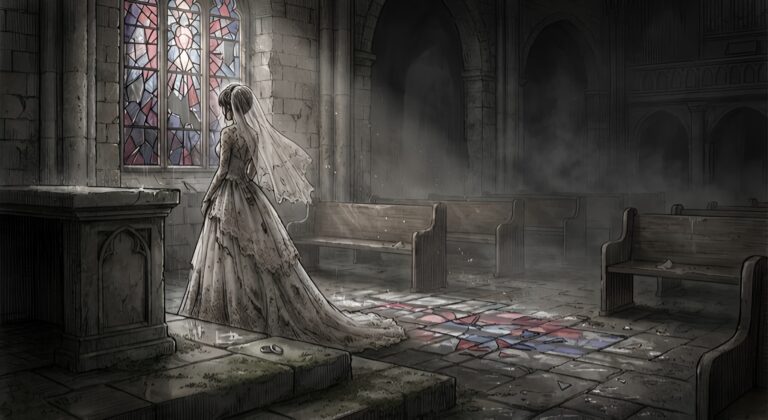

Ready or Not Ending Explained: Hmmm ok… so you just finished Ready or Not, and you’re probably sitting there going, wait, what? A bride in a blood-soaked wedding dress and yellow sneakers is smoking a cigarette on the ground while a mansion burns behind her. A cop walks up and asks what happened here. She looks at him and says one word: “In-laws.” And that’s it. That’s the ending.
Same, Grace. Same.
I get it, because I’ve got questions too, and I bet you do as well. Did that whole family really just blow up one by one when the sun came up, like popcorn in a very expensive microwave? Why did Alex, the guy who spent half the night helping his wife escape, suddenly grab her and hold her down for the knife?
And if he was supposed to be one of the good ones, why did he blow up with everybody else? Did nobody read the fine print on this deal?
Here’s the good news. It all makes sense once you know the rule. The ending isn’t random chaos, even though it feels like a food fight in a very rich slaughterhouse. It runs on one rule written down by a devil, and nearly every death in the last act comes from it. The bad news is that it’s exactly the kind of rule a family should mention before the wedding, not after the cake.
So let’s go through it together, like two friends who just walked out of the theater and can’t stop talking. We’ll cover what the Le Domases actually signed up for, why sunrise turned them into confetti, what was going through Alex’s head, why Daniel’s poison is the most important thing anyone does all night, and why Grace laughs at the worst moment of her life.
Spoilers everywhere, obviously. And if your own in-laws are annoying, take comfort. At least they’re not doing this!
Who’s Who in this Whole Mess??
Let’s do a fast headcount, mostly because you shouldn’t get too attached to anyone in this doomed bloodline.
Grace (Samara Weaving): The bride. Grew up in foster care and wanted a family so badly she married into this one. Careful what you wish for.
Alex (Mark O’Brien): The groom. Walked away from his family years ago, came back for the wedding, and somehow forgot to mention the card.
Daniel (Adam Brody): Alex’s older brother. Drinks a lot, feels guilty about everything, and is the only person in the house with a working conscience.
Charity (Elyse Levesque): Daniel’s wife. More loyal to the family than the family is. Scary levels of commitment.
Tony (Henry Czerny): The dad. Runs the family like a board meeting and the ritual like a team-building event.
Becky (Andie MacDowell): The mom. Warm to Grace right up until it becomes inconvenient.
Helene (Nicky Guadagni): Alex’s aunt. Lost her husband to the last ritual thirty years ago and still believes in the whole thing.
Emilie (Melanie Scrofano) and Fitch (Kristian Bruun): Alex’s sister and her husband. Emilie has the worst aim in the house. Fitch mostly looks like he’s waiting for a table.
Georgie and Gabe: Emilie and Fitch’s young sons.
Stevens (John Ralston): The butler. Takes his job very seriously.
Mr. Le Bail: The mysterious “benefactor” behind the family fortune. Shows up for a couple of seconds at the very end.
Wait, Who Plays Hide and Seek on Their Wedding Night?
The movie opens thirty years before the wedding, and that opening matters more than it looks like it does. A wounded man named Charles stumbles through the mansion and begs a young Daniel for help. Daniel goes and tells his family instead. Charles was Helene’s brand-new husband, married that same night.
The family shows up in robes and masks, hunts him down, and drags him away while Helene begs them to stop. Afterward, they tell Daniel how proud they are of him. Hold on to that one, because Daniel never really gets over it.
Fast-forward to Grace and Alex’s wedding. Right before the vows, Alex asks her if she’s sure about this. Sweet, a little suspicious. Then at midnight the whole family gathers for a tradition. Everyone who marries in has to draw a game card from a puzzle box that belongs to Mr. Le Bail. Tony tells the origin story with a straight face.
His great-grandfather Victor was a sailor who solved that puzzle box for a rich collector named Le Bail, and in return Le Bail funded a playing card business that grew into the Le Domas games empire. What Tony skips is the part where the deal was with the devil, and it comes with sacrifices.
Grace draws Hide and Seek. The room goes weird. Grace, who has no idea, thinks it’s cute. She’ll hide, they’ll look, everybody laughs. Then Tony hands a weapon to every family member, like it’s a potluck where everyone brings a crossbow, and reminds them that if they don’t find, catch, and sacrifice her before dawn, they all die.
Here’s the part that makes Alex look bad. Before the game, he quietly tells Tony he’s ready to do what’s necessary if she pulls the wrong card. When she pulls it, he finally tells Grace the truth: Hide and Seek is the only card that requires the family to kill whoever draws it.
He says he never thought she’d pull it, and that he kept quiet because he knew she’d leave if she knew. So he knew the risk, rolled the dice with her life, and said nothing. Ever had a partner say “it’s just a family thing, it’ll be fine”? This is that, with a body count.
How Did a Bride in Yellow Sneakers Outlast a Whole Family of Rich Weirdos?
Mostly because the Le Domases are the worst hide-and-seek team in recorded history. Emilie shoots a maid, thinking it’s Grace. Then she kills another one with a crossbow that goes off at the wrong moment. A third maid tries to call the family and dies in the dumbwaiter.
That’s three members of the staff gone before anyone has managed to catch the bride. Do these people think maids are a renewable resource? They can plan a wedding down to the napkin rings, but they can’t find one bride inside their own house.
Meanwhile Grace gets help from the one place you’d expect. Alex tells her to run, shuts down the security cameras, and gets caught by Tony, who handcuffs him to a bed. Daniel finds Grace in the study and gives her a ten-second head start before he tells the others.
Charity, who is far more into this than her husband, is furious. Grace splashes boiling tea in Stevens’s face, gets shot through the hand by one of the kids in the goat barn, and falls into a pit full of what’s left of earlier sacrifices. Yes, the family has a pit.
She makes it out the front gate, Stevens catches her, and she wrecks the car he’s driving. Then Daniel finds her again, and this time he doesn’t let her go. She wakes up tied to a table, surrounded by a family in robes who are about to do the thing they’ve been doing for generations.
Why Did the Le Domases Blow Up at Sunrise?
Short answer: they missed a deadline, and the guy they signed it with doesn’t do extensions.
The deal has exactly one rule for Hide and Seek. Kill the new member as a sacrifice before dawn, or the family pays instead. That’s it. No loopholes, no grace period, which is a painful joke when the bride is named Grace.
Everything that happens in the last act is the family trying to beat the sun, and a lot goes wrong for them. Tony raises the knife, and then the ritual drink the family shares turns out to be poisoned, and everyone starts coughing blood. Charity shoots Daniel.
A fire breaks out in the chaos. Becky attacks Grace, and Grace beats her to death with Le Bail’s own puzzle box, which is the most on-brand weapon this movie could have picked. By the time Alex gets loose and the family gets back around the table, they’ve burned a huge chunk of the night.
Then the sun comes up, and Grace is alive.
Here’s the funny part. Nothing happens. For a few seconds the family looks around at each other and decides the whole thing was a myth. Imagine finding out you’ve been doing this for generations for nothing. Helene isn’t ready to let it go.
She grabs a weapon and goes after Grace anyway, believing it’ll please Le Bail. She gets about one swing in before she blows up. The rest follow, one by one. Fitch. Charity. Emilie. The kids. Tony. The deal doesn’t care about age, rank, or how nicely you set the table.
Why the delay? The movie never explains it, so take this as one reading and nothing more. The deadline passed the moment the sun came up, and the bill just took a few seconds to arrive.
It makes the family’s mistake even worse, because they relaxed at the exact moment they should have been running. Why do rich people always assume the rules stopped applying to them? Because most of the time, they have.
Why Did Helene Go First, and Why Couldn’t She Just Stop?
Helene is the one person in that room who has already paid for the deal. Thirty years ago, the ritual took her husband on their wedding night. She watched it happen, and she stayed loyal to the family anyway.
So when the sun comes up and nothing happens, everyone else sees a myth they can finally laugh at. Helene sees something else: if the deal was never real, then Charles died for nothing.
That’s a hard thing to accept, and she doesn’t. She goes after Grace anyway, convinced that Le Bail will still be pleased if the job gets done. Ever argued with someone who would rather walk off a cliff than admit they were wrong? Helene took that literally. She doesn’t even get to finish the swing.
So why her, and why first? The movie never says, so here’s how I read it. Helene is the only person in the room still going after Grace once the deadline has passed.
Everybody else is standing around deciding they got tricked, and she’s the one still trying to finish the job. The curse catches her in the middle of it, which is the loudest possible way to tell the whole room it was never a myth.
It’s a nasty kind of fitting, too. She’s the one who already lost a husband to this deal, so she’s the one who believed in it the hardest, and she’s the first to find out how right she was. Ever notice that the person holding on tightest to a bad idea is usually the first one it bites?
What Was Daniel Doing With That Poison, and Why Does It Matter So Much?
This is the part where the jokes slow down for a minute, because Daniel’s story isn’t funny.
Thirty years ago, Daniel was a kid who gave away a wounded man and got praised for it. He’s been carrying that ever since. When Grace shows up, he’s the one family member who can’t do it again. He gives her a head start. He hears her out.
But he’s still a Le Domas, so he also catches her again and lets the ritual get going. He wobbles all night, and that’s what makes him feel real. People don’t flip a switch. They wobble.
Then, with Grace tied to the table and the family ready to go, everyone starts coughing blood. Daniel put poison in the ritual drink. He unties Grace, and she tells him she knew he’d come through. He tells her it wasn’t an instant decision. Fair. When did anyone in that house ever make a quick, clean choice?
Why does it matter so much? Because without the poison, the sacrifice happens long before sunrise, and Grace is dead. It’s the single biggest reason she lives. And Daniel pays for it right away, because Charity shoots him, the one person in the house who cared more about the family’s rules than about her own husband.
It also makes what comes next hurt more. Daniel dies saving his brother’s wife from his brother’s family. Then Alex walks right back into the circle.
Why Did Alex Turn on Grace, and Why Did He Blow Up Anyway?
Let’s start with what Alex does right. He tells Grace the truth once a maid is dead. He tells her to run. He shuts down the cameras, fights Tony, and ends up cuffed to a bed for his trouble. He even tells his mother he’ll kill her if Grace dies. Becky says she’s sorry about what has to happen, but the family comes first, and she waves off his threat. She knows her son better than Grace does, she says.
Then Grace kills Becky.
Alex gets loose, finds his brother’s body, and finds his wife covered in his mother’s blood. Grace pulls away from him. That’s the moment. Two things hit him at once: his mother is dead, and the person he married won’t come near him.
So he picks the only version of the night where he doesn’t lose everything. Finish the ritual, keep the family, keep the money, keep the life he swore he left. He grabs Grace, calls the others in, and joins the chant.
Is that a good reason? No. It’s a terrible reason. It’s the same reason a lot of people stay in bad situations: they can’t see the other option. But notice what’s missing. Alex never gets to a place where he says “I did this, and I deserve to lose her.”
He tries to fix the fear of being left by making sure there’s nothing left to lose. Ever had a partner take their family’s side the second things got hard? That’s Alex, with a knife.
And here’s what makes it sting. The movie hands him an easy way out. He’s the one who unlocked the doors and shut off the cameras earlier. When Grace pulls away, he could have kept helping her anyway, grief and all, and let her walk out. He basically figured that if his marriage was already toast, he might as well keep his spot at the family dinner table.
So why does he blow up like the rest of them? Because the deal covers the family, and he stood in the ritual. He was a great husband for about six hours, and a Le Domas for the one moment that counted. The deal doesn’t grade on how much you helped earlier. It only looks at who was in the circle when the sun came up.
And why does he go last? The movie never says, so here’s how I read it. The film gives him a few extra seconds to beg Grace to take him back and apologize for turning on her. She uses those seconds to take off her ring, throw it at him, and tell him she wants a divorce. Then he goes.
Did the ring toss matter to Le Bail? We don’t know. Did it matter to Grace? Obviously. It’s the one decision in the whole night that’s completely hers.
Why Is Grace Laughing While Her In-Laws Pop Like Water Balloons?
Because at that point, what else is there? She’s been shot in the hand, fallen into a pit, tied to a table, and nearly killed by her own husband. And then the people responsible start going off one at a time, like someone’s popping balloons at the grossest birthday party in history.
If that were you, would you cry? Maybe. But a laugh is the only reaction that fits the size of what just happened.
The best part is that the laugh wasn’t in the script. According to the filmmakers in an interview with Bloody Disgusting, the actor playing Grace came up with it on the day they shot the explosions. They weren’t sure it would work, they shot it a couple of times, and then they watched the cut without it and it didn’t work at all.
It ended up being a laugh all the way through. And it does something smart. It tells you it’s okay to laugh too. Isn’t that a relief after ninety minutes of dread?
Then the cops show up and ask what happened, and she says “In-laws.” The filmmakers have said the line was originally “Rich people,” but that felt too on the nose and they’d already made that joke earlier.
“In-laws” is better because it’s smaller. It makes the worst night of her life sound like a bad Thanksgiving. Everyone who’s ever gotten married has said that word in exactly that tone.
Who Is Le Bail, and Why Did He Nod at Grace?
Le Bail is the person, or thing, who started all of this. In the family story he’s a wealthy collector of unusual objects who bet Victor he couldn’t solve a puzzle box. Victor solved it, Le Bail paid for his business, and ever since the Le Domases have been running a games empire on borrowed time.
The ritual makes it pretty clear who he really is. The family shouts “Hail Satan” over Grace while Tony raises the knife. So who is Le Bail? The movie strongly suggests the Devil, or something close enough that nobody’s quibbling.
At the end, after the last Le Domas is gone, he shows up for a couple of seconds, looks at Grace, and gives her a nod. Then he’s gone. What does it mean? The movie doesn’t say.
The most straightforward reading is that he’s acknowledging the result. Hide and Seek is his game, and Grace won it. But it definitely leaves a massive cliffhanger dangling. A literal demon with a taste for blood sports now knows exactly what this bride is capable of.
One more thing about that puzzle box. It’s the family’s most sacred object, the thing every new bride draws her card from, and Grace uses it to beat Becky to death. Is that a statement about the family’s faith or just a lucky grab in a bad moment? Your call, but it’s hard to ignore how neat it is.
What If Alex Had Finished the Job?
The filmmakers told Bloody Disgusting that an earlier version of the story ended with Alex killing Grace and the family getting away with it. That’s the movie where Grace dies, the Le Domases keep the money, and you leave the theater wanting to throw something.
The directors decided they wanted people to leave cheering instead, and that tone shift is why Grace gets to walk away.
They also thought about a final scene where two ordinary guys walk into a huge ballroom and find a convention of rich people all connected to Le Bail. The idea was that maybe obscene wealth is a deal with the devil on some level. They dropped it, but you can see where the idea went.
Is the ending got better? Obviously. Alex winning? The family passing the jam at breakfast the next morning like nothing happened? Hard pass.
Is This Whole Movie Just Saying Rich People Are Awful?
Mostly, yes, but it’s doing more than that.
The class part is easy. The Le Domases treat other people like furniture. The staff dies in the first hour and nobody mourns. The family fortune sits on a pit of past sacrifices. They pay for their lifestyle with other people’s lives, and when the deal goes bad, they finally pay with their own.
Does anyone really believe a family that is rich got there clean? Not subtle, and that’s the joke.
But look at what else is in there. Grace wanted a family more than anything, and the family she got was the one that wanted her dead. The only person who helps her for real is Daniel, and it costs him everything. Then there’s marriage. Alex’s lie, small and big, drives the entire night, which is why “I want a divorce” lands harder than any speech.
And there’s tradition. The family believes just enough to kill for it, then stops believing the second the sun comes up and nothing happens. Funny how that works. Believing in something is easy when it pays you.
So, What Did We Learn About Marrying Into a Family?
So that’s the whole mess. The ending of Ready or Not comes down to a deal with a deadline, and the Le Domases missed it. Everything else, the poison, the fire, the knife that never finished the job, came from people making choices. Daniel couldn’t live with what he did as a kid. Alex got scared and picked the wrong side.
Charity cared more about the family than her own husband. Helene couldn’t admit the whole thing might have been for nothing. And Grace? She just had to stay alive until the sun came up, and she did it in yellow sneakers. Not bad for a first night of marriage.
When she strolls away from the flaming wreckage dragging on a cigarette and drops that one-word punchline, you really can’t debate her logic. If you’re wondering what happens to her right after, a sequel starts the second this one ends, and we’ve got a separate article on the Ready or Not 2: Here I Come ending explained.
So, if you learn anything from Grace’s terrible night, let it be the importance of ruthlessly interrogating your partner about their clan’s customs before getting hitched.
When their explanation is simply “it’s just a fun family game,” take that as your cue to start a serious cross-examination. What’s the worst that could happen? Well, now you know.
TL;DR: Quick Ending Recap!
- The Le Domas family blows up at sunrise because they failed to sacrifice Grace before dawn, which breaks their family’s deal with Le Bail.
- Hide and Seek is the one card in the puzzle box that requires the family to kill whoever draws it, and Grace draws it.
- Alex helps Grace for most of the night, then switches sides after she kills his mother, because he realizes she’ll never trust him again.
- Alex blows up too because he joins the ritual and is still part of the family’s deal. He is the very last casualty of the morning, detonating right on cue the second she tosses the jewelry back and loudly calls it quits.
- Daniel’s poison wrecks the first sacrifice attempt. It’s the biggest reason Grace is alive, and it costs him his life.
- Grace laughs because the whole situation has become absurd, and “In-laws” is the shortest honest summary of her night.
- Le Bail shows up for a couple of seconds and nods at Grace. The movie never explains the nod.
FAQs: Mostly Asked…!
Why did the Le Domas family explode in Ready or Not?
They failed to sacrifice Grace before dawn, which broke their family’s deal with Le Bail.
Why did Alex explode last?
He took part in the ritual like the rest of them, and the movie lets him beg for a few extra seconds before Grace throws back her ring and he goes too.
Who is Le Bail?
Le Bail is the supernatural benefactor behind Le Domas fortune, and the movie strongly implies he’s the Devil.
Does Grace survive Ready or Not?
Yes, Grace is the only survivor of the night.
About the Author.
Hi, I’m Vansh, the founder of Vibe On Cue. I track the absolute best ways to experience cinema, from the biggest Hollywood Blockbusters and upcoming release dates to the finest details of PVOD & Streaming and pristine Blu-ray & 4K physical media. And when the credits roll, I break down the narrative with deep-dive Ending explained guides. If you live for the full life cycle of film, stick around and explore the site!