
Never Let Go Ending Explained: Momma tethering her kids to a house with actual ropes should have been a red flag from scene one, but here we are, still arguing about what “Never Let Go” was really trying to tell us. Alexandre Aja’s survival horror flick spent most of 2024 quietly haunting theaters, then did something a lot of horror movies dream about but rarely pulled off: it found a second wind on streaming, climbing charts more than a year after release. That kind of slow-burn afterlife usually means one thing: people are still confused about that ending, and the algorithm is finally catching up to them.
If you just watched it and you’re sitting there wondering whether Momma was protecting her family from an actual supernatural threat or whether the real monster was trauma the whole time (sorry, had to), you’re not alone. This one is built entirely on ambiguity, and Aja never hands you a neat little bow to tie it all up. So let’s actually break down what happens, what it might mean, and why the ending leaves just enough room for you to argue with your group chat about it.
Heads Up: We are jumping straight into the deep end of the plot twists now. If you hate spoilers, close your eyes and turn back. (Or, you know, go watch the movie and come right back)!
TL:DR, Quick Key Takeaways
- Momma believes a supernatural force called “the Evil” has taken over the world, and the only protection for her and her two sons, Nolan and Samuel, is staying tied to their cabin by rope at all times.
- As food runs out and the family starts to fracture, Nolan begins doubting his mother’s version of reality while Sam leans further into it.
- Momma eventually dies by suicide after confronting a vision of her own mother.
- The house catches fire, and Sam appears to become violently possessed by the entity, attacking Nolan.
- Nolan survives, drags his unconscious brother out of the burning cabin, and the two are found and rescued by real, modern-day paramedics proof that the outside world Momma swore was destroyed had been fine the entire time.
- In the final scene, Sam shows Nolan a Polaroid he took of the fire, revealing a scaled hand on his own shoulder, suggesting he never fully escapes whatever the Evil represented.
- Whether “the Evil” was ever real or just Momma’s inherited psychosis passed down to her kids is left deliberately unresolved.
What Never Let Go Is Actually About?
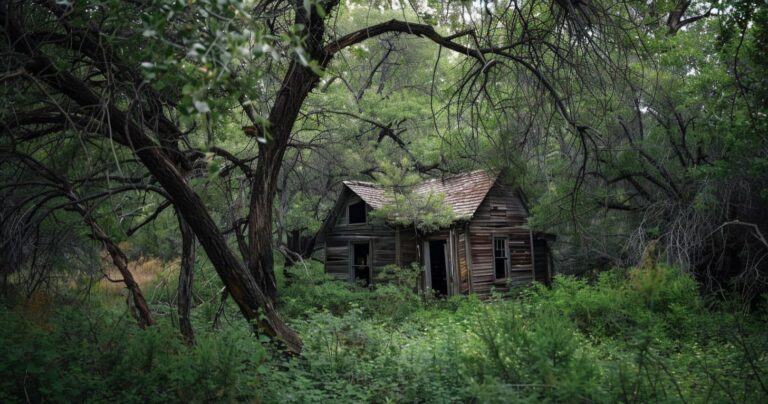
At its core, this is a story about three people isolated in a cabin in the woods, living by rules that sound absurd until you realize how much Momma actually believes them. According to her, an entity called “the Evil” wiped out most of civilization, and it can possess anyone who touches it directly. The only way to stay safe is to remain physically connected to the house at all times via rope, treating the home itself almost like a sacred anchor keeping the family grounded in reality.
Nolan and Samuel, twin brothers played by Percy Daggs IV and Anthony B. Jenkins, have grown up knowing nothing else. For them, this isn’t a survival situation they chose; it’s simply how the world works, the same way a kid raised in any isolated household accepts their parents’ worldview as fact until something forces them to question it. That’s an important detail, because the film spends real time establishing how deeply normalized this fear has become before it ever cracks.
Momma, meanwhile, is haunted by visions the boys can’t see: shapeshifting figures that take the form of people from her past, most often her own mother and her former husband. These aren’t throwaway jump scares. Aja uses them to slowly reveal Momma’s own history of trauma, hinting through scars and old wounds that her fear didn’t start with some world-ending event, but from something much older and much more personal.
The genius of the setup, if you can call psychological horror “genius” without sounding pretentious, is that the film never rushes to explain itself. It lets you sit in the family’s routine long enough that the rope-tethering, the prayers to the house, the constant vigilance, all start to feel disturbingly normal. Which is exactly the point, because normalized fear is the whole emotional engine of this movie.
By the time cracks start showing, you’ve already been conditioned right alongside the boys to take Momma’s warnings seriously, even as your gut tells you something is deeply off.
The Rules of the Rope, and Why They Matter?
The rope isn’t just a survival tool in this movie, it’s basically the film’s entire thesis rendered as a physical object. Momma insists that anyone who unties themselves from the house risks being touched and possessed by the Evil, so the family’s daily existence revolves around staying connected, foraging only as far as their tether allows, and reciting a daily prayer thanking the house for keeping them safe.
That imagery does a lot of heavy lifting. The rope is protection, sure, but it’s also a leash, and the film clearly wants you thinking about both meanings at once. Family bonds can save you, but they can also be the thing keeping you trapped in someone else’s fear long after it stops serving you.
There’s a pivotal early moment where Nolan and Sam get into an argument while out foraging, and Nolan steps on Sam’s rope, causing him to fall and snap loose. Nolan then unties himself entirely to go rescue his brother, and nothing happens to him. No possession, no monster, nothing. It’s a small moment, but it plants the first real seed of doubt, both for Nolan and for us as an audience.
As the winter drags on and food runs out, that seed grows. The family starts eating tree bark. Momma suggests killing the family dog for food, which understandably horrifies Nolan and becomes one of the film’s uglier turning points. Desperation strips away a lot of the ritual’s authority, and you start to see how much of “the rules” were really about control and fear rather than actual supernatural danger.
By the midpoint, the rope has stopped being a comforting symbol and started feeling exactly what it looks like: a restraint.
The Turning Point: Nolan Starts to Doubt
Nolan is the audience’s proxy for skepticism throughout the film, and his arc is really the emotional spine of the whole thing. Once he realizes untying himself didn’t summon any monster, he can’t unsee it. He starts quietly testing the boundaries of what his mother has told him, venturing further from the house using extra rope, looking for any sign that the outside world isn’t the wasteland Momma describes.
That search eventually pays off in one of the film’s most important scenes: Nolan finds an actual road. Not a symbolic road, not a hallucination, a real paved road, which directly contradicts everything Momma has told them about the world ending. Shortly after, he encounters Cole, a hiker who heard him calling for help, which is about as concrete a piece of evidence as the film gives us that the outside world is fine.
This is where the film’s ambiguity gets interesting rather than frustrating. Nolan doesn’t immediately run off with Cole or abandon his family. He’s still tangled, emotionally and literally, in the world Momma built. That hesitation says a lot about how deep this kind of inherited fear runs; even with proof in front of him, walking away from a lifetime of conditioning isn’t as simple as just deciding to.
Sam, on the other hand, moves in the opposite direction. Rather than growing skeptical alongside his brother, he becomes more devoted to Momma’s version of events, and more erratic and volatile as starvation and isolation wear him down. The brothers essentially split into two competing responses to the same trauma: one leans toward doubt and escape, the other leans toward belief and self-destruction.
That divergence is what sets up everything that happens in the film’s final act, because it means the boys are no longer united when the actual crisis hits.
Momma’s Death, Explained
Momma’s death is the film’s emotional gut-punch, and it happens right in front of Nolan. After the conflict over killing the family dog, Nolan cuts Momma’s rope and locks her inside the greenhouse, hoping isolation will force her to confront reality and realize the Evil isn’t real. Instead, she encounters a vision of “the Evil” taking the shape of her own mother, and rather than fight it, she takes her own life in front of him.
It’s a brutal scene, and deliberately so, because it refuses to give you the clean catharsis of “the monster got her.” Whatever Momma saw in that moment, whether it was a genuine supernatural entity or the final collapse of a mind worn down by trauma and starvation, the result is the same: her son watched her die, and he’s the one who indirectly set that moment in motion by trying to help her.
This is where the film’s psychological reading gets its strongest ammunition. Momma’s visions have always centered on her mother and her ex-husband, the two figures most tied to whatever damaged her long before the boys were even born. That she dies confronting a version of her own mother suggests this was never really about a world-ending force at all; it’s about a woman who never escaped her own inherited trauma, and ended up passing a version of it down to her sons anyway.
Nolan’s guilt over the moment is immediate and consuming. He didn’t cause her death directly, but the film makes sure you feel the weight of his decision, because cutting that rope was an act of love and rebellion at the same time, and it still ended in tragedy.
Samuel’s reaction is arguably more important for where the story goes next. He blames Nolan outright for Momma’s death, and that blame curdles into something much darker as the brothers are left alone with no food, no parents, and no shared understanding of what just happened.
Real Monster or Broken Mind? The Central Debate
This is the question the whole movie is built around, and Aja is clearly uninterested in answering it definitively. For most of the runtime, Momma is the only one who can see the Evil, and it always manifests as people from her own past rather than some generic monster-movie creature. That’s a very deliberate choice; a true external threat probably wouldn’t be so tailored to one specific person’s psychological wounds.
The case for psychological reading is honestly pretty strong. Momma’s visible scars and vague references to a harsh, likely abusive upbringing suggest a woman who has been fighting something long before any “world-ending” event. Add in that both boys are severely malnourished and dehydrated by the film’s climax, and you’ve got a textbook setup for hallucination, paranoia, and folie à deux, where an isolated family gradually adopts one member’s delusion as shared reality.
But the film doesn’t let you fully dismiss the supernatural angle either. Sam’s transformation late in the story is genuinely physical and violent in a way that’s harder to write off as pure psychosis, and the visual language Aja uses for “the Evil” throughout is consistent and specific enough that it doesn’t feel like random hallucinatory noise. If this were purely about mental illness, you’d expect more inconsistency in how the entity looks and behaves.
What makes the ambiguity work rather than feel like a cop-out is that both readings support the same emotional truth: trauma gets inherited whether or not there’s a literal monster involved. Momma’s fear, real threat or not, became her children’s fear. Whether that fear had teeth in the physical world or only in her mind almost doesn’t matter to the boys living under its rules every single day.
Aja seems far more interested in that inheritance than in delivering a tidy verdict on whether ghosts are real, and honestly, that restraint is probably why people are still debating this ending well over a year later.
What Happens to Sam?( And That Polaroid Scene)
Samuel’s arc takes the darkest turn of anyone in the film, and it’s the part of the ending that leans hardest into full-blown supernatural horror territory. After Momma’s death, grief and starvation push him further into believing the Evil is not only real, but actively targeting their family. His behavior grows increasingly hostile toward Nolan, whom he blames for their mother’s suicide.
The film complicates things further with a hiker’s daughter who appears near the cabin, a figure who initially seems like she could be genuine outside help, similar to Cole. It’s eventually revealed that this girl is actually the Evil itself in disguise, and Samuel becomes possessed by it, turning violently against his own brother in the film’s climax.
Whether you read this as literal demonic possession or as Sam’s psychological break finally manifesting as full-blown violence, the effect on screen is the same: he becomes a genuine physical threat to Nolan, setting the house on fire in the chaos that follows. It’s the most unambiguous “monster movie” beat in the entire film, which makes it a useful test case for your own theory of what’s really going on here.
If you’re in the psychological-breakdown camp, Sam’s possession reads as the final collapse of a starving, grieving, traumatized kid who’s spent his entire life being told an external evil is coming for his family, so of course that’s the shape his own unraveling takes. If you’re in the literal-monster camp, this is the entity claiming its final victim exactly as advertised the whole movie. Aja gives you enough rope, no pun intended, to hang either interpretation.
As the fire spreads, Sam does something easy to miss in the chaos: he grabs Momma’s old Polaroid camera, the one she’d shown the boys earlier while reminiscing about her life before the cabin, and snaps a photo of the burning house. It’s a small, strange detail to fixate on mid-disaster, but it ends up being the key to the film’s very last image.
Either way, Sam ends up unconscious after the fire, and it’s Nolan who has to physically drag him to safety, which sets up the film’s final, most concrete scene.
The Final Rescue and What It Really Meant?
After the fire, Nolan confronts one last vision of the Evil, this time taking his mother’s shape, in the small crawlspace where he and Sam take shelter from the flames. It’s the film’s final gut-check moment, forcing Nolan to face the same figure that broke his mother, except this time he survives it.
What happens next is arguably the most important, and most concrete, moment in the entire movie: Nolan and Sam are found and rescued by actual, modern-day EMTs. Not other survivors scraping by in some post-apocalyptic wasteland, but real paramedics, with real equipment, doing their real jobs, exactly as if nothing had ever happened to the outside world at all.
This detail is doing a ton of quiet work. If the world had genuinely ended, you wouldn’t expect a functioning emergency response system showing up to save two starving kids from a burning cabin. Their arrival is about as close as the film gets to confirming that Momma’s apocalyptic worldview was, at minimum, wildly disconnected from actual reality, whatever the visions themselves may or may not have been.
That said, Aja still doesn’t spell out exactly what the boys experienced or whether the visions were “real” in any objective sense within the film’s universe. He simply lets the modern rescue speak for itself, trusting you to connect the dots between “the world was fine the whole time” and “so what exactly were we watching for the last hour and a half.”
It’s a quietly devastating way to end things, because it reframes the entire story retroactively. These weren’t survivors of an apocalypse. They were two kids raised inside someone else’s unresolved trauma, finally pulled back into a world that had been waiting for them the entire time.
Except the film doesn’t quite let you leave on that note of relief. In the final seconds, Sam leans over to Nolan and whispers, “She loves me more,” then shows him the Polaroid he took of the burning house. In the photo, there’s a scaled, clawed hand resting on Sam’s own shoulder, the same texture and shape as the Evil throughout the film. Aja has confirmed in interviews that the image is meant to show the darkness hasn’t left Sam the way it seemingly has Nolan, that one brother questioned his mother’s reality and found a way out, while the other believed her completely and may still be carrying whatever that belief cost him.
It’s the film’s last unresolved thread, and deliberately so. Nolan gets his concrete, real-world rescue. Sam gets a photograph that suggests he isn’t done with the Evil yet, whatever the Evil actually was.
If you love psychological thrillers that leave the big questions up to interpretation much like our breakdown of the Undertone ending explained!
Is There a Never Let Go Sequel or Prequel?
Given how the film has quietly built momentum on streaming well after its theatrical run, it’s a fair question, and it turns out there’s already been movement on it. Halle Berry has publicly said she’d be interested in this becoming a horror franchise, and she’s confirmed that both a prequel and a sequel have already been written.
Nothing has been officially greenlit as of now, so treat this as “in development in spirit” rather than a confirmed follow-up on any release calendar. Still, the fact that scripts already exist suggests this isn’t just Berry being polite in an interview; there’s genuine interest behind the scenes in expanding this world.
A prequel angle actually makes a lot of narrative sense given how much of Momma’s trauma is hinted at rather than shown. Her scars, her fractured relationship with her own mother, whatever pushed her toward this extreme worldview in the first place, all of that is prime prequel material if the team wanted to dig into it properly instead of leaving it as backstory implication.
For now, the ending stands on its own as a self-contained, deliberately ambiguous piece of psychological horror. But if you finished this movie wanting more answers about where Momma’s fear actually came from, you’re apparently not alone, and the people who made the film may eventually give you exactly that.
Keep an eye on future casting or festival announcements if this is the kind of follow-up you’d want, since nothing concrete has moved beyond “scripts exist” at this stage.
Most Googled Questions: Answered
Was the Evil in Never Let Go real, or was it all in Momma’s head?
The film never confirms it either way on purpose. There’s strong evidence for both readings: Momma’s visions are tied specifically to her own trauma, but Sam’s later transformation is hard to explain away as pure psychology. Most viewers land somewhere in between.
How did Momma die?
After Nolan locks her in the greenhouse hoping isolation will snap her out of her fear, she encounters a vision of the Evil in the form of her own mother and takes her own life in front of him.
What happens to Sam at the end?
Sam becomes increasingly unstable after Momma’s death, eventually appearing to be possessed by the Evil disguised as a hiker’s daughter, and attacks Nolan before the cabin catches fire.
Do Nolan and Sam survive?
Yes. Nolan drags an unconscious Sam out of the burning house, and the two are found and rescued by real paramedics, confirming the outside world was never actually destroyed.
What does the Polaroid at the end of Never Let Go mean?
As the cabin burns, Sam takes a photo of the fire on Momma’s old Polaroid camera. In the film’s final moment, he shows it to Nolan, and it reveals a scaled hand resting on Sam’s shoulder, the same texture as the Evil. Director Alexandre Aja has said this suggests Sam, unlike Nolan, never fully escapes whatever darkness his mother was dealing with.
Is there a Never Let Go sequel or prequel in the works?
Nothing is officially confirmed, but Halle Berry has said prequel and sequel scripts already exist and that she’d be open to a franchise.
Does Never Let Go have a post-credit scene?
No, there’s no scene during or after the credits.
Wrap Up
Never Let Go earns its slow-burn streaming comeback honestly. It’s not a movie that hands you easy answers, and that’s exactly why people are still picking it apart well past its theatrical run. Whether you walk away convinced Momma was fighting something real or convinced she was simply a woman who never escaped her own trauma and passed it down to her kids anyway, the ending hits the same emotional note either way: fear, once it takes root in a family, doesn’t need an actual monster to do damage.
About the Author.
Hi, I’m Vansh, the founder of Vibe On Cue. I track the absolute best ways to experience cinema, from the biggest Hollywood Blockbusters and upcoming release dates to the finest details of PVOD & Streaming and pristine Blu-ray & 4K physical media. And when the credits roll, I break down the narrative with deep-dive Ending explained guides. If you live for the full life cycle of film, stick around and explore the site!!!