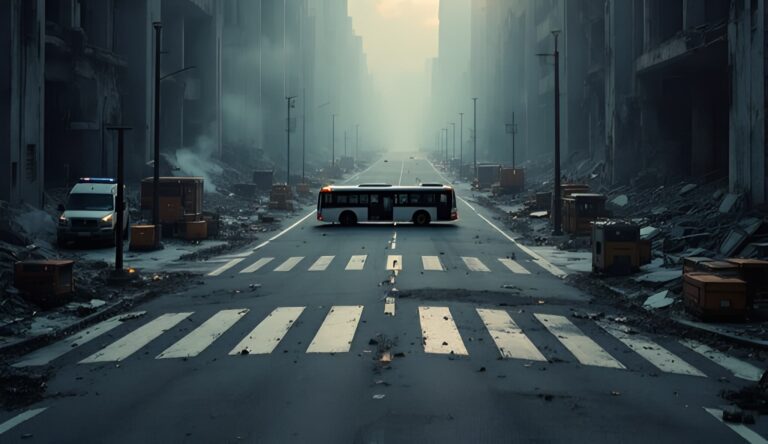

Colony Ending Explained: Hmmm ok….so the last scene of Colony just ended and your brain is basically buffering. Picture it: the street’s wrecked and weirdly quiet, cars are parked crooked with their doors hanging open, one of them is still on fire, and dozens of infected people are standing frozen mid-step, like somebody hit pause on the whole city.
The guy who caused all of this is dead on the ground. Se-jeong’s standing right in the middle of it, on the phone with Seol-hee, talking about what they have to do next, and you finally let out a breath. Alright, that’s done, right?
Then one of those frozen bodies twitches, lets out a cry, and the film cuts out on you.
If you’re sitting there going “wait, what was that?”, you’re in good company. That last beat is the reason so many people search for Colony’s ending the second the movie finishes. The film spends two hours teaching you that these infected share one mind and take orders from a single leader, and then the final shot seems to poke a hole in the very rule it worked so hard to build.
Here’s the good news, though: the ending plays fairer than it feels in the moment. Nearly everything in those closing minutes, the fungus-covered coat, the crowd spinning in circles, the bus ad, the burning car, the sudden freeze, gets planted way earlier. Map out those early hints, and the final twitch goes from feeling like a hollow gimmick to a deeply intentional twist.
So that’s what we’re sorting out together: how these infected think, who’s really running the horde, how one coat takes down a hive, why nobody gets a cure, and what that last twitch means.
Quick warning: this covers the whole film, so if you haven’t watched it yet, bookmark this and come back later!
TL;DR: Quick Key Takeaways!
- The villain, Young-cheol, lets the very first infected person bite him on purpose, and that makes him the one boss every infected body listens to.
- When he burns to death at the end, the orders stop, so every infected person in the city freezes on the spot.
- Se-jeong beats the hive with a loop trick: she throws a fungus-covered coat over one infected, the whole horde chases it in circles, and their shared mind crashes back to day one.
- There’s no cure at the end. The infection ruins the brain beyond repair, and killing Young-cheol also destroys the only source of the vaccine.
- He lured Se-jeong to the building on purpose, because she once reported his father for misusing research money, and his father took his own life afterward.
- The infected that moves in the last shot isn’t her ex-husband coming back. The most likely reading is that the hive has already adapted past its own weak spot.
Who’s who in Colony?
Quick roll call first, because the names get tangled fast.
Kwon Se-jeong (Jun Ji-hyun): a blunt biotech professor who lost her university job after one clash too many, and the one who figures out how the infected think.
Seo Young-cheol (Koo Kyo-hwan): a remarkably well-spoken former Chains Bio scientist who serves as patient zero and the mastermind behind the chaos.
Choi Hyun-seok (Ji Chang-wook): a patrol guard for the building who finds himself completely out of his depth when the doors lock.
Choi Hyun-hee (Kim Shin-rok): his older sister, who uses a powered wheelchair and drops by for lunch.
Gong Seol-hee (Shin Hyun-been): a biotech researcher working outside the building, married to Se-jeong’s ex-husband, and Se-jeong’s partner on the phone.
Han Gyu-seong (Go Soo): Se-jeong’s ex-husband, who invites her to the conference.
Kang Woo-chul (Kim Jong-tae): the CEO of Chains Bio and the first person infected.
Lee Bong-seok (Lee Joong-ok): the counter-terror police leader who keeps putting the plan ahead of people.
So-eun and her classmate: a high school student who’s being bullied, and the girl who bullies her, both trapped in the mall.
Wait, what’s even going on in this building to begin with?
Let’s rewind for a second, because the ending pays off a setup that’s easy to forget once the chaos kicks in.
The movie opens with Young-cheol calling the police on himself. He announces an “experiment” at the Doongwoori Building, a Seoul high-rise with a shopping mall below and offices above, and he injects himself while he talks. He tells the officer he’s the only vaccine for what’s coming. Hold onto that line, because it comes back with teeth at the end.
Upstairs, a company called Chains Bio is holding a conference. Its CEO, Woo-chul, shows off research built on slime mold, with the big party trick being a paralyzed lab rat that walks again. He also talks about how slime mold and ants solve problems as a group, with no single brain calling the shots.
Se-jeong is in the audience because her ex-husband Gyu-seong dragged her there to help her land a job. She’s also carrying an invitation with a handwritten line on it: “Imperfect communication is the source of all tragedy.” She assumes Woo-chul sent it. He didn’t.
A few minutes later, Young-cheol corners Woo-chul in a VIP room, accuses him of stealing his research, and jabs a syringe into his neck. Woo-chul starts vomiting white fungus, his body twists up, and he bites the first people he sees.
The building goes into lockdown, and then comes the twist that traps everybody: the authorities won’t send rescuers in until Young-cheol is brought to the roof alive, since he claims to be the only vaccine. So the survivors’ only way out runs straight through the man who caused all of it.
How do these infected actually think?
What makes Colony different from your average zombie movie is that these infected aren’t a mob of individuals. They’re one network wearing a lot of bodies. The white fungus they spit up and smear on walls works like a Wi-Fi signal between them, so whatever one infected learns, every infected learns.
You can actually watch it happen. Every so often one of them stops, tilts its head up, and starts twitching, then the rest follow, and for a few seconds the whole group locks up. Think of your phone freezing mid-update. Same vibe: everyone’s downloading the same patch. And when they come back, they act differently.
That’s how the film shows evolution in real time. At first they crawl on all fours and can’t tell a person from a picture of a person, so they’ll happily tear into a cardboard cutout or an ad screen. When the survivors switch off the lights in the camping store, the infected don’t give up.
They spot reflections in the glass, share the news, and charge the wrong window. Hyun-hee’s idea of sending cutouts rolling out on her wheelchair buys everyone time, but once the infected learn cutouts aren’t people, they stand up on two legs and can suddenly see over shelves. Later they imitate human voices and even fire guns.
The scary part is that they learn fast but they never fact-check. If the hive picks up a wrong piece of information, it just believes it. That’s how the perfume trick works: an older man who used to be a runner douses himself in perfume and races around, so the infected decide humans smell like perfume, and the survivors hide in antifreeze among perfumed mannequins. It’s a great trick, right up until the hive learns mannequins are fake.
Why is he doing all this, and why drag Se-jeong into it?
Young-cheol’s motive comes in layers, so let’s peel them one at a time.
Layer one is the surface: he feels robbed. He’s entirely driven by the belief that his former boss at Chains Bio, Woo-chul, jacked his research on hive-mind biology and then effectively exiled him. That’s the grievance he throws in Woo-chul’s face right before the injection.
Layer two is personal, and it explains Se-jeong. Years earlier, she reported Young-cheol’s father for misusing research money. A flashback shows young Young-cheol overhearing a phone call where his father begs her to let it go, explaining that he moved funds to pay students who worked on the project and never got paid. Se-jeong refused. The scandal exploded in the press, and his father took his own life.
Here’s where it gets interesting, though, because Young-cheol doesn’t blame her the way you’d expect. When she yells that he should’ve come after her if it was revenge, he waves that off. In his mind, nobody was the villain: two people couldn’t understand each other, and that gap killed a man. That’s the line he wrote on her invitation, and his father used similar words in that old call.
Layer three is the ideology, and it’s the real engine. If misunderstanding causes tragedy, his answer is to delete misunderstanding by wiring every human mind into one network. No secrets, no arguments, no minority opinion. He calls it a new humanity.
And you’ve probably spotted the catch already: the hive isn’t equal. There’s one boss, and it’s him. The perfect communication he’s selling is really a thousand bodies receiving orders from one head. That’s not understanding, that’s obedience.
So why invite Se-jeong at all? Because he wants the person who set his family’s collapse in motion to watch something she can’t stop. And his jab that she can go be an outcast if she wants to be alone? As you’ll see in a bit, that’s also a dare.
Wait, who’s actually in charge of the infected?
Early on, the hive feels leaderless, like a swarm teaching itself. But watch how Young-cheol behaves around it. In the cargo elevator, he suddenly presses the button for the ninth floor, the doors open on a waiting crowd of infected, and they tear into everybody except him. That’s your first sign that his vaccine claim holds up, at least in the sense that the infected treat him as one of their own.
Then comes the stranger part. The survivors watch him on the control room cameras walking back to Woo-chul, the first infected person, and letting Woo-chul bite him. Because Young-cheol is immune, the infection doesn’t turn him into a mindless body. He gets full access to the biological Wi-Fi, but his actual cognitive functions remain completely untouched. He’s a human mind steering a swarm.
How do we know he’s the boss? The film hands you proof away from the building. Seol-hee visits his lab, where infected monkeys sit in glass cages. The cage marked 1 is broken, and when a soldier shoots that monkey, every other monkey locks up on the spot. That’s the rule in miniature: kill the one at the top and the whole body stops.
So the government’s plan sounds logical. Find patient zero, kill him, done. They work out that Woo-chul was the first infected, a team finally reaches him and kills him, and nothing changes. The horde keeps coming. That’s when Seol-hee realizes the real commander isn’t the first person infected, it’s the man who got himself bitten afterward.
It also explains why the survivors keep getting hunted even after they blindfold him. Young-cheol can see through the infected’s eyes and hear through their ears, which is how Se-jeong catches on in the first place: he compliments a stunt he couldn’t possibly have witnessed.
After that the group switches to texting, but some of them keep talking out loud anyway. You know that one person in the group chat who ruins the surprise by blurting it out in front of the birthday kid? Same energy, except people die.
What’s the deal with Hyun-hee and Hyun-seok, and why does she stab him?
This is the part of the film that hurts the most, so let’s take it carefully.
Hyun-seok is a security guard, and Hyun-hee is his older sister, who drops by the building to have lunch with him. Early on, she mentions they should go camping sometime, a throwaway line that turns heartbreaking later.
When the group reaches the control room, Hyun-hee volunteers to stay behind. She watches the cameras and guides everyone through the group chat on their phones, and it works until it doesn’t. Officer Bong-seok decides she isn’t worth the risk, argues about it out loud, and lets her location slip right in front of the blindfolded Young-cheol. The hive looks up the room on a computer, and Hyun-seok runs off to save her alone.
Here’s the gut punch. When he calls her for directions, she sends him, on purpose, to an elevator that doesn’t go to her floor. She knows he can’t fight through that horde, so she picks his survival over her own rescue. Her last words to him are about the camping trip they should’ve taken the week before. Then the infected break through the glass.
Hyun-seok falls apart, and his later announcement over the building’s speakers gives away everyone’s position, which costs more lives.
When he finally corners Young-cheol, the villain has one last move. He brings out the infected Hyun-hee, standing and walking, which is exactly what the slime mold did for that lab rat in the opening presentation. Young-cheol treats it like a gift. Hyun-seok freezes, and she stabs him with his own knife.
Why a knife instead of a bite? Here’s how I read it: a bite would’ve made Hyun-seok part of the colony, a sort of reunion for the siblings as one. A stab denies them that. Young-cheol wants them apart, even in death.
How does one coat break the whole hive?
This is the movie’s big moment, and it only works because Se-jeong explains the trick earlier. Let’s go in order.
The setup. Back in the camping store, Se-jeong tells everyone about ants. When army ants get separated from their colony, they follow the scent trail of the ant ahead of them, and if that trail loops, they march in a circle until they drop. It’s called an ant mill, and at that point it sounds like a nerdy aside. It isn’t.
The disguise. She pulls a white coat caked in fungus off an infected body and wears it out of the building. Earlier, Hyun-seok, soaked in blood and fungus, had made the infected hesitate, so she’s betting that enough mycelium makes a human look like part of the colony. Seol-hee watches traffic cameras from outside and guides her, and Se-jeong takes a car and goes after Young-cheol.
The order. Young-cheol tells the horde to attack her, but they stall because the coat confuses them. So he sharpens the command: attack that coat.
The trap. Se-jeong throws the coat over one infected person’s head. Now there’s a fungus-covered target in a fungus-covered crowd, and every infected is chasing the one in front of it. They end up in a spinning ring, running in circles, the same loop as those ants.
The crash. Young-cheol can’t fix it by shouting, so he wades into the middle and pulls the coat off. That’s the worst possible move. The sudden flood of conflicting information overloads the network, and it reboots. Think of it like a massive game crash. All their leveled-up skills are toast, so instead of shooting guns and talking, they’re right back to crawling like bugs and chasing flat images.
The finish. Se-jeong uses that. She slides under a bus with an ad showing a person on it, and the crowd rushes the picture instead of her. In the crush, Young-cheol gets shoved into a burning car, and when he lunges at her, she pushes him back. He doesn’t get up.
It’s a clever ending because he loses to the flaw he built into his dream: a network that obeys without ever asking whether the order makes sense.
So why can’t anyone just make a cure?
After all that, you’d expect somebody to be holding a syringe by the end. Nobody is, and that’s on purpose.
Start with what the infection does. Seol-hee studies the monkeys and concludes it destroys the brain in a way that can’t be repaired, so the people stumbling around aren’t patients waiting for medicine, they’re past saving.
Next, the vaccine. Young-cheol said he’s the only one, and the film backs that up: the infected leave him alone, and his blood is the only possible source of protection. But a vaccine is for people who haven’t been infected yet. It wouldn’t bring anybody back.
Put those pieces together and the brutal dilemma makes sense. The only move to stop the chaos is dropping the guy in charge, but the second he dies, the one and only path to a cure dies right along with him. So whoever pulls that trigger takes the blame for everyone a vaccine might’ve protected, and for giving up on anyone who might’ve been saved.
Seol-hee and Se-jeong talk it through on the phone and land in the same spot: it has to be him.
And that’s what “outcast” meant. When Young-cheol said Se-jeong could go be one, it was a dare. Whoever ends this will be hated by everyone who wants a cure, and Se-jeong is already used to being the odd one out in every room she walks into.
The way the movie closes that loop is quiet. She doesn’t celebrate. She calls Seol-hee, the two agree to work together, and the difference between their partnership and Young-cheol’s hive is the whole point of the film: two separate minds choosing to stand together, versus one mind pretending to be thousands.
Okay, so what’s that one infected doing at the very End?
Here’s what we actually see in Colony’s ending: after the freeze, as Se-jeong walks off, the camera drifts across the frozen crowd, and one infected moves and cries out. No explanation, no follow-up, and the film ends.
First, the guess a lot of people make: that it’s Gyu-seong, Se-jeong’s ex-husband, who dies early on. It’s tempting, but nothing in the shot or the story ties the two together, so I wouldn’t lean on it.
Second, the idea that a new boss has taken over. If one commander’s death shut the hive down, a new one waking up fits the rules the movie built.
Third, and the reading that fits the movie best: it’s a mutation. The hive just got burned by its own weak spot, a single head and a loop that can crush it, and this one body has already evolved past it. These infected learn from every failed attack, so they’re not going to stop learning because the villain died.
What the film doesn’t do is tell you what comes next. It leaves that door open and walks away.
So how should you take that last shot? I’d say it answers a question the whole movie has been asking: can you kill an idea by killing the man who started it? Apparently not that easily.
Wrap Up: So, what’s the point of all this?
Zoom out and Colony is arguing something simple. Young-cheol thinks disagreement is the problem, so he removes it, and the result is a hive that chases cutouts, falls for a bus ad, and runs in circles because nobody in it can say “hang on, that doesn’t look right.” Se-jeong wins because she’s the opposite: blunt, stubborn, and used to going against the room.
But the movie doesn’t let her win cleanly. A cure is off the table, most of the people she tried to protect are gone, and that last twitch says the hive may not be finished. What’s left is two people choosing to stand together anyway, and that’s the answer to Young-cheol: you don’t fix miscommunication by deleting people, you do the messy work together.
If you’re interested, you can check out our The Wailing ending explained here!
FAQ: Most Googled Ones!
Why does everything freeze when Young-cheol dies?
He was the single commander of the hive, so once he’s gone nobody is giving orders.
Why did Young-cheol invite Se-jeong to the building?
She reported his father for misusing research money years earlier, and his father took his own life afterward.
Can the infected people be Cured?
No, because the infection ruins the brain beyond repair and the vaccine only protects people who aren’t infected yet.
Who survives at the End of Colony?
Se-jeong and Seol-hee are the only main characters left standing.
About the Author.
Hi, I’m Vansh, the founder of Vibe On Cue. I track the absolute best ways to experience cinema, from the biggest Hollywood Blockbusters and upcoming release dates to the finest details of PVOD & Streaming and pristine Blu-ray & 4K physical media. And when the credits roll, I break down the narrative with deep-dive Ending explained guides. If you live for the full life cycle of film, stick around and explore the site!