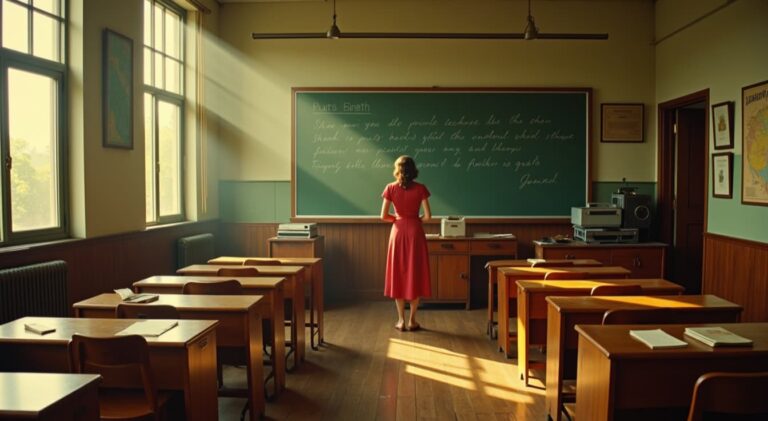

Bad Apples 2026 Release Date: Okay, pop quiz. What do you do when one kid in your class is so relentlessly awful that the other nine-year-olds have started flinching every time he walks in the room? If you’re a normal teacher, you write a strongly worded email to the principal. If you’re Saoirse Ronan in Bad Apples, you accidentally kidnap him and lock him in your house. And somehow, that’s the reasonable version of what happens next.
I want to be upfront: I did not expect a movie about a British primary school to become one of the most talked-about festival titles of the last year, but here we are. Bad Apples has been quietly building buzz since it premiered at TIFF, and now it’s finally getting a proper theatrical release with a date, a trailer, and a premise so unhinged you’ll want to read it twice just to make sure you understood it correctly.
So let’s get into it: when it’s coming out, who’s in it, what it’s actually about, and why this one deserves a spot on your September watchlist.
So When Is Bad Apples Actually Coming Out?
Mark it down: Bad Apples hits theaters on September 18, 2026, in both the US and the UK. Paramount Pictures confirmed the date themselves when they dropped the official trailer and poster, so this isn’t a rumor or a “probably” it’s locked.
That date is also doing some quiet emotional work if you’ve been following this film for a while, because Bad Apples has technically existed, in finished form, for a full year already. It premiered at the Toronto International Film Festival all the way back in September 2025, then spent the better part of a year making the festival rounds San Sebastián, the BFI London Film Festival, AFI Fest collecting the kind of “have you seen this yet?” word-of-mouth that studios love and can’t manufacture. Paramount clearly decided to let that buzz simmer before giving it a wide release, and honestly? Smart move. This is not a film you want to bury in a random February dump weekend.
One quick housekeeping note, because I don’t want anyone showing up to the wrong theater: there is a completely unrelated horror movie that also happens to be called Bad Apples, which came out earlier this year in February. Different director, different cast, different everything just an unfortunate title collision. The one we’re talking about here is the Saoirse Ronan dark comedy from Paramount. If someone’s search results are showing you a grainy horror poster, that’s not this movie.
Wait, What Is This Movie Actually About?
Here’s the setup, and I promise it gets weirder the more you sit with it.
Saoirse Ronan plays Maria, a primary school teacher at what’s described as a fairly upscale private school in the UK. She’s young, idealistic, genuinely good at her job, and clearly loves teaching which makes it worse when one particular student starts systematically wrecking her classroom’s entire vibe. That student is Danny, played by Eddie Waller, and by all accounts he is not your garden-variety “acts out sometimes” kid. He’s foul-mouthed, aggressive, and in one of the trailer’s more startling beats shoves a classmate over a banister and breaks her arm. This isn’t a misunderstood-kid-finds-his-way story. Danny is presented as genuine chaos on legs.
So Maria, at the end of her rope and watching her career quietly implode alongside her classroom, makes what the official synopsis diplomatically calls “a series of bad decisions.” Those decisions culminate in her accidentally taking Danny and locking him in her home. Not premeditated evil-mastermind stuff more of a spiraling, “how did I end up here” chain reaction that she can’t quite walk back.
And this is where the film gets genuinely uncomfortable in the best way: once Danny is “missing,” the class starts improving. Parents are thrilled. The staff are thrilled. Maria’s own performance reviews probably look great for the first time in months. She tries to backtrack, to figure out how to undo what she’s done but the better everyone’s lives get without Danny in the picture, the harder that backtracking becomes. It’s less a kidnapping thriller and more a pitch-black moral experiment: what happens when getting rid of the problem actually works, and nobody around you seems to want it fixed?
That’s the engine of the whole thing: a satire dressed up as a thriller, or maybe the other way around.
Meet the Cast (Yes, That Saoirse Ronan)
Saoirse Ronan anchors this as Maria, and if you’ve been paying attention to her career, you’ll know she doesn’t often sign onto something unless there’s real meat on the bone. Four Academy Award nominations will do that for your instincts. Early reactions out of TIFF specifically called out how she plays against type here trading her usual wounded-but-composed energy for something messier and funnier, a woman visibly losing her grip while still trying to act like everything’s fine at parent-teacher conferences.
Eddie Waller plays Danny, and from what’s been said about the performance, he’s doing a lot of heavy lifting for a child actor going full-throttle into a character the film needs you to genuinely dislike before it can complicate your feelings about him later.
Rounding out the cast: Jacob Anderson, Rakie Ayola, Robert Emms, Sean Gilder, Kerry Howard, and Nia Brown, who plays Pauline the unfortunate teacher’s pet who ends up on the receiving end of Danny’s chaos early on.
Behind the camera, this is Swedish filmmaker Jonatan Etzler’s English-language debut, working from a screenplay by Jess O’Kane. The film is based on De Oönskade (“The Unwanted”), a debut novel that apparently carries the same darkly comic, satirical DNA the movie’s been praised for. Etzler previously built a reputation on festival-circuit work, and by most early accounts, he’s brought a genuinely distinct directorial voice to this one rather than playing it as a straightforward prestige drama.
There’s something worth noting about handing an English-language, distinctly British institutional satire to a Swedish director making his crossover debut. Sometimes that kind of outsider’s-eye approach is exactly what makes a familiar setting feel newly strange the same way a foreign-born filmmaker can spot the absurdities of a school staff meeting or a parents’ evening that everyone inside the system has stopped noticing.
Early festival chatter suggests that’s more or less what happened here: the film reportedly leans hard into deadpan, almost clinical observation of British social politeness cracking under pressure, which tracks with a director watching those dynamics from slightly outside them. Producer Oskar Pimlott, working alongside Pulse Films, has assembled a project that clearly wanted festival credibility before commercial rollout, the kind of sequencing usually reserved for films a studio genuinely believes in rather than one it’s trying to offload quickly.
The Book Behind Bad Apples
Here’s a detail that doesn’t get nearly enough attention in the trailer chatter: Bad Apples isn’t an original screenplay. It’s adapted from De Oönskade translated roughly as “The Unwanted” a Swedish debut novel by author Rasmus Andersson, first published back in 2020. In its original language, the book follows a school where both children and staff live under a kind of low-grade dread caused by a group of disruptive students, a premise that’s been condensed and sharpened for the film into a single central antagonist in Danny.
What’s genuinely interesting is how personal this adaptation was for the people who made it. Director Jonatan Etzler was a teacher himself before moving into filmmaking, and According to Hollywood Reporter, he’s said he was “really struck” by the novel’s central moral dilemma when he first read it struck enough to chase the rights and adapt it as his English-language debut. When his team went looking for a screenwriter, they landed on Jess O’Kane who, According to The Hollywood Reporter, had also worked as a teacher before turning to writing, in a neat coincidence. So you’ve essentially got two former educators translating a novel about the darkest edges of classroom burnout into a studio release which probably explains why so much of the film’s classroom detail reportedly rings true rather than feeling like outsider guesswork.
One choice worth flagging for anyone who tracks down the book afterward: the novel is set in Sweden, but Etzler deliberately relocated the story to England for the film. His reasoning, from what’s been reported, came down to the fact that Swedish and British school systems don’t map onto each other cleanly enough for a direct transplant so rather than force a Swedish setting into an English-language film, he rebuilt the world around a British institutional backdrop instead. If you’re the type of reader who likes comparing the book to the movie, that’s the biggest structural change to expect going in everything else, from the core moral trap to the basic shape of Maria’s spiral, reportedly carries over intact.
Where Was Bad Apples Actually Filmed?
If the film’s setting felt specific and lived-in to you in the trailer, that’s not an accident. Bad Apples was shot on location across the southwest of England. According to trade outlet Screen Global Production, production spent roughly six weeks filming around Somerset and Bristol. That’s a deliberate choice Etzler and his team weren’t looking for a generic “anywhere England” backdrop, they wanted a specific regional texture, and Somerset’s mix of small-town intimacy and quietly affluent private-school energy fits the film’s satire of institutional politeness cracking under pressure.
Within the story itself, Maria whose full name, according to Variety, is Maria Spencer teaches at a fictional school The Hollywood Reporter identifies as Ashton Brook Primary, described as an unremarkable elementary school in an unnamed Somerset town. It’s a deliberately ordinary setting, which is part of the point: this isn’t some overtly sinister boarding school or gothic institution, it’s the kind of unassuming small-town primary school that could exist anywhere, which makes everything that unravels inside it land even harder. Per the same Hollywood Reporter review, one of the film’s opening scenes takes place at a local cider factory during a class trip with a nice bit of very-Somerset local color before things start going sideways.
For anyone who likes to plan a bit of movie-tourism around a release, don’t expect a marked “Bad Apples filming trail” ; the production kept things fairly low-key regionally rather than shooting at one single iconic landmark. But if you’re ever driving through Somerset or Bristol after this hits theaters, there’s a decent chance you’ve passed within a few miles of Maria’s basement.
The Long Road From TIFF to Your Local Theater
It’s worth sitting with just how unusual the Bad Apples release timeline actually is, because it says a lot about how Paramount is positioning this film. A full calendar year passed between its Toronto premiere and its wide theatrical release that’s an eternity in film marketing terms, where most titles either open within a few months of their festival debut or quietly disappear into a streaming deal.
Instead, Bad Apples got the slow-build treatment: TIFF in September 2025, then San Sebastián where, per the festival’s own official selection, it opened the New Directors competition followed by stops at the BFI London Film Festival and AFI Fest, before Paramount finally locked the trailer, poster, and release date this past July. That’s not the pattern of a studio unsure what it has.
That’s a studio letting critics and festival audiences do a year’s worth of free word-of-mouth marketing before spending a dollar on a wide push banking on exactly the kind of “wait, THAT’S the movie everyone’s been talking about?” reaction this article is probably giving you right now.
For context, that’s the same playbook that’s worked well for other festival-to-theatrical dark comedies in the past year, several of which turned early buzz into real awards-season conversations. Whether Bad Apples follows that same trajectory remains to be seen, but the ingredients: a festival-tested screenplay, a proven lead actress working against type, and genuinely strong critical reception are all in place.
Okay, But Is It Actually Good?
Look, I try not to just parrot review aggregate scores at you and call it analysis, but the numbers here are worth mentioning because they back up what the festival chatter’s been saying for a year: as of this writing, Rotten Tomatoes has Bad Apples sitting at 83% across 36 reviews, which is a genuinely strong number for a film this tonally risky.
What’s more interesting than the score is how critics have been describing it. The word “dark comedy” keeps getting used, but multiple reviewers have specifically pointed out that it takes a while to even clock that you’re watching a comedy; the setup plays uncomfortably straight before the satire kicks in.
Ronan’s performance has been singled out repeatedly as a highlight, with several critics noting she’s playing “against type” in a way that feels genuinely fresh for her. There’s also been praise for how the film uses its premise to comment on something bigger institutional failure, communities quietly agreeing to look away from uncomfortable truths, that kind of thing without ever losing its sense of humor about the absurdity of the whole situation.
Not everyone’s fully sold, to be fair. A handful of reviews have noted the film’s satire feels specifically rooted in British institutional dynamics in a way that might not translate perfectly for every audience, and at least one review felt the film raises more interesting questions than it ultimately answers. But even the more mixed takes tend to credit the cast, particularly Ronan, for elevating the material.
Basically: this isn’t a film that’s coasting on premise alone. People who’ve actually seen it seem to think it delivers.
Why This One’s Worth Actually Paying Attention To?
I’ll be honest, “teacher does something morally questionable” is not exactly a fresh logline on paper. What makes Bad Apples stand out is the specific angle it’s taking. This isn’t a redemption story, and it’s not really a crime thriller either, despite the kidnapping-adjacent plot. It’s using an absurd, almost farcical premise to poke at something a lot more uncomfortable: our collective willingness to quietly benefit from a problem disappearing without asking too many questions about how.
There’s also just the pure “how is this going to escalate” curiosity factor. Once you know the setup teacher accidentally kidnaps disruptive student, class gets better, everyone’s happy, teacher now has to live with what she’s done you genuinely can’t predict where it goes next. Does Danny escape? Does Maria get caught? Does the film let her off the hook, or does it make her sit in the consequences? That kind of genuine uncertainty is rare in a marketplace full of trailers that spoil their own third acts.
And then there’s the release strategy itself, which tells its own story. Paramount sitting on this for a full year after TIFF, letting it build festival cred at San Sebastián and London before finally scheduling a wide release, suggests real confidence that word-of-mouth would do more for this film than a rushed rollout. That’s not usually how studios treat something they’re lukewarm on.
It also helps that Ronan is at a point in her career where she can afford to take genuine swings on smaller, riskier material between bigger studio commitments and this feels very much like one of those choices. Actors with four Oscar nominations don’t need to sign onto a British indie about a teacher who kidnaps a fourth grader unless something about the script actually got under their skin. That’s worth factoring in if you’re deciding whether to prioritize this one among everything else hitting theaters this September.
What Kind of Audience Is This Actually For?
Worth being honest about who’s going to love this and who might want to sit it out. If you’re the type of moviegoer who gravitates toward films that make you laugh and then immediately feel a little guilty about laughing, think of the discomfort-comedy lane rather than pure slapstick that is squarely built for you. It’s also going to appeal to anyone who enjoys a good moral-dilemma thriller where the “right” answer keeps shifting depending on whose side of the story you’re standing on.
If you’re looking for something purely feel-good, or if child-endangerment premises are a hard pass for you regardless of the satirical wrapping, this probably isn’t your September pick and that’s a completely fair line to draw. The trailer doesn’t hide what it is, and neither should this article. It’s a film that wants you to be uncomfortable in service of a bigger point, not a cozy afternoon watch.
If you’re interested, you can check out our Dune 3 Release Guide!
Should You Watch the Trailer Before Going In?
This one’s genuinely up to your personal spoiler tolerance, and I say that as someone who usually just watches everything anyway. The trailer Paramount released does show its hand a bit. You’ll see the classroom chaos, get a sense of Maria’s spiral, and catch a glimpse of just how far things go. If you want to walk in completely cold and let the “wait, is she actually going to” moments hit at full strength, I’d say skip it and just show up opening weekend.
If you’re the type who likes knowing the general shape of a story before committing two hours to it, the trailer will give you plenty to work with without fully spelling out the ending.
Either way, September 18 is the day to have this one on your radar.
FAQ: Most Googled Ones!
When does Bad Apples come out?
September 18, 2026, in theaters in both the US and the UK, via Paramount Pictures.
Is Bad Apples Based on a True Story?
No. it’s based on the Novel De Oönskade (“The Unwanted”), a work of fiction.
Who stars in Bad Apples?
Saoirse Ronan leads as Maria, with Eddie Waller as Danny, alongside Jacob Anderson, Rakie Ayola, Robert Emms, Sean Gilder, Kerry Howard, and Nia Brown.
Is Bad Apples a horror movie?
No, despite the kidnapping premise, it’s classified as a dark comedy/thriller, not horror. (There is an unrelated horror film with the same title that was released earlier in 2026, a different movie entirely.)
Where did Bad Apples Premiere?
It debuted at the Toronto International Film Festival in September 2025, before playing San Sebastián, BFI London Film Festival, and AFI Fest.
Is Bad Apples good?
Early reviews are strong, it holds an 83% score on Rotten Tomatoes from 36 critics, with particular praise for Saoirse Ronan’s performance.
About the Author.
Hi, I’m Vansh, the founder of Vibe On Cue. I track the absolute best ways to experience cinema, from the biggest Hollywood Blockbusters and upcoming release dates to the finest details of PVOD & Streaming and pristine Blu-ray & 4K physical media. And when the credits roll, I break down the narrative with deep-dive Ending explained guides. If you live for the full life cycle of film, stick around and explore the site!!!