
The Bride Ending Explained: Ok…So Frank is dead. The Bride is dead. A cop basically tells a scientist to take her time, and then the voice of a long-dead author pops up to say these two remind her of Romeo and Juliet. Totally normal Tuesday in a lab. And then the lights flicker, there’s a flash outside the windows, and two hands start twitching on a table. Then they grab each other. Then it just ends.
I know the exact question you have right now, did they actually make it out alive? Do they know who they are? Do they know each other?”, yeah, same. That’s the one thing the movie won’t tell you. After a whole movie of watching a monster and a woman with zero memory make a life up as they go, the last shot gives you a maybe and walks off.
So what helps? Knowing the ending isn’t random, even though it feels that way. The doctor who says no, the cop who steps out, the ghost who won’t stop talking, they’ve all been set up way earlier, and once you stack them next to each other, the big flip stops feeling like it came from nowhere, and you can actually see why it plays out the way it does.
A few things are left open on purpose too, and I’ll tell you straight which bits are the movie’s answer and which bits are just me making a guess.
Full spoilers from here on, so if you haven’t seen it, go watch it first. Everyone else, let’s sort this out!
Who’s Who in The Bride?
Before the deep dive, here’s a quick reminder of who’s who, since a lot of people run through this story.
Frank (Christian Bale): Frankenstein’s monster, lonely for about a century, who wants a companion and gets a lot more than he planned for.
Ida / Penelope Rogers / the Bride (Jessie Buckley): A woman killed in 1936 Chicago, brought back with no memory, and known by three different names as the movie goes on.
Mary Shelley (Jessie Buckley): The author of Frankenstein, speaking from the afterlife, who keeps taking over people so she can tell her story.
Dr. Cornelia Euphronius (Annette Bening): The scientist who revives Ida and carries a painful secret about her husband.
Detective Jake Wiles (Peter Sarsgaard): The cop chasing the pair, who had a past with Ida.
Myrna Malloy (Penélope Cruz): Wiles’s assistant, who is sharper than anybody gives her credit for.
Clyde (John Magaro): One of Lupino’s men, sent to finish the job on Ida.
Lupino (Zlatko Burić): The crime boss at the center of all the trouble.
Ronnie Reed (Jake Gyllenhaal): The movie star Frank worships.
Greta (Jeannie Berlin): Euphronius’s maid, who is in the room for the finale.
Quick Rewind: Where Does This Story Even Start?
It starts with a woman who’s about to have the worst night of her life. Mary Shelley, speaking from beyond the grave, says she has a story she never got to tell, and she borrows a woman named Ida in 1936 Chicago to tell it.
Ida starts talking in a trance at a fancy dinner, and what comes out of her mouth is the kind of stuff nobody should say about a mob boss named Lupino. His men, Clyde and James, pull her aside to quiet her down. Ida ends up dead at the bottom of a staircase.
Meanwhile, across town, Frank has shown up at Dr. Euphronius’s door. He’s read about her reanimation work, and he asks her to build him a companion.
After around a hundred years alone, he’s tired of it. Euphronius agrees, and they pick Ida’s body. It works, but the woman who wakes up has no memory of her old life.
That one moment sets everything else in motion. Frank looks at a blank slate and tells her she’s his bride who lost her memory in an accident. She believes him, because why wouldn’t she? She has nothing else to go on.
So that’s your starting position. A woman with no past, a man who lied to her on day one, a mob boss who thinks she’s dead, and a ghost who hasn’t finished talking. If you keep those four things in your head, the ending suddenly gets a lot easier to follow.
Why Does Frank Lie to Her, and Why Does She Stay Anyway?
Okay, Frank gets a little fairness here, because the movie wants you to feel two things at once. He lies to her, and that’s not okay. But he lies because he’s terrified of being alone again. When you’ve spent a century with no one, and somebody finally opens their eyes next to you, you grab on with both hands.
The part that’s easy to miss is that the lie doesn’t actually hold her. When two men attack her outside the club and Frank kills them, he tells her to leave. She’s free to walk. She doesn’t. She decides to run with him, and that choice is hers, made after she’s seen exactly how violent he can be.
Why would she do that? Think about what she has to choose from. She has no home, no memories, no one else who knows her. Frank is the only person in the world who’s been there since the moment she woke up. But I don’t think it’s only that.
Plenty of people stay with the wrong person because it’s the only one they have. This feels different because she keeps choosing him in small moments after that, and the ones that matter come after she finds out the truth.
When Wiles tells her she was Ida, she’s furious, and she shoots him in the foot. Then Frank tells her what he did and how she came back. And she doesn’t leave. Why? Because over those weeks, something real got built, even if it started on a lie.
That’s the difference between being kept somewhere and choosing to stay, and the movie spends most of its time showing you that she’s the second kind.
How Does Frank’s Love of Movies Lead the Cops Right to Him?
This one’s a fun detail that pays off at the end, so let’s talk about it.
Frank is obsessed with movies, and especially with a star named Ronnie Reed. It’s the one thing in his life that made him feel human before he met the Bride. He takes her to a Reed film on their first outing. He finally meets Reed in person at a party and gets brushed off. He even starts dancing like the guy in a room full of strangers.
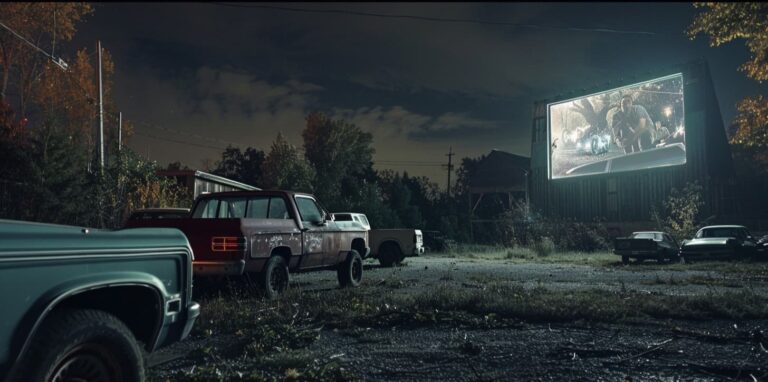
Now, you could treat all that as just flavor. But it’s actually how the police find him. Malloy notices that the sightings and the crimes keep happening in cities connected to Reed’s films, and that tells her where the couple is headed next. That’s how the chase ends up at Niagara Falls, and later at a drive-in, which is a movie spot too.
Pay attention to that for a second. The thing Frank loves most is the thing that gets him caught. He can’t give up his hero even while running for his life. It’s a very human mistake, and it makes the shooting at the drive-in feel almost inevitable.
He’s standing in a place built for watching movies, saying the most important thing he’s ever said, and he’s exactly where Malloy was heading.
It also tells you something about Malloy. The cops around her keep missing things, but she puts it together from a pattern nobody else was reading. When Wiles hands her the lead near the end, you don’t feel like he’s being generous. You feel like she’s been doing the work all along.
Who Was Ida, and Why Does Learning Her Name Change Things?
The names matter a lot more than they seem to, because the ending leans on them hard.
She starts as Ida, but she doesn’t know it. Frank gives her a new name, Penelope Rogers, and she likes it. That’s the name she carries through the cross-country run. Then there’s the nickname the newspapers hang on her, Frankenstein’s bride. By the time the story gets to the drive-in, she’s been called three different things and was told she was somebody she never was.
Then Wiles shows up and says her real name. And it landed, because he knew her. He tells Malloy that he and Ida had been planning to bring down Lupino together, and that he blames himself for what happened to her. So the truth isn’t just a fun twist. It’s a man owning up to his own failure. He didn’t act when he should have, and Ida paid for it.
What I like about how the movie handles this is that it never rewinds. She doesn’t go back to being Ida. She can’t, since she doesn’t remember being her. But she also doesn’t stay with Penelope, a name Frank invented. She picks something new. At the drive-in, once Frank has told her everything, she decides to call herself the Bride.
Why does that matter? Because every name before this was handed to her by somebody else. Mary Shelley gave her a job, Frank gave her a story, and Wiles gave her a past. The one she picks for herself is the only one that fits, and that’s why the next scene hits the way it does.
Why Does She Say “I Would Prefer Not To” When Frank Proposes?
This is where the movie loses a lot of people, so we need to unpack exactly what happens here.
At the drive-in, Frank apologizes for everything, tells her he loves her, and proposes. He asks if she’ll marry him. And she says, “I’m not anybody’s bride.” Then she adds, “I would prefer not to.” And then a gunshot goes off.
On a first watch, that can feel harsh. The man just poured his heart out. But look at what she actually said. She called herself the Bride a moment ago, and she’s still using that name. She just won’t let it mean “Frank’s wife.” She took a word that other people were using as a label and turned it into something she owns.
The line “I would prefer not to” is borrowed from Herman Melville’s story Bartleby, the Scrivener, about a clerk who answers every request with that same calm refusal. She’s been using it for a long time. She says it to Euphronius early on when the doctor wants to run tests on her.
It’s her way of saying no without raising her voice. So when she says it to Frank, it isn’t cold. It’s the same line she’s used on everybody who’s tried to tell her what to do.
And think about what Frank has done over the whole story. He’s the one who helped pick her body, who gave her a false past, and who gave her a new name. A proposal is one more thing he’s offering her to wear. Of course she turns it down. But here’s the sweet part.
She turns it down because she’s finally able to, and he seems to understand that. She isn’t rejecting him. She’s rejecting being owned by anything, even something loving.
That’s also why Clyde’s gunshot feels so cruel. She’s just found her own voice, she’s mid-sentence, and the man she’s said it to gets shot in the head.
Why Does Dr. Euphronius Say No, Then Say Yes?
Now we get to the question in the title, and it’s the one that matters most.
Once she makes it back to the lab with Frank, she pleads with Euphronius to repeat the revival process. And the doctor says no. This isn’t cruelty. She tells the Bride about her husband. She once tried to bring him back, and it went wrong. It went so wrong that she had to kill him herself. That’s the weight she’s been carrying.
So when she says no, it’s not about Frank. It’s about her. She’s scared of repeating the worst day of her life. And that’s a very understandable thing to be scared of. Who’d want to go through that twice?
Then a few things happen fast. Clyde breaks in and the lab turns into a shootout. By the time it’s over, the Bride is dead on the floor too, and Clyde has slipped away. The police pour in.
Malloy takes charge, sends the officers after Clyde, and then does something small and kind. She leaves Euphronius alone with the bodies and tells her, in effect, to take as long as she needs.
Now look at how the situation has changed. Before, Euphronius could say no because she was protecting herself from a risk. Now there’s no one left to save and no one left to watch her fail. The only thing she can do is nothing, or something. And that’s a very different question when two people you made are lying in front of you.
There’s also a quieter reason I think she says yes. She’s the one who brought Ida back in the first place, and that first revival cost the woman her entire past. Whatever she believes about her husband, she has a second chance to try again with people who actually wanted to live.
Director Maggie Gyllenhaal told Entertainment Weekly that the doctor does something radical at the end, something she shouldn’t do and does anyway. That sounds right to me. The movie isn’t saying it’s the wise choice. It’s saying it’s the brave one.
What Is Mary Shelley Doing in That Lab?
Now the ghost, who most people forget about until the last five minutes, and who’s been messing with everything the whole time.
For most of the film’s runtime, Mary Shelley uses Ida as her own personal mouthpiece before eventually shifting her control over to the Bride. She makes her say things she wouldn’t, she causes outbursts, and she even gets a room full of party guests dancing like they’re in a trance. A lot of the trouble in this story starts because she can’t keep quiet.
In the finale, she doesn’t need a body anymore. While Euphronius and her maid Greta are alone with the bodies, the ghost’s voice floats into the room and compares Frank and the Bride to Romeo and Juliet.
It’s a bizarre choice of words for two corpses, but it tells you exactly what she wants. She’s definitely not stepping in to just dish out life advice. She’s pushing the doctor toward an ending that feels like a story and not like a cleanup.
Remember how this all began. Shelley said she had a tale she never got to tell. Now think about what that means for the last scene. If the Bride and Frank stay dead, then she’s told a story about two people who run, fight, fall in love, and get shot.
That’s a tragedy, and it’s been told before. If they come back, even in some strange, uncertain way, the story gets to keep going.
So my read is that the ghost isn’t a villain and she isn’t just a helper. She’s a writer who refuses to end her own book on the saddest page. And Euphronius is the only person in the room who can turn the page.
One more thing worth noticing. Gyllenhaal told Entertainment Weekly that what feels triumphant to her is everybody in that room, the ghost, Malloy, Greta, and the doctor, pulling together to bring someone back to life.
Looking at it from that angle, bringing them back wasn’t just a solo call. It’s a handful of people, all with different reasons, giving the same push at the same moment.
Do Frank and the Bride Remember Each Other When They Wake Up?
This is the big one. And I’m going to give you the honest answer, which is that the movie doesn’t tell us.
What we know for sure is pretty small. The final shot shows both of them alive, or at least moving, and their hands find each other. That’s it. There’s no line of dialogue, no eyes opening, no names said out loud.
Now, here’s the thing that makes this tricky. The first time Euphronius brought Ida back, she woke up with no memory at all. That’s the rule the movie set up for us. So there’s no reason to assume the second time works any better.
Gyllenhaal has said as much. She said that if they come back with no memory, it’s fair to wonder whether that’s a happy ending, and that maybe one of them remembers and the other doesn’t, and they might not even know each other.
Her words were, “Is that a happy ending? I don’t know.” The other stars didn’t try to settle it either. Jessie Buckley said she hopes so and feels their love is bigger than both of them, and Christian Bale said there’s simply no predicting what characters like that will do.
So let’s play it out. If they both wake up blank, they’d be doing that first night all over again, two strangers who might find out they like each other. If only one of them remembers, that person would be the one holding all the secrets again. And we’ve already seen how that goes.
But here’s why I lean a little hopeful. Look at what the hands do. Neither of them reaches for a weapon, a door, or the doctor. They reach for each other. Whatever’s gone, something in them still moves toward the other person.
You could say that’s just the way a camera likes to end a scene. But after two hours of watching these two choose each other over and over, it feels like more than that.
The movie leaves the door open, and I think that’s the point. The second chance is real. What they do with it is up to them, and up to us.
What’s Going On in the Mid-Credits Scene?
For anyone who stayed past the credits, you get a quick bonus scene that finally deals with Lupino, checking the last real question mark off the list.
It opens with Wiles, the retired detective, casually eating an ice cream cone. He just comes across as someone who isn’t in a rush to get anywhere. Then the scene moves indoors, and a group of women who were inspired by the Bride have caught up with Lupino. Wiles helps them out.
This is the bit I like best: they don’t kill him. Instead, they give him the Bride’s own lip tattoo, marking him the way she’s marked. Gyllenhaal explained that she didn’t want this to be one more case of violence feeding on itself, and that’s why he gets his comeuppance without getting a bullet.
Think about how that fits the rest of the story. This is a movie where nearly every conflict gets settled with a gun. Frank kills the men at the club.
Penelope kills a cop. Clyde shoots Frank, and the Bride goes down in a hail of gunfire. After all that, the last act of justice is a mark on a man’s face. It’s a quiet way of saying the cycle can stop.
And it pays off Wiles’s whole arc. Remember, he blamed himself because he and Ida had planned to take Lupino down and he didn’t act in time. Now he finally gets to finish that job, just with a different crew than he’d imagined. He doesn’t need to say anything. The ice cream cone does the work.
Outside the lab, by the way, the police have also grabbed Clyde while the lights flash inside. So within the same few minutes, the man who pulled the trigger is in custody and the two people he shot are stirring. The movie wants you to feel that the bad stretch is ending on every front at once.
Wrap Up: So, Happy Ending or Not?
It’s both, and that’s the most interesting part. On one side, you’ve got two people who’ve been shot, revived, and who may not remember a single thing they went through together.
On the other side, you’ve got a mob boss in custody, a doctor who beat her fear, a detective who finally made things right, and a ghost who got the ending she wanted. If you count heads, the good outweighs the bad. But the thing you care about most, whether those two know each other, is the one thing the movie keeps back.
I think that’s deliberate. The whole story is about what happens when somebody else decides who you are, and the last scene refuses to do that to its own characters. It gives them a pulse and a pair of hands, and leaves the rest blank. So, do they remember each other?
Maybe not. But they’re alive, they reached for each other first, and for a pair who started this movie with a lie and a stolen body, that might be the best start they could get.
If you’re interested, you can check out our indepth written The Witch ending explained here!
TL;DR: Quick Summary!
- Frank gets shot at the drive-in right after proposing, and the Bride answers that proposal with “I’m not anybody’s bride,” which is her way of saying she’s done being handed labels.
- Dr. Euphronius refuses to bring Frank back because her own attempt on her husband went horribly wrong, and she had to end him herself.
- The Bride then gets shot in the lab too, which changes the whole situation, because now there are two bodies on her floor and no reason left to hold back.
- Detective Malloy clears the room and gives Euphronius space, and Mary Shelley’s ghost pushes her over the line.
- The final shot shows both of them alive enough to hold hands, but the movie never shows what they remember.
- The director admits they might wake up with no memory at all, so the happy ending is not guaranteed.
- The mid-credits scene closes the Lupino storyline without anybody being killed, which matches the way the movie wants to end.
FAQ: Most Googled Ones!
Who kills Frank in The Bride?
Clyde, Lupino’s man, shoots Frank at the drive-in right after Frank proposes.
Why does Dr. Euphronius refuse to bring Frank back at first?
She once tried to revive her husband, it went horribly wrong, and she had to kill him herself.
What does the Bride mean when she says “I would prefer not to”?
It’s a line borrowed from Herman Melville’s Bartleby, the Scrivener that she uses to calmly refuse anyone who tries to tell her what to be.
Does The Bride have a Mid-credits scene?
Yes, it shows Wiles and a group of women catching Lupino and giving him the Bride’s lip tattoo instead of killing him.
About the Author.
Hi, I’m Vansh, the founder of Vibe On Cue. I track the absolute best ways to experience cinema, from the biggest Hollywood Blockbusters and upcoming release dates to the finest details of PVOD & Streaming and pristine Blu-ray & 4K physical media. And when the credits roll, I break down the narrative with deep-dive Ending explained guides. If you live for the full life cycle of film, stick around and explore the site!