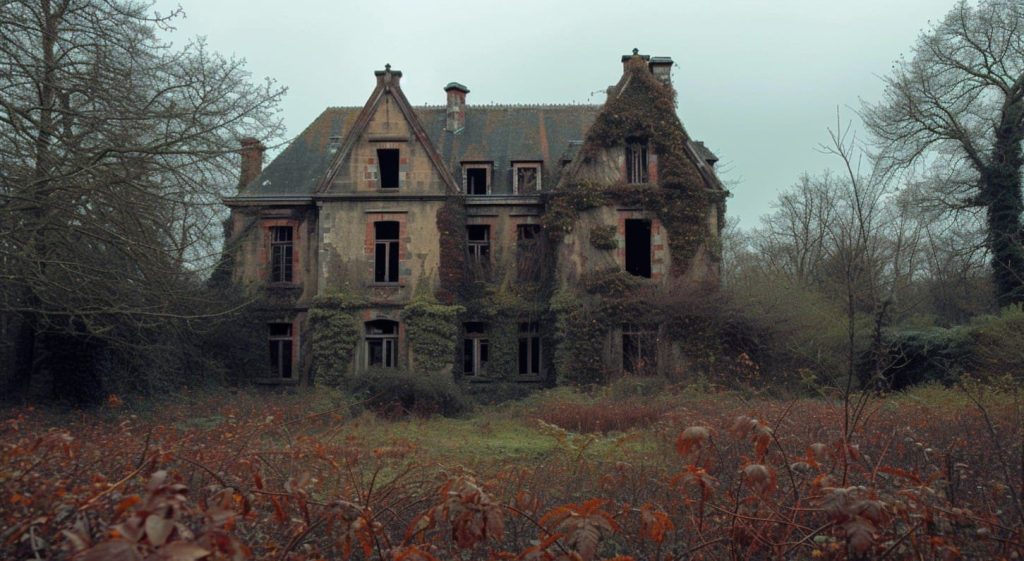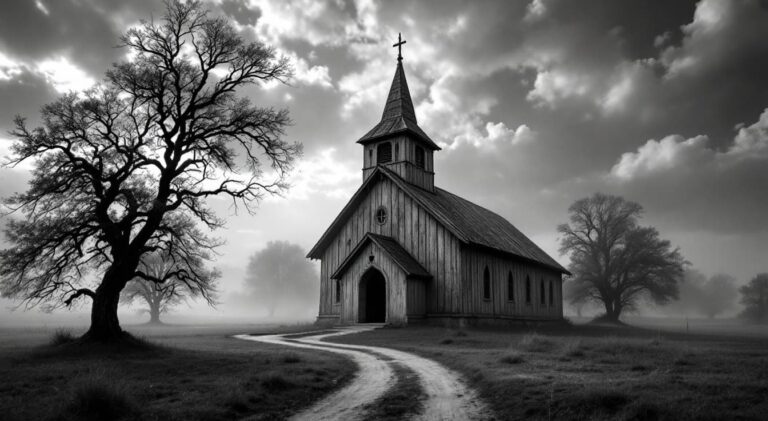

In The Tall Grass Ending Explained: Let’s think about the last few minutes for a second. A little boy you’ve watched get dragged around a field for the whole movie is suddenly inside an old church, looking out a window at the road. A car pulls up. Two people climb out. Then the silence breaks, and a child’s desperate shouts start ringing out from the field opposite the church. It’s his own voice. He’s listening to himself.
If you said “hold on, what?” ……don’t worry, you are definitely not the only one. A few seconds later he’s outside, begging two strangers not to walk into the grass, and pressing a necklace covered in blood into a woman’s hand.
She believes him. They drive off. And somewhere behind them, a man you’ve spent the last hour rooting for lies down in the grass and the grass closes over him.
So what just happened? How did that boy get back to the church? Why does one necklace do what no amount of screaming could? Why didn’t Travis leave with him? And did the field actually let anyone go, or did it just look away for a minute?
We’re going to take this in the order of the questions you probably have, not the order the scenes show up in. The movie’s order is exactly what makes it so slippery, so we’ll rebuild it piece by piece.
Heads Up: We are jumping straight into the deep end of the plot twists now. If you hate spoilers, close your eyes and turn back. (Or, you know, go watch the movie and come right back)!
Who’s Who?
- Becky DeMuth (Laysla De Oliveira): Pregnant, headed to San Diego to hand her baby to an adoptive family.
- Cal DeMuth (Avery Whitted): Becky’s brother, driving her across the country, and very protective of her.
- Travis McKean (Harrison Gilbertson): The father of Becky’s baby, who walked away from her and then changed his mind.
- Tobin Humboldt (Will Buie Jr.): A young boy whose cries for help pull everyone in.
- Ross Humboldt (Patrick Wilson): Tobin’s father, who finds the rock and comes out of it very wrong.
- Natalie Humboldt (Rachel Wilson): Tobin’s mother, who figures out something is badly off with her husband.
- Freddy: The family dog, who matters more to the plot than you’d expect.
How do Becky and Cal end up in the field in the first place?
It starts as an ordinary road trip. Becky and Cal are driving across the country to San Diego, where Becky plans to give her baby to a family who wants to adopt. She’s very pregnant, she feels sick, and they pull over beside an old church so she can throw up. That’s it. That’s the whole reason they’re anywhere near this place.
Then they hear a boy yelling for help from the grass across the road. Look at the parking lot behind them, too. There are other cars sitting there covered in dust, like nobody has touched them in a long time. It’s an easy thing to miss on the first watch, and an easy thing to regret missing.
They go in after him, because what else do you do? Within minutes the field starts breaking the rules. They can shout and hear each other, but the more they walk toward the sound, the further apart they seem to get.
They try to retrace their steps and can’t find the road. Space inside the grass simply doesn’t hold still, and the only thing the movie lets us hold onto early on is that the boy’s voice never gets any closer.
Wait, how does everybody end up in the field because of everybody else?
This is the knot that everything else hangs on, so let’s untie it carefully.
Becky and Cal walk in because they hear Tobin calling for help. Tobin is calling for help because he’s lost in the field with his parents. His parents and his dog went into the field because they heard a man shouting Tobin’s name from inside the grass. That man is Travis. And Travis is in the grass because Becky and Cal vanished, and he went looking for them.
Read that again and you’ll see there’s no first lap. Every group enters because of the cry of another group. If you tried to point at the moment the whole thing began, you couldn’t, because each cause turns out to be somebody else’s result.
That’s the loop, and it’s why the movie jumps around so much. It isn’t being sloppy with the timeline. The grass has stitched the timeline together out of order and handed it to us in pieces.
Here’s a way to make it feel less abstract. Ever lost a friend in a crowded place and ended up shouting their name, then heard somebody shout back and walked straight toward it without thinking?
You don’t stop to ask whether the voice is really them. You just go, because stopping feels worse than being wrong. That’s the trap here. Every person in this movie does exactly that, and the field is counting on it.
If you pay close enough attention, you can spot the cracks in the timeline.. Travis shows up at the church and finds a book Becky dropped, which we never see her drop, and walks into the field. He meets Tobin, who leads him to Becky’s body, badly decayed, as though she’d been out there far longer than a day.
Then Tobin disappears, and Travis starts yelling for him, and that’s the voice the Humboldts hear when they pull up.
Later, Becky and Cal are just arriving, just hearing Tobin’s first cries, and Travis is somehow already there. When they all finally meet, Travis tells them they’ve been missing for two months. To them it’s been a single afternoon.
Even Tobin doesn’t line up. When Travis meets him a second time, the boy doesn’t seem to know him. Of course he doesn’t. For this version of Tobin, they’ve never met.
One more rule helps you keep your footing. The field doesn’t move dead things. Tobin says it about a dead crow and he says it about his dead dog, and it turns out to be useful.
A body that stays put gives you a fixed spot to head toward. That’s how Travis, Becky, Cal and Tobin manage to find each other at all, by calling out and walking toward the one thing in the field that won’t shift.
Who is the woman on the phone, and what mistake is she talking about?
Partway through, Becky’s phone rings, and a voice on the line is warning them not to make “the same mistake” again. It’s garbled and distressed, and it’s easy to forget about once the story picks up speed.
It comes back around. Late in the film, Becky ends up alone at the rock, finds her phone in the mud, and calls her past self, begging her to stop Cal from hurting Travis. That lines up with the warning we heard earlier.
Everything points to Becky herself being the voice on the line, calling backward through the loop to the version of her who hasn’t understood what’s happening yet.
Notice what she asks for, too. She doesn’t say “get out.” She says to stop Cal from hurting Travis. By that point she’s learned the loop isn’t just the field being cruel. It’s partly made of what the people inside do to each other, and one of the worst moments in it happens on a rooftop.
Why does Cal let go of Travis on the roof?
After watching Ross crush Natalie and break Travis’s arm, the remaining characters make a run for it and take cover in a ruined building. Believe it or not, they are guided by Freddy, proving the dog is alive and well during this specific sequence of events. Everyone is exhausted and scared, and that’s when things get ugly between them.
It comes out that Travis had asked Becky to end the pregnancy, that she’d refused, and that he’d left. Now he says he regrets it and wants to be part of the baby’s life and hers.
He also blames Cal for how tightly he held on to his sister, and he says it in a harsh way, accusing him of having feelings about Becky that a brother shouldn’t have. The movie lets that accusation hang in the air without ever settling it.
A little later, up on the roof, Travis finds that Freddy has gotten out through a hole that leads back to the road. Then he slips, and Cal lets him fall. He could have held on. He doesn’t.
Nothing in the scene says the grass made him do it. This reads as a human choice, built out of jealousy and a feeling that Travis is about to take Becky away. Becky sees right through it.
When Cal catches up to her, she can tell something happened to Travis and suspects Cal, and she runs from her own brother into the field. It matters, because the field is already cruel enough on its own, and here Cal is adding to it.
What’s the rock, and what happened to Ross?
That massive stone is resting in an open circle right at the dead center of the field. Tobin tells Cal early on that the rock told him Becky would die soon, and he invites Cal to touch it. Cal doesn’t, because he hears Becky scream and runs. Ross is a different story. Somewhere in his hours of wandering, he finds the rock and becomes transfixed by it.
When we meet him again, he’s changed. He leads Becky, Cal, Travis and Tobin straight to it and says touching it is the way out. He also says it will let him “know everything the grass knows.” Natalie shows up and tells everyone not to touch it and to get away from her husband, and he doesn’t take that well.
He breaks Travis’s arm and crushes Natalie’s head in front of their son, telling Tobin that it’s only flesh and all flesh is grass. He doesn’t even seem to want to leave the field anymore. The way out isn’t the point for him.
Notice who sees it first, too. While Becky and Cal are still trying to figure him out, Natalie immediately senses that something is deeply twisted with her husband. She’s the only one who’s already watched what Ross turns into, so she shouts at everyone to stay away from the rock and from him.
Nobody has a reason to trust her yet, and that’s what makes the next moment so hard to watch. Why would you listen to a stranger over the confident man who just promised you a way out?
From there Ross keeps coming. He kills Cal. He chases Becky. In the later loop, he’s even wearing Cal’s face when he finds her. Tobin sums up the horror of it later when he tells Travis that Ross has killed all of them, over and over, and will keep doing it.
The rock is more than a landmark, too. When Becky is carried to it, the marks on its surface relate to her pregnancy, as if it knows what’s coming. And when she goes into labor, the ground around it opens up to show roots and people reaching up out of the earth. Whatever that thing is, it’s been collecting for a very long time.
How you read Ross comes down to a simple idea. The rock gives you knowledge, and it gives you what you were already carrying. Ross walked up to it looking for answers and certainty, and what came back was a man who thinks the field’s cruelty is a plan.
The film doesn’t spell that out, so take that as a reading and not a rule. But it explains why he’s so sure of himself while everyone around him is falling apart.
What’s going on with the baby and “Grass”? Just grass.”?
This is the hardest part of the movie to sit through, so let’s be careful with it.
Ross kills Cal. Becky stabs Ross in the eye and gets away, running through a storm until strange figures with grass for faces close in around her and carry her to the rock. She goes into labor there, the ground opens, and she passes out.
Pay attention to what the movie doesn’t show you. It doesn’t walk us through everything that happened to the baby. It gives us the worst of it through Becky’s horror and through Tobin, who tells Travis that Ross killed the baby and Cal both. That’s enough.
We understand that in this stretch of the loop, the baby doesn’t make it, and that the field has found the single most painful thing it could take from her.
That matters later. When Becky eventually decides to keep her baby, she’s making the opposite choice from the one the field forced on her. The grass took the child away in the worst possible way, and the ending gives her a version of events where she keeps it.
Why does Travis touch the rock, and why doesn’t he turn into Ross?
By the time Travis reaches the rock, he’s in terrible shape. Ross has wounded him badly, stabbing him with a broken bone pulled out of the mud. Becky, nearly dead herself, fights back and takes Ross’s remaining eye with her necklace before she dies. Travis finishes the job, wrapping grass around Ross’s neck and strangling him.
Ross is gone, but nothing has been solved. Travis is dying, Becky is dead, and Tobin is standing in the same field, and Tobin has already told him this will happen again and again. So Travis does the one thing no one has done on purpose. He touches the rock.
He has visions, and then he understands. He takes Tobin’s hand and leads him straight to an exit, which no one has managed all movie. He tells Tobin he isn’t leaving, that Tobin doesn’t belong here, and that Becky doesn’t either. And he tells him to stop her and Cal from ever going in.
So why doesn’t the rock turn him into another Ross? The movie never says, but the two men are touching it for very different reasons. Ross walked up to it wanting to know more, wanting the way out, and then wanting nothing but the rock. Travis touches it with nothing left to gain for himself. He’s already dying. He knows he can’t leave.
What he wants, for the first time, is for someone else to get out, which is a big change from the man who asked Becky to end the pregnancy and walked away. Read that way, the rock hands him the same knowledge it handed Ross, and the difference is what each man does with it.
It also costs him. Travis’s choice isn’t a clever workaround. He understands the loop well enough to see that the only way to break it is to start it over differently, and the person who understands it can’t be the one who walks away.
How does Tobin end up back at the church, and why does the necklace work?
Travis sends Tobin to the church, and Tobin comes out the other side not in the present but earlier, just before Becky and Cal enter the field. He sees the car, he hears his own voice calling from the grass, and he understands what he’s there to do.
He does the obvious thing first. He tells them not to go in. But a lost kid yelling at two strangers by the road isn’t going to be enough, and the film knows it. This is where the necklace comes in.
Tobin has a second copy of Becky’s necklace, bloody, taken from a version of her who didn’t make it, and Travis is the one who gave it to him. It’s a twin of her own necklace in the hands of a boy she’s never met.
Why the church, though? The church sits just outside the grass, right at the spot where everything started, and it’s the one place where a warning can still land before the first step into the field.
Send Tobin anywhere deeper and he’s just another lost kid in the grass. Send him to the edge, at the right moment, and he’s the one person who can tell Becky and Cal what’s coming.
That’s why it works. Words can be dismissed. A child’s story about a field can be dismissed. But an object that belongs to you, covered in blood, handed over by a kid with no reason to have it, can’t be. It’s the one piece of proof that can’t be explained away, and Becky isn’t stupid. She sees it for what it is.
Look at what she does next. She stops Cal from going in. She decides they should take Tobin to the police in the last town they passed. And she changes her mind about San Diego, deciding she wants to keep her baby after all. The loop breaks, and the human choice inside it is that she keeps her baby.
The cleverest thing about the ending is how it answers the loop’s own logic. Everybody entered the field by following a voice. Tobin finally gives the voice an answer. Instead of someone walking toward the cry, somebody is standing outside saying don’t.
So did the time loop actually End?
For Becky, Cal and Tobin, yes. They never go into the field. They drive away, and the cries from the grass keep coming but nobody answers them.
For Travis, no. He hears them leave, and then he dies in the field, and the grass closes over him. There’s a question here that the movie never answers, which is what happens to Travis who’s still out in the world. Travis only goes into the field because Becky and Cal vanish, and now they don’t. It’s tempting to say there’s Travis at home. That’s a guess, though. All we’re shown is the one who stays.
For Ross and Natalie, the film says nothing. Tobin ends up outside with a necklace and his memories. We never learn what happens to his parents. They entered the field because of Travis’s voice, which now won’t happen, but the movie doesn’t walk us through how that adds up, and it’s smart enough not to try.
And what about the field itself? Nothing in the ending says it’s been destroyed, weakened or satisfied. Travis broke one cycle. He didn’t break the thing that makes cycles. If another car pulls over by that church, the grass is still there, and so is the rock.
Does the Book End like the Movie?
No, and the differences are big. In the original novella, there’s no loop-breaking escape. Cal touches the rock and ends up tricking Becky into eating her own miscarried child. When she realizes it, she’s told that if she touches the rock she’ll see the baby is fine and she’ll understand the grass. She does, and she gives in.
The story then jumps ahead to a group of travelers who stop at the church, hear a woman and a boy calling for help, and all walk into the grass.
In The Tall Grass keeps the horror but changes the shape of it. It adds Travis, gives the loop a way to be interrupted, and lets Becky walk away with a choice instead of being absorbed. It’s a bleak ending, but a kinder one than the original.
Wrap Up!
So here’s the short version of what the ending is really asking: can one person change a cycle that has already swallowed everyone around him? The field wants Becky to stay lost, wants Cal’s jealousy to win, and wants Ross’s certainty to spread from person to person.
Travis is the one who interrupts all of it, and he does it the hardest way possible, by staying in the one place he can never leave so that someone else can walk away.
The necklace is only the proof. The sacrifice is what actually makes the whole thing work, and it’s worth noticing that it comes from the same man who walked out on Becky at the start.
It’s also a quieter story about second chances than the horror around it lets on. Travis spends the movie trying to fix a mistake he made, and he only gets there once he stops trying to save himself. Becky gets to choose her baby instead of having the choice taken from her.
Tobin gets out of a field that kept him for what felt like forever. And the grass is still out there waiting, which is the part that stays with you long after the movie ends. Isn’t that the unsettling thing, that the happy ending only works because nobody ever finds out what they were spared?
If you’re interested, you can check out our It Ends ending explained here!
TL;DR: Quick Recap!
- The field and the rock at its center bend time as well as space, so three groups of people walk in because of each other’s voices, in a circle with no clear first lap.
- Ross touches the rock to get answers and turns into a killer who keeps hunting everyone through the loop.
- Travis touches the rock too, but he spends what he learns on getting Tobin out, not on himself.
- Tobin lands back at the church just before Becky and Cal go in, and the bloody twin of Becky’s necklace is the proof that makes her listen.
- Becky and Cal never enter the field, and Becky decides to keep her baby instead of giving it up for adoption.
- Travis can’t leave, so he stays in the field and dies there.
- The film never tells us whether the field is finished with anybody else.
FAQs: Most Googled!
Does Travis die at the End of In the Tall Grass?
Yes, he dies from his wound in the field after Becky, Cal and Tobin drive away, and the grass closes over him.
Do Becky and Cal escape the field?
They never go into the field at all, because Tobin stops them before they enter.
Who is on the phone call Becky receives?
Everything points to Becky herself, calling her past self from later in the loop.
Is the time loop over at the End?
It’s over for Becky, Cal and Tobin, but the film never says whether it’s over for the field, Ross or Natalie.
About the Author.
Hi, I’m Vansh, the founder of Vibe On Cue. I track the absolute best ways to experience cinema, from the biggest Hollywood Blockbusters and upcoming release dates to the finest details of PVOD & Streaming and pristine Blu-ray & 4K physical media. And when the credits roll, I break down the narrative with deep-dive Ending explained guides. If you live for the full life cycle of film, stick around and explore the site!