
Skinamarink Ending Explained: Did you actually say “huh?” out loud when that “572 days” card popped up? I’m guessing you did. One second Kevin’s walking across a ceiling in a house that forgot how doors work, and the next there’s a random number on the screen, a few busted family photos flicker past, and a blurry face tells a four-year-old to go to sleep. Then it just ends. No explanation, nothing.
But here’s the part that changed how I see the whole thing: this movie isn’t sitting on a secret answer you somehow missed. Almost every odd thing in it was a deliberate call, and Kyle Edward Ball has talked about a lot of those calls in interviews. How he lit it, what he told the child actors, which old films he borrowed from. Most explainers skip all of that, and it honestly makes the ending click.
So grab a seat and let’s go through it one question at a time. I’ll tell you what’s actually on screen, what Ball has said himself, and where it’s just us guessing.
Fair warning, we’re spoiling everything, and a little kid gets hurt in this one. Haven’t watched it yet? Go do that first, then come back!
TL;DR: What’s The Short Version?
- The ending isn’t random, but it’s barely explained, and that’s the whole design.
- ”572 days” never says what it’s counting, and the timeline is scrambled on purpose: a 1995 story, a 1970s look, and 1930s cartoons.
- Ball’s own one-line pitch for the voice, given to the kid actors, was that it’s a monster, which is about as official as you’ll get.
- You never see faces in this movie, so the smudged family photos at the end are a gut punch.
- The toy-filled hallway was borrowed from the last shot of Solaris, where a familiar house turns out to be a memory.
- Kevin isn’t okay in any normal way, and limbo or a trapped nightmare fits best.
- ”Go to sleep” means the night doesn’t end.
Who Are We Even Dealing With Here?
You barely see anybody’s face in this thing, so here’s a quick rundown.
Kevin (Lucas Paul): The little guy, four years old, and the one the movie follows right to the last frame.
Kaylee (Dali Rose Tetreault): His big sister, six, who keeps him calm, makes the decisions, and flat-out refuses to talk about Mom.
Dad (Ross Paul): Barely around before he’s gone, and fun fact, he’s played by Lucas’s real-life father.
Mom (Jaime Hill): Already missing before the story starts.
The voice: No name and no face, and Kevin finally asks it to introduce itself in the closing seconds.
Quick note: don’t go hunting for faces to match those names, because the film hides them on purpose, and we’ll get to why.
Okay, What’s Going On In This House To Begin With?
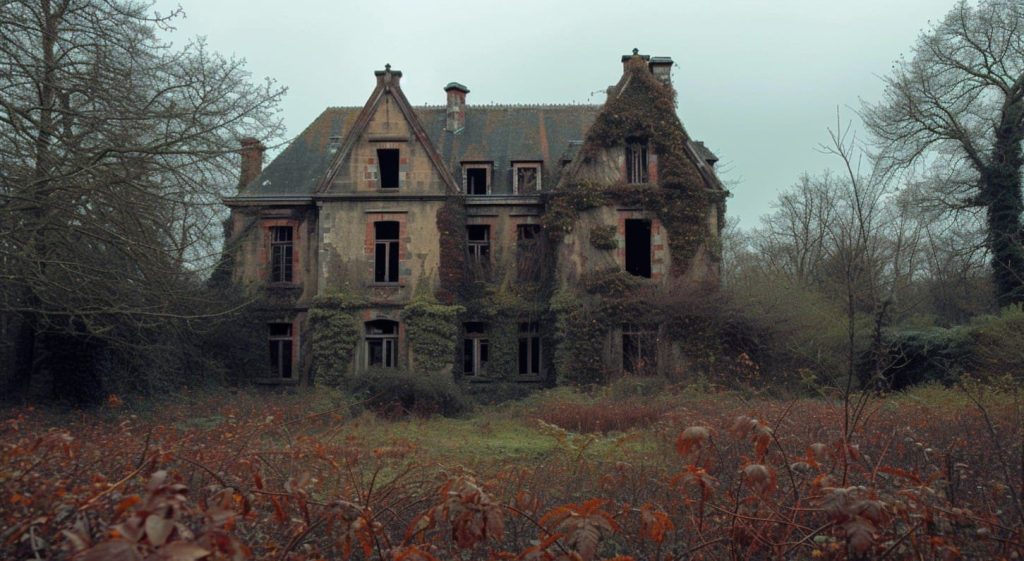
Let’s set the scene. It’s 1995, a perfectly average night. Kevin takes a spill down the stairs, Kaylee insists he was sleepwalking, and honestly that’s all the backstory you get. Next thing you know the kids wake up in the dark, Dad’s nowhere to be found, and the windows and doors are quietly turning into plain walls, like the house is sealing itself shut.
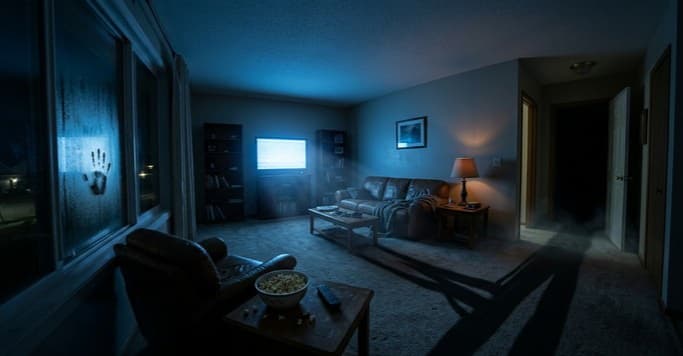
What gets me is how the kids deal with it. No screaming, no sprinting around. They haul blankets and pillows in front of the TV and kinda wait for a grown-up to sort it out, because that’s what a four-year-old and a six-year-old would actually do. If you ever camped out on the living room floor after something spooked you at night, you know that instinct.
And it feels like a real place for a reason. It’s Ball’s childhood home, lit mostly by the TV, a lamp, and a flashlight, and he’s said it looks nothing like the movie in daylight. That’s kinda the whole trick: your own house is two different places at noon and at 3 a.m., and this movie just cranks the 3 a.m. version as high as it’ll go.
So What Is That Voice, Exactly?
Alright, the big one. This surprised me: Ball gave the child actors a simple version of the story. As he explained during his Film Inquiry interview, the director gave the kids a very basic setup, they were playing a brother and sister dealing with a monster who makes the house’s escape routes completely disappear. So when you ask what the voice is, the filmmaker’s own short answer is a monster.
That’s pretty much where the official answers end. Ball told Fangoria he has firm ideas about some of what the monster is up to and why, but he prefers to keep his own theories under wraps, and when asked about that creeping under-the-bed sequence, he flat-out confessed that he doesn’t know the answer either.
He’s described that scene as his Room 237 moment, the kind that gets you obsessing over what’s inside without ever opening the door. And there’s one shot with an actual person standing in the dark, which he refuses to point out. So no, you weren’t imagining things when you scanned the black corners of the screen.
If you just watch what the voice does, the pattern’s pretty clear. It never shows itself. It copies Dad’s voice, later sends a “Mom,” says it wants to play, and rearranges the house whenever it feels like it. And the payoff for doing what it says? More time, that’s all. The only thing that ever piles up is punishment.
So to me it plays like a super strict grown-up with zero warmth, one who never has to explain a rule. One caution: Heck, his earlier short was a test run he expected the feature to differ from, so don’t use it as a cheat sheet.
How Come We Never See Anybody’s Face?
Quick question: did you notice you never actually see anyone’s face? That’s by design. Ball says the script had that rule from day one, and the reasons are refreshingly practical. It saved shooting time, it made working with kid actors way easier, and it meant he could swap lines later without worrying about lips matching.
So most of the dialogue got recorded afterward, with the kids hanging out in a living room, and he coached them through takes, even asking for one a touch quieter. That hushed, whispery feel you hear the whole time? Directed.
Subtitles grew out of the same planning. They were written into the script early on, as a nod to analog horror and as insurance, since little kids don’t always speak clearly. Ball even aged the text so it’d look worn out.
Now here’s why I care. You spend an hour and forty minutes with people who are basically faceless: feet, the backs of heads, a shape in a doorway. Kevin and Kaylee feel like any kids in any house, and the whole family feels half remembered, like a dream you can’t quite picture. Hang onto that, because it pays off in the last few minutes.
Why Does Kevin Just Go Along With Everything?
Honestly? Because he’s four. Little kids haven’t learned yet that a calm adult voice can be wrong. And notice how the voice builds it up: come here, go there, let’s play. Tiny stuff. By the time it asks him to hurt himself, he’s been saying yes all night. The movie mostly keeps that moment off screen and lets the sound carry it, which somehow makes it harder to sit through.
Then there’s the 911 call, which is the meanest beat in the movie. For a few seconds, someone outside the house picks up, tells Kevin to stay on the line, and says help is coming. You actually think he’s getting out.
Then the phone in his hand is a toy. The director has pointed out that his goal with that scene was to make the audience genuinely sad, rather than just hitting them with another scare. And look at the timing: something that can do anything doesn’t have to cut the line. It let him taste hope first.
Look at how the two kids end up. Kaylee pushes back and gets wiped out. Kevin goes along and gets to stay. Stay for what, though? Doing what he was told didn’t rescue him, it only kept him in the house.
If you’ve ever been a kid who did exactly what an adult told you out of pure fear, you know this isn’t about being weak. It’s about having no other plan. Kevin’s only tool is the one every four-year-old has, which is being good, and the voice is the one thing in the house that knows it.
So What’s The Deal With “572 Days”?
Okay, so what is that card counting? Here’s the thing most people skip: it never says. 572 days since what? Since the doors vanished? Since the voice showed up? Since Kevin’s fall? Even interviewers read it differently, and one took it to mean since the doors and windows first disappeared. Ball never settled it.
What he did explain is how the movie handles time overall, and it’s all over the place on purpose. He wanted something that looked and felt like the 1970s but took place in 1995, so he just did both. Then the TV runs cartoons from the 1930s.
That’s three decades fighting over one house before any number shows up. Honestly, I treat that number as a heavy atmosphere rather than an actual ticking clock. A real four-year-old with no doors, no bathroom, no parents, and an untreated wound wouldn’t make it a week, so the number’s basically telling you normal rules are off.
Here are the usual takes. It could be literal time stuck in the house, though that leaves the survival unexplained. It could be a coma that started with the stairs fall, but no hospital ever appears.
It could stand in for how long the kids have lived in a scary home, which is a lens you bring, not something shown. Or it could just mean this place has no real clock, and that’s the one that explains the most. Either way, a number that exact, sitting over a hallway of toys, feels like somebody’s been keeping score.
What’s Going On With The Photos, The Blood, And That Face?
Let’s talk about the last stretch, because those images are doing real work. Kevin ends up walking on the ceiling, a bedroom becomes a void, and Kaylee sits on a bed and slowly fades away. Then old family photos start flickering past with the faces smeared or missing, blood splatters on the floor, disappears, splatters again, and Kevin cries for his mom.
Remember the no-faces thing? This is where it pays off. A movie that never shows a face finally points at who this family was, in photographs, and wipes it out right in front of you. And the blood loop is the movie saying that awful moment doesn’t end, it just keeps repeating.
Then Kevin asks to watch something happy, a white door shows up in the dark, and instead a faint face leans over his bed. The door is bait. Notice how small his wish is, too: he isn’t begging to go home, he wants something cheerful with a sister who’s no longer there.
Ball told Inverse that a late scare near the end went through nineteen versions and wasn’t in the original script, with earlier ideas including a giant eye borrowed from the Twilight Zone movie. So that ending was being reworked right up to the wire.
Why Is There A Hallway Full Of Toys That Never Ends?
That toy-filled hallway is the shot that makes you wonder what this place even is, and Ball says it came out nearly identical to the script. He told Inverse it’s borrowed from the final shot of Solaris, where a man sees his old house and his father, and then the camera pulls back to show it’s a memory held by the planet.
So think about that. If the shot’s lifted from a movie where a familiar house turns out to be a memory, then the house here may be less a real place and more a remembered one, built out of Ball’s own childhood home and toys his mom had saved. That’s me reading between the lines, but it backs up every theory where Kevin isn’t in the real world anymore.
And memories are creepier than they sound, since they get edited over time. Photos lose their faces, rooms lose their doors, people get blurrier each replay. The doors the kids can’t find were, funnily enough, erased digitally in post.
It also explains why the ending doesn’t feel like it’s going anywhere. A normal scary movie wants to get the hero out of the house. This one keeps pulling the camera back and showing you more house.
Do The Cartoons On The TV Actually Mean Anything?
It’s tempting to treat every cartoon as a hidden warning, but Ball’s own account is a lot more down to earth. He told Filmmaker Magazine they came from a bargain-bin VHS of public-domain shorts he watched constantly as a kid, and the ones he remembered all ended up in the movie. One is an odd Cinderella-style short made by General Motors.
Another is Max Fleischer’s Somewhere in Dreamland, which he leaned on because it’s about a boy and a girl who dream. He’d probably have picked The Lion King if he could, since that’s what most kids were watching in 1995, but public-domain rules got in the way, and he’s said he came to like how sweet and creepy those old shorts are at the same time.
I’d call the cartoons memory first and commentary second. Fans did notice echoes, which are fun as long as we call them readings: a spider running a trap hotel in The Cobweb Hotel sounds an awful lot like a house that won’t let its guests leave, and a rabbit who keeps vanishing in Prest-O Change-O sounds like a house that keeps deleting things. Neat coincidences, even if they weren’t the plan.
Okay, But Is Kevin Dead Or Not?
The movie won’t say. What it shows is a kid surviving stuff that should’ve ended him, in a house that resets itself, with blood that shows up, vanishes, and shows up again. That doesn’t read like a normal death, it reads like being stuck.
So I lean toward limbo or a trapped nightmare, which fits the scrambled clock, the memory-house idea, and the loop. And “limbo” can mean two things: an actual afterlife where he’s already died, or a nightmare he’s stuck in while still alive. Nothing on screen separates them.
The coma theory rests on the stairs tumble, which is the only real-world event the film sets up. Trouble is, there’s no hospital and no beeping machine anywhere, so most of that theory is you filling in blanks. The abuse reading starts from the same tumble and asks whether it was really an accident, with the voice standing in for someone in the house.
The film never confirms that, so think of it as one lens, not an answer. And the grief reading is the gentlest of the bunch: the entity is what loss feels like when you’re very small.
The ball isn’t picking a winner. Asked what it all means, he told Inverse it stopped mattering what he thinks, and “Now it’s your movie.” That’s basically a green light to hold whichever theory you like. They don’t have to fight each other either: a coma can contain a nightmare, and a nightmare can be about grief.
Where Did Mom And Dad Go?
Dad vanishes somewhere between the stairs tumble and the kids waking up, and we never watch him leave. Mom was gone even before the story begins, and when Kevin guesses Dad “went with mom,” Kaylee cuts him off fast.
Whatever happened is old and sore. If you ever lived in a house with one subject nobody touched, you know that silence, because kids absorb the shape of what isn’t said long before anyone explains it.
Here’s what I think explains the most. Ball built the film from a nightmare that kept turning up in the stories people sent him, and he described it to Filmmaker Magazine as a kid between six and ten, at home, where “my parents are dead or missing or incapacitated.” Notice that the list never settles on one. So the parents’ absence isn’t a puzzle waiting for a solution, it’s where the dream starts.
Ball told Jezebel he’s worked out backstories for them and isn’t sharing. Then there’s the “Mom” on the upstairs bed, the warmest moment in the whole movie, and that’s exactly why it’s a trap. When Kevin finally cries out for his mom, nobody answers, and that’s what you’re meant to carry out of the theater: no one is coming.
Why Does It Finish With A Face Saying Go To Sleep?
Sleep is the one thing a scared kid can’t bargain with. It keeps showing up: the kids wake up in the dark, drift off in front of the TV, “Mom” tells Kaylee to shut her eyes, and the voice orders Kevin to sleep before it asks him for anything else. At home, a parent says go to sleep to shoo the monsters away. Here the order comes from the monster, so the lullaby flips into a threat.
It also says nothing resets. You can’t get out of a bad dream by trying harder, because waking up is something that happens to you, and that’s the thing the voice takes from Kevin. Then he asks the face its name, twice, which is so little-kid of him. He doesn’t scream or bolt, he just wants to know who’s standing there. No answer comes, the film cuts out, and it kinda feels like it was talking to you the whole time.
There’s another reason it works: it’s the last thing the movie can do to Kevin that doesn’t need a monster at all. No knife, no trick, no toy phone. Just a quiet instruction from someone he can’t see, and a kid who’s too tired to argue.
Wrap Up: So What Do You Take Away From All This?
With the hard facts, mostly. The kids can’t leave, the voice makes the rules, Kaylee’s gone, and 572 days have passed with Kevin still inside. The why never shows up, and no rewatch will shake it loose. Honestly that’s the point, because a nightmare with a clear explanation turns into a story, and stories don’t keep you up at 3 a.m.
What you’re left with is a feeling most of us know: little, awake way past bedtime, listening to the house creak, totally sure something’s out there and nobody’s coming to check.
Skinamarink just refuses to let morning come. If it’s still got you a little rattled, the movie did exactly what it was built to do, and you get to hang onto whichever theory creeps you out the most.
And if you want one takeaway, make it this: don’t go into Skinamarink looking for what happened, go in looking for what it feels like. The film is much better at that than it is at telling you facts.
If you’re interested, you can check out our No One Will Save You ending explained here!
FAQ: Most Googled Ones!
What does “572 days” mean in Skinamarink?
The card is a time jump that never says what it’s counting, which tells you time works differently inside that house.
Is Kevin dead at the End of Skinamarink?
Nobody confirms it, but Kevin surviving what he does, plus the looping images, points to him being stuck somewhere outside normal life.
Who is the Voice in Skinamarink?
According to Ball, he told the child actors it was a monster, but the film itself never explains what it is.
What happens to Kaylee in Skinamarink?
She loses her eyes and mouth after demanding her parents, then fades away, and Kevin is left alone.
About the Author.
Hi, I’m Vansh, the founder of Vibe On Cue. I track the absolute best ways to experience cinema, from the biggest Hollywood Blockbusters and upcoming release dates to the finest details of PVOD & Streaming and pristine Blu-ray & 4K physical media. And when the credits roll, I break down the narrative with deep-dive Ending explained guides. If you live for the full life cycle of film, stick around and explore the site!