
Primate Ending Explained: Hmmm so here’s the thing about Primate that nobody tells you going in: you think you’re signing up for “killer monkey movie,” and you sort of are, but then somewhere around the one-hour mark you realize you’re actually watching a movie about a family that’s been quietly falling apart since a funeral nobody ever talks about. And then the chimp rips someone’s jaw off. It’s a lot. It’s a genuinely strange needle to thread, and honestly? I think it mostly works, which is why so many people are walking out of this thing needing to talk through what actually happened.
I want to be upfront about something before we get into it: this is one of those horror movies where the “twist” isn’t really a twist so much as a gut-punch you don’t see coming until it’s already landed. There’s no secret cult, no dream sequence, no “it was Ben’s ghost the whole time.” It’s simpler and, weirdly, sadder than that.
A family loses its center, stops talking to each other, and by the time they remember how to be a family again, the damage is already catastrophic. So let’s actually walk through what happens, why Ben goes full rage-monster, who makes it out, and what that final soundboard moment is doing to your chest.
There’s also just something viscerally effective about the “animal you trusted turns on you” premise that hits differently than your average masked-killer slasher. It taps into a very specific, very old kind of fear, the same one that made Cujo work back in the day, or that makes people quietly nervous around any big dog they don’t know well. You spend the first act of this movie genuinely liking Ben.
He’s playful, he’s expressive, he clearly loves this family. And then the movie spends the rest of its runtime slowly, methodically taking that goodwill away from you, one kill at a time, until you’re just as terrified of him as the characters are. That’s a harder trick to pull off than it sounds, and it’s a big part of why the ending lands as hard as it does.
Heads Up: We are jumping straight into the deep end of the plot twists now. If you hate spoilers, close your eyes and turn back. (Or, you know, go watch the movie and come right back)!
TL;DR, Quick Key Takeaways
- Ben, the family’s beloved pet chimp, goes on a killing spree after getting rabies from an infected mongoose bite
- Adam (Lucy’s dad) actually gets the positive rabies test result on his phone and ignores it, which is arguably the most brutal detail in the whole movie
- Six people die over the course of one night: Doug the vet, Nick, Kate, Drew, Brad, and Hannah
- Only Lucy, Erin, and Adam make it out alive, and only because they finally stop being a fractured family and start fighting as a team
- Ben dies by getting impaled on a broken chair leg after falling from a balcony during the final fight
- The very last beat of the movie is a cop accidentally triggering Ben’s old communication tablet, which plays back the phrase “Lucy bad” a gut-punch that reframes the whole tragedy
- The movie is basically Cujo with a much smarter, much more heartbreaking dog substitute
Wait, who even is everybody in this movie?
Quick roster, because the cast is bigger than you’d expect for a movie that’s essentially “family vacation gone wrong.”
Lucy (played by Johnny Sequoyah, who you might recognize from Dexter: New Blood) is our lead. She’s been away at college for a while and is coming home to Hawaii for the first time since her mom died. Erin (Gia Hunter) is her younger sister, who’s understandably a little resentful that Lucy bailed on the family for years. Adam (Troy Kotsur, the Oscar-winning CODA actor) is their dad, who’s deaf and communicates through sign language, and who’s been increasingly absent lately chasing a book deal instead of, you know, parenting. Lucy brings her friends Kate (Victoria Wyant) and Nick (Benjamin Cheng) along, and then Kate without asking anyone invites Hannah (Jessica Alexander, of the live-action Little Mermaid) too, which immediately creates that awkward “wait, who is this again” energy that anyone who’s ever had a friend group vacation will recognize instantly.
On the flight over, they also meet two guys, Drew (Charlie Mann) and Brad (Tienne Simon), who are just there for a Hawaii party weekend and have zero idea they’re about to become collateral damage in someone else’s horror movie.
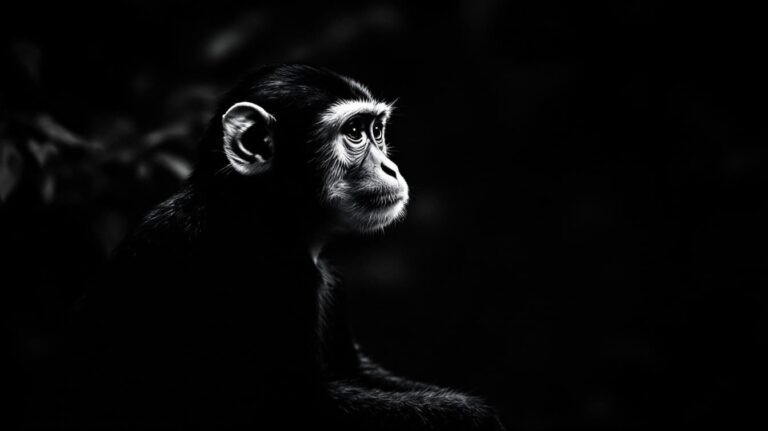
And then there’s Ben, brought to life through a mix of performance work from Miguel Torres Umba and vocal work from Ben Pronsky. Ben isn’t just a pet. Lucy and Erin’s late mother was a linguistics professor, and Ben was essentially her life’s work a chimp she raised and trained to communicate using a custom tablet soundboard, kind of like the talking-button setups you’ve probably seen dog owners use online, except this one’s for an actual primate who can apparently also operate a car key fob (we’ll get there).
Lucy gives Ben a teddy bear early on as a “hey, I still love you” gesture, and it’s genuinely sweet, which is exactly why it’s going to hurt so much later.
That teddy bear, honestly, might be the single most efficient piece of foreshadowing in the whole movie. It shows up again a little later, and by then it’s stained with blood, sitting there as this quiet, wordless signal that something has already gone horribly wrong before anyone in the house has clocked it. It’s such a simple image, but it does more emotional heavy lifting than a lot of the dialogue around it, because it’s the exact object that represented the family’s love for Ben now sitting there as evidence of what that same love is about to cost them.
It’s also worth pausing on how the movie sets up Adam specifically, because his arc matters a lot for how the ending lands. He’s not written as a bad dad in some cartoonish way, he’s written as a guy who’s grieving in the worst possible way, which is by disappearing into work so he doesn’t have to feel anything.
That’s a pretty recognizable pattern if you’ve ever watched someone (or been someone) who copes with loss by staying “productive” instead of actually processing what happened. The movie doesn’t excuse him for it, but it does give you enough context to understand why a smart, caring father would be capable of ignoring a rabies test result at exactly the wrong moment.
Okay so why does Ben snap in the first place?
This part is refreshingly simple, in a “the movie isn’t trying to trick you” kind of way. Ben gets bitten during a scuffle with a rabid mongoose that somehow made its way onto the property. Adam finds the dead mongoose in Ben’s enclosure that same night and realizes something’s wrong, so he arranges to get it tested and asks the local vet, Doug Lambert, to check on Ben before heading off to his book signing. Naturally, Doug never makes it out of that enclosure alive; Ben is already deep into the early stages of the infection, and Doug becomes the first of six people to die before sunrise.
Here’s the detail that genuinely got under my skin, and I think it’s the smartest thing the script does: Adam actually gets the lab results. He gets a text confirming the mongoose tested positive for rabies. And instead of rushing home, he’s wrapped up in a conversation about a potential film adaptation of his book and decides it can wait. It’s not a dramatic, plot-twisty betrayal, it’s the kind of small, mundane distraction that ruins lives in real life all the time.
You’ve probably had a version of this moment yourself, where you see a text buzz in during a meeting or a dinner and think “I’ll deal with that later,” and nine times out of ten it’s fine. This is the one time out of ten where it very much is not fine, and the movie doesn’t let Adam off the hook for it, even after he redeems himself later.
Rabies, biologically speaking, tracks pretty accurately here too; it causes exactly the kind of restlessness, aggression, and hydrophobia (fear of water) that Ben displays. That hydrophobia detail isn’t just flavor text, by the way it’s the entire reason the pool becomes a safe zone for a big chunk of the movie. Ben physically cannot make himself get into the water, which gives the group a fighting chance they wouldn’t otherwise have.
What actually happens once Ben goes full rampage?
The chaos escalates fast once night falls. Kate wakes up and spots Ben wandering the house looking off, and the group’s teddy-bear peace offering turns up stained with blood, a small detail, but an effective one, because it tells you Ben’s already killed something (or someone) before anyone’s even clocked that he’s dangerous.
Not long after, the group tries to restrain Ben using a rope, which goes about as well as you’d expect: it backfires immediately, Erin gets seriously wounded in the scuffle, and everyone scrambles into the pool for safety, since Ben won’t follow them into the water.
This is where the movie shifts into pure survival mode, and honestly, it’s where Primate is at its best. Ben prowls the pool’s edge like he’s waiting them out, which is somehow more unsettling than if he’d just charged in. Nick tries to shove him away from the ledge at one point and gets shoved back instead right off the cliff. It’s brutal and it’s fast, the way most of the deaths in this movie are; nobody gets a long, drawn-out death scene, which actually makes each one land harder because you don’t have time to brace for it.
The next morning, with Ben nowhere in sight, Kate and Lucy sneak inside to grab a phone from the living room. Ben’s been lying in wait the entire time, and he crushes Kate’s skull with a rock the second they’re separated. It’s one of those moments where you’re yelling “don’t split up” at your screen even though you know it’s coming, because that’s just how these movies work and also, let’s be honest, because splitting up when you’re panicking and desperate for a signal on your phone is exactly what real people do too.
Why do Drew and Brad even bother showing up?
This is the part where the “outsiders wander into danger” horror trope gets its most gruesome showcase. Drew and Brad roll up to the house because they heard the commotion, completely oblivious to what’s actually happening inside. Drew gets cornered in Lucy’s bedroom and Ben tears his jaw apart genuinely one of the nastiest kills in the whole film.
Brad, searching for the girls outside, gets killed with a shovel. Neither of them ever really had a chance; they’re proof that in this story, ignorance isn’t bliss, it’s a death sentence.
Then there’s Hannah, whose death is somehow the most quietly devastating of the bunch, because she almost makes it. She sneaks out, grabs a phone and car keys, and makes a break for the driveway except she jumps into the wrong car. She dials 911 and nobody picks up in time.
And here’s the detail that makes this scene genuinely unnerving instead of just tragic: Ben uses the correct key fob to unlock the car she’s hiding in. He’s smart enough, thanks to all that soundboard training, to operate human tech well enough to hunt with it.
It’s a small beat, but it’s the moment the movie fully commits to “this isn’t just a rabid animal anymore, this is something that remembers being taught how the world works, and it’s using that against you.”
Okay, so how does the final fight actually go down?
Adam finally makes it home late, understandably guilt-ridden, and just in time to actually be useful for once. Lucy, Erin, and Adam team up and fight Ben off with a shattered wine bottle, and for one brief moment they think it’s over. They share this quiet, relieved, almost tender family reunion beat, which if you know anything about horror movie pacing, you immediately clock as a trap. Sure enough, Ben isn’t done.
He attacks Lucy again, sending both of them tumbling over a balcony. Adam manages to save Lucy at the last second, and Ben hits the ground below, where he’s fatally impaled on a broken chair leg.
It’s not a triumphant kill. Nobody delivers a badass one-liner. Ben just… falls, and it’s over, and the three of them are left standing in the wreckage of their own home surrounded by the bodies of people who came here for a fun weekend and never made it out. Police and paramedics eventually arrive, tracing the location from Hannah’s unanswered 911 call.
Erin is taken to the hospital, and Lucy and Adam try to comfort each other in the aftermath, both of them clearly changed by the night in ways that aren’t going to heal quickly.
Wait, what does that “Lucy bad” ending actually mean?
Here’s the scene everyone’s talking about. As the police process the scene, an officer picks up Ben’s old communication tablet, the one Lucy’s mom built for him while examining it as evidence, and it accidentally plays back a stored phrase: “Lucy bad.”
It’s such a small moment, and it absolutely wrecks the ending. The movie isn’t suggesting Lucy actually did anything wrong, and it’s not trying to imply she caused any of this. What it’s doing is showing you that Ben, even in whatever fragmented, rabid, barely-there version of his mind was left, still associated Lucy with something negative maybe because she’s the one who brought a house full of strangers into his territory, maybe because his final coherent memories before the infection took over were tied to the chaos her homecoming created. It’s not a logical accusation.
It’s an emotional one, learned language weaponized by an animal whose brain was actively being destroyed by disease. And that’s exactly why it stings the way it does: Lucy gets to survive the single worst night of her life, and her final “goodbye” from the creature she once loved is essentially him blaming her for it. There’s no closure at that moment. There’s just an echo she’s going to be carrying around for a long time.
It’s worth sitting with how differently that plays depending on how you’ve been reading Lucy the whole movie. If you’ve clocked her as someone who left her family behind and is only now trying to make it right, “Lucy bad” almost feels like the universe’s cruelest joke; she comes home to fix things and gets blamed anyway.
If you’ve been reading it more sympathetically, as someone who’s actually the film’s moral center, the one who keeps trying to protect Erin, the one who never gives up on anyone, then it feels less like an indictment and more like proof that trauma doesn’t care about fairness. Either read works, honestly, and I don’t think the movie’s trying to pick one for you.
So is the movie actually “about” the killer chimp, or is that just marketing?
I’d argue it’s about as much about grief as it is about a rabid animal, which is a weirder sentence to write than I expected going into this. The Pinboroughs are a family that’s been quietly disintegrating since their mom’s death Lucy ran off to college and stayed gone longer than she needed to, Erin’s stuck at home nursing resentment she’s never actually voiced out loud, and Adam’s been throwing himself into work as a way of not dealing with any of it.
Ben, in a weird way, is the last living piece of their mother that’s still around; he’s literally something she built, taught, and left behind. So when Ben turns on the family, it’s not just “the pet went crazy” it’s the last remaining connection to their mom actively falling apart and turning violent in front of them.
That’s also why the “who lives, who dies” pattern in this movie isn’t random, even though it might feel that way in the moment. Every character who dies, dies alone or in a pair, cut off from the group. Kate splits off with Lucy but gets caught the second Lucy’s attention shifts elsewhere. Drew and Brad wander in with zero backup. Hannah’s death happens specifically because she runs off on her own instead of sticking with anyone.
Meanwhile, the three who survive only make it because they eventually stop operating as separate, disconnected people and actually fight side by side. It’s not subtle, but it’s effective and if you’ve ever gone through a rough family stretch where everyone’s technically under one roof but nobody’s actually talking to each other, there’s something uncomfortably relatable buried under all the gore here.
There’s also a quieter thread running through the film about how badly we want to believe we can domesticate the things that scare us whether that’s a wild animal, or grief, or a fractured relationship with your own dad. Ben was never actually “safe,” not really; he was a wild animal that a grieving family collectively decided to treat like a person because it was easier than sitting with the person they’d actually lost.
The rabies infection is the mechanism, sure, but the movie’s underlying anxiety is bigger than that: sometimes the things we love the most are also the things we understand the least, and pretending otherwise doesn’t make it less true. It’s the kind of idea that could’ve felt heavy-handed in a lesser script, but Primate mostly lets it sit under the surface instead of hammering you over the head with it every five minutes, which I genuinely appreciated.
Was there any way this could’ve been prevented?
This is the question I keep coming back to, honestly, more than “could Ben have been stopped,” because the movie seems way more interested in the former. Structurally, there are at least three separate points where this whole tragedy could’ve been avoided: if the mongoose had never made it onto the property in the first place, if Doug had managed to properly examine Ben before things escalated, or, most damningly, if Adam had just left his meeting the second that text came through.
None of those are wild, contrived “well actually” scenarios; they’re the kind of small, human near-misses that make disaster movies like this one feel unnervingly plausible instead of purely fantastical.
That’s part of what separates Primate from a lot of creature-feature horror, honestly. A lot of movies in this genre lean on the “nobody could’ve seen this coming” angle, because it’s simpler and it keeps the human characters sympathetic without complicating things.
Primate does the opposite: it hands you a family that had multiple real chances to catch this before it spiraled, and then lets you sit with the discomfort of watching them miss every single one. It’s not interested in making you feel good about how the night could’ve gone differently. It’s interesting in making you feel how close “differently” actually was.
If you’re interested, you can check out our No one will save you ending explained here!
Does the Ending feel like a happy one, or not really?
I’d call it a survival ending rather than a happy one, and I think that distinction matters a lot for how you walk away from this movie. Lucy, Erin, and Adam are alive, which is obviously the best-case outcome compared to everyone else in this story. But nothing about the final scene plays like a victory lap. Erin’s being loaded into an ambulance. The yard is littered with the aftermath of a night none of them are going to fully recover from. And then that soundboard clip plays, and any lingering sense of relief gets yanked right back out from under you.
It’s the kind of ending that trusts its audience to sit with an uncomfortable, unresolved feeling instead of tying everything up with a bow. Nobody gets a clean, cathartic moment where they process what happened and move on. The movie just ends, mid-grief, which honestly feels more honest than a tidier wrap-up would have. Real trauma doesn’t wrap up neatly in a two-minute epilogue, and to its credit, Primate doesn’t pretend otherwise.
Wrapping it up
Primate ends up being a stranger, more emotionally loaded movie than its “killer chimp” premise suggests, and I think that’s exactly why people keep circling back to that final soundboard moment. It’s easy to walk away from a creature feature thinking about the kills and there are plenty of memorably brutal ones here but the thing that actually sticks with you afterward is that last accusation echoing out of a device Ben’s own trainer built for him.
It’s not a jump scare. It’s just sad, in a way that horror movies don’t always earn. If you’ve seen it and that ending hit you harder than you expected, you’re definitely not the only one.
Frequently Asked Questions,Most Googled…!
Does Ben actually die at the end of Primate?
Yes, during the final fight he falls from a balcony and lands on a broken chair leg below, which fatally impales him.
Who survives Primate?
Only Lucy, her sister Erin, and their father Adam make it out alive.
Why does Ben turn violent?
He’s bitten by a rabid mongoose earlier in the story, and the infection gradually turns him aggressive and eventually lethal.
What does “Lucy Bad” mean at the End?
It’s a phrase Ben learned on his communication tablet that gets accidentally played back by a police officer, suggesting he still associated Lucy with something negative even while rabid.
Did Adam know the mongoose had rabies before everything went wrong?
Yes, he gets the positive test result by text but stays at a work meeting instead of heading straight home.
How does Ben get into the car with Hannah?
He uses the correct key fob to unlock the door, showing how far his trained intelligence extends even in his rabid state.
Is there a post-credits scene in Primate?
Not really, just a brief audio clip after the credits finish, with no actual narrative content or sequel setup.
About the Author.
Hi, I’m Vansh, the founder of Vibe On Cue. I track the absolute best ways to experience cinema, from the biggest Hollywood Blockbusters and upcoming release dates to the finest details of PVOD & Streaming and pristine Blu-ray & 4K physical media. And when the credits roll, I break down the narrative with deep-dive Ending explained guides. If you live for the full life cycle of film, stick around and explore the site!!!