
Mudbrick Ending Explained: So you just finished watching Mudbrick, and you’re sitting there wondering what the hell you just watched. Good. That means the movie did its job.
This is one of those folk horror movies that doesn’t hand you anything. No villain monologue, no flashback montage that spells out the twist, no character turning to camera to explain the lore. You get atmosphere, dread, and a family falling apart in real time and you’re left to piece together what any of it means. Honestly? Let’s break down what happens, what it means, and why that ending is going to sit with you a lot longer than the runtime suggests.
Key Takeaways
- The Ending Signifies Caretaker Cycle Continuity: Paul doesn’t escape the curse at the end; instead, he becomes the new caretaker of the house, inheriting the exact isolation and burden that Jakov carried for years.
- The House as a Symbol for Generational Obligation: The decaying mudbrick structure represents unavoidable family trauma and inheritance, requiring constant spiritual and physical upkeep to prevent collapse.
- The Role of Slavic Pagan Mythology: The film relies on the dual nature of the Slavic god Veles (ruler of the underworld, continuity, and trickery) to frame the family’s ancient pact as a grim necessity rather than outright evil.
- A Fractured, Cyclical Timeline: The repeated “springtime” arrival scenes suggest the story is a time loop, meaning Paul’s arrival and ultimate entrapment have happened before and will happen again.
- Atmospheric Dread Over Clear Answers: Mudbrick deliberately avoids conventional horror resolution, leaving the ending ambiguous to emphasize that real family debts rarely come with clean or tidy closures.
*Heads up, Spoiler Alert: Stop scrolling unless you want the ending ruined. If you haven’t watched Mudbrick yet, go stream it now. Otherwise, don’t complain to me when the twists get spoiled. You’ve been warned!
Wait, What Even Is Mudbrick?
Quick context before we dive into spoilers. Mudbrick is a Serbian-set folk horror film from writer-director Nikola Petrović, shot on location in a village near Pirot with a mostly Serbian cast and crew. It made the festival rounds before landing on VOD and streaming, and it’s built its small but loyal following almost entirely on word of mouth, it’s not the kind of movie that got a big marketing push, so if you’d never heard of it before landing on this article, that’s completely normal.
It’s also a movie people either love or bounce off completely. There’s no real middle ground here. Some viewers call it one of the more underrated folk horror entries in years. Both reactions make sense once you understand what the film’s actually trying to do, which is less “tell a horror story with a twist” and more “make you feel a family’s dread from the inside, without ever fully letting you out.”
The Specificity of the Setting
Part of what makes Mudbrick stand out is just how specific it is. This isn’t a generic “Eastern European folk horror” movie that could’ve been set anywhere with spooky woods and an old church. The cast and crew are almost entirely Serbian, the location is a real village, and the director has talked about pulling from stories his own grandparents told him growing up. That specificity shows up on screen in small details, how the house is built, how the family prays, how the villagers treat outsiders and it’s a big reason the movie feels lived-in rather than staged.
Indie Constraints as a Creative Choice
It also helps to know this was made on a very small budget, which explains some of the film’s choices. There’s no sprawling CGI ritual sequence, no army of extras, no elaborate practical effects showing off Veles in full form. Everything stays grounded and intimate, mostly confined to the house, the surrounding woods, and a handful of characters. That constraint ends up working in the movie’s favor, it forces the horror to live in performance and suggestion rather than spectacle, which fits a story that’s ultimately more about a broken family than about a monster.
Quick Recap: What’s Mudbrick Actually About?
Here’s the setup in plain terms. Paul is a Londoner who gets word that his father back in Serbia has died, leaving him the family home; an old mudbrick house in a remote village near Pirot. Problem is, his brother Jakov has been living there this whole time, along with his wife Natalija and daughter Ana. Jakov’s not exactly thrilled to see Paul roll back into town acting like he owns the place. Because, legally, he kind of does.
You’d think that’s the whole conflict, two brothers fighting over a house nobody in London would want anyway. But the movie keeps dropping hints that something bigger is going on:
- Villagers who won’t make eye contact with Paul.
- Jakov’s family kneeling in the woods praying to something that isn’t in any hymn book.
- Runes carved into the walls that definitely weren’t there for decoration.
That’s the trick of Mudbrick. It lets you sit in “sibling rivalry drama” mode for a while before it starts pulling the rug out.
The Slow Creep of Horror
Here’s the thing, though the movie never actually tells you upfront which genre you’re watching. For a solid chunk of the runtime, you could be forgiven for thinking this is a slow-burn family drama with some unsettling regional flavor thrown in. The horror elements don’t announce themselves with a score sting or a jump scare. They creep in through behavior. A neighbor who won’t look Paul in the eye. A prayer whispered a little too intensely. A totem that’s clearly been maintained, not just left to rot with the rest of the house. By the time you realize you’re watching something closer to The Wicker Man than a Sundance family drama, you’re already too deep in to look away.
Paul’s Blank Slate
Paul’s life back in London barely gets any screen time, and that’s a deliberate choice. You get just enough to understand he’s built a normal, modern existence far removed from anything the village represents no ritual, no old debts, no complicated relationship to the land his family came from. That absence of detail matters, because it means Paul arrives at the house as close to a blank slate as the story can manage. He’s not fighting to protect a life we’ve seen. He’s just a man walking into something he thought he’d successfully outrun.
The Silent Village Chorus
The villagers deserve a mention too, even though most of them don’t get names or backstories. Their collective wariness toward Paul does a lot of quiet work early on. It’s never explained outright why they treat him the way they do, but the discomfort is consistent enough that you start reading it as confirmation whatever’s going on with this family, the whole village seems to know about it, or at least suspect it, long before Paul catches up.
Who’s Who: The Family at the Center of It All
Before we get further into the ritual and the ending, it helps to actually know who you’re watching, since the film doesn’t spend a ton of time on formal introductions.
- Paul (played by Philip Brodie): The estranged brother who left Serbia as a kid and built a life in London. He’s the audience’s way into the story, the outsider who doesn’t know the rules and doesn’t buy into the old beliefs, at least not at first.
- Jakov (played by Andrew Howard): The brother who stayed. He’s lived in the house his entire adult life, married Natalija, and raised their daughter Ana there. Howard plays him less like a straightforward antagonist and more like a man cracking under pressure he’s carried alone for years, which is honestly one of the stronger performances in the film.
- Ana (played by Dušica Nastova): Their daughter who sits somewhere in between young enough to question the tradition, but raised too deep inside it to walk away from it clean.
This dynamic gets even more interesting when you consider how the movie frames Paul’s guilt, or notable lack of it, for most of the runtime. He doesn’t arrive racked with obvious remorse about leaving. If anything, his early scenes suggest a man who’s mostly made peace with his decision, someone who views the house as an inconvenience to be dealt with practically rather than an emotional reckoning waiting to happen. That emotional distance is exactly what the film spends its second half dismantling, piece by piece, until Paul can no longer treat any of this as someone else’s problem.
Keep this dynamic in mind as we move forward, because the ending doesn’t just land on Paul. It lands on this whole family and what they’ve all agreed to sacrifice to keep something buried.
Signs of Generational Rebellion
There’s also a small but pointed subplot involving Ana and her boyfriend, who shows up partway through the film and immediately clashes with Jakov. It’s a brief thread, but it adds another layer to the generational angle the movie’s working with even Ana’s generation is starting to push back against the old ways, in a much smaller and more mundane way than Paul’s rebellion, but a rebellion all the same. It’s a reminder that this family’s relationship to tradition isn’t static. Every generation renegotiates how much of it they’re willing to carry.
Beyond the immediate family, you’ll also spot a couple of village figures who orbit the story without ever becoming fully fleshed-out characters: neighbors, an older villager or two who seem to know more than they let on. They’re not given much dialogue, and you shouldn’t expect the film to develop them further. Think of them less as characters and more as a kind of Greek chorus, silently reinforcing that whatever’s happening at this house isn’t a private family matter. It’s something the whole village has quietly made peace with.
The House Isn’t Just a House
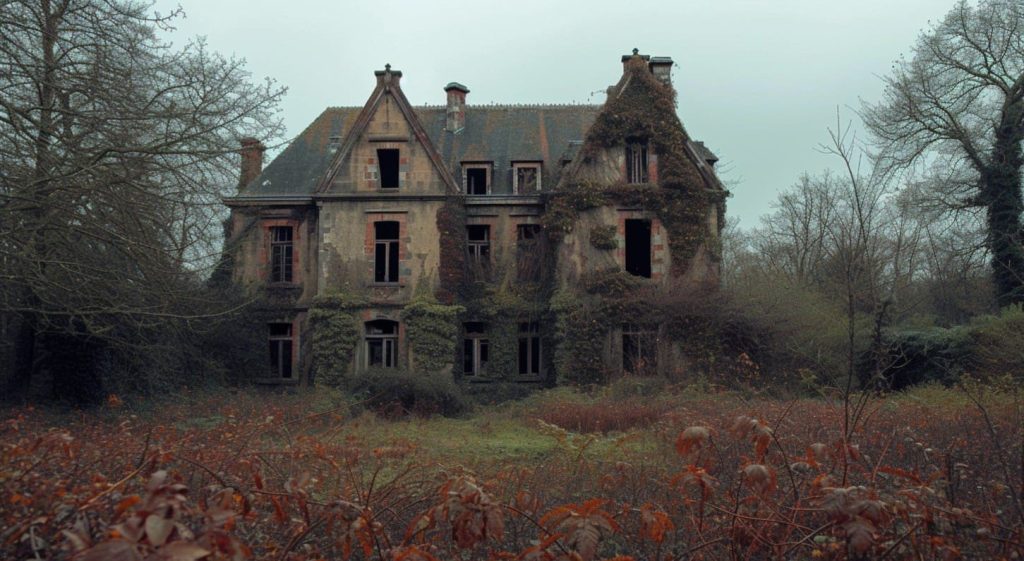
Once Paul actually moves into the place, the movie starts treating the house itself like a character. Every wall has something etched into it. Every room feels like it’s holding its breath. This isn’t your standard haunted-house dressing either the symbols tie directly into old Slavic pagan belief, specifically the worship of Veles, a god who rules the underworld and is tied to cattle, trickery, and the boundary between life and death.
Why does that matter? Because the movie isn’t asking “is this house haunted.” It’s asking something closer to: what do you owe a place that’s been feeding a debt for generations before you even showed up?
Jakov clearly believes the house demands something. He’s not just squatting there out of spite he’s been maintaining a pact, whether Paul realizes it or not. And that’s the tension underneath every argument between the brothers. Paul thinks this is about property. Jakov knows it’s about something a lot older than property law.
The Camera’s Focus on Space
Pay attention to how the camera treats the house compared to how it treats the two brothers. Wide, static shots linger on the walls far longer than they need to for basic scene-setting. That’s not accidental framing. The film wants you to register the house as a presence in its own right, almost like a third character sitting quietly in every scene, watching the two brothers argue over who gets to claim it. By the time the ritual sequence kicks in, you’ve already been trained to see the house as something with its own agenda, not just a backdrop for a family feud.
Mudbrick as a Metaphor
There’s also something worth noting about the choice of material itself. A mudbrick house isn’t built to last forever the way stone or brick construction is, it requires constant upkeep, constant patching, constant tending, or it starts crumbling back into the earth it came from. That’s not a subtle metaphor once you notice it. The house needs someone to keep maintaining it, physically and spiritually, the same way the family’s pact needs someone to keep honoring it. Let either one go untended, and it collapses.
The Physics of Belonging
It’s also worth pointing out how differently Paul and Jakov physically move through the space. Jakov moves like a man who’s mapped every inch of this house in the dark, he knows which floorboards creak, which rooms to avoid at certain hours, which corners hold which totems. Paul, by contrast, is constantly discovering the house as he goes, stumbling into rooms he didn’t expect, misreading symbols he doesn’t understand. That contrast in movement quietly reinforces the whole “outsider versus keeper” dynamic without the film ever needing to say it out loud.
Jakov Isn’t the Villain, He’s the Believer
It’d be easy to read Jakov as the antagonist here. He’s aggressive, he’s hostile to his own brother, and he clearly wants Paul gone. But watch his behavior again and you’ll notice he’s not acting out of greed. He’s terrified.
Jakov stayed. He inherited the responsibility that came with staying the rituals, the debts, whatever arrangement his family made with whatever’s living under (or in) that house. Paul left for London and got to pretend none of it was real. So when Paul shows back up claiming ownership, Jakov isn’t just defending a house. He’s watching someone who abandoned the duty try to walk in and undo everything he’s sacrificed to maintain.
You know how this goes in every family where one sibling stays and one leaves. Resentment doesn’t need a supernatural curse to fester, Mudbrick just adds one on top for good measure.
The Roots of Sibling Resentment
There’s a particular scene where Jakov snaps at Paul over something that, on its face, looks minor; a disagreement about how long Paul’s actually planning to stay. But watch Howard’s performance in that moment. That anger isn’t really about the house at all. It’s someone who’s spent years convinced nobody’s coming to help him carry a weight he never chose, finally getting to say it out loud to the one person who could’ve shared it and didn’t. That’s the emotional engine driving Jakov through the entire back half of the film, long before the ritual elements take over.
Natalija’s Devotion
Natalija’s role in all of this deserves more credit than she usually gets in conversations about the movie. She’s not just standing beside Jakov out of loyalty, several scenes suggest she may actually be more devoted to the family’s spiritual obligations than he is. That detail complicates any easy reading of Jakov as a man simply trapped by circumstance. He may have married into this belief system just as much as he inherited it, which makes his fear and aggression toward Paul feel even more layered. He’s not just protecting a house. He’s protecting a marriage built partly on a shared conviction that this pact has to be honored.
The Motivation of Absolute Terror
It’s worth asking, too, what Jakov actually thinks happens if the pact breaks. The film never gives him a monologue explaining his worst fears, but his behavior fills in the gaps. Every time Paul threatens to sell the house or simply leave without settling things properly, Jakov’s panic reads less like stubbornness and more like genuine terror the reaction of a man who believes, completely, that something catastrophic follows if this obligation goes unmet. Whether or not the audience is meant to share that belief, Jakov clearly does, and that conviction is what makes him sympathetic rather than simply hostile.
The Ritual: Where the Movie Stops Being Subtle
The back half of the film is where things stop pretending to be a grounded family drama. The runes start to feel less decorative. The totems seem to react. And Paul, whether he wants to or not, gets pulled toward whatever ceremony this family has been quietly building toward since he arrived.
This is also where the film gets genuinely divisive. Some viewers find this stretch mesmerizing, a slow-burn folk horror payoff in the vein of Midsommar or The Wicker Man. Others found it disorienting, even confusing, with the film’s perspective shifting and timeline fracturing right when you’d expect it to clarify things. Worth knowing going in: this isn’t a movie that wraps its ritual sequence in a neat bow. It leans into ambiguity on purpose.
Shifting Perspectives
Somewhere around this point, the film’s point of view starts drifting away from Paul and toward Jakov, which is a deliberate choice worth sitting with. For the first half of Mudbrick, you’re anchored to Paul’s perspective; you’re the outsider, learning the rules alongside him. Once the ritual takes hold, the movie starts letting you see things from Jakov’s side instead, and that shift changes how you read everything that follows. Suddenly the “villain” of the story has interiority you weren’t given access to before, and Paul, your entry point into the film, starts feeling more like an object the story is acting upon rather than a character driving it.
The Narrative Hinge
That’s also around when a death occurs that reshapes the family dynamic for good, the kind of moment that, in a more conventional horror movie, would function as a clear turning point toward a final confrontation. Here, it functions more like a hinge the story swings on without pausing to explain itself. If you found that stretch hard to follow on a first watch, you’re not alone; even people who love this movie tend to admit the pacing and structure get genuinely disorienting right when the stakes are supposed to sharpen.
Textures Over Crescendos
The sound design carries a lot of the weight during this stretch too, and it’s easy to overlook if you’re focused purely on plot. There’s no big orchestral swell to signal “this is the climax.” Instead, the film leans on quieter, more textured sound wind, chanting, the creak of the house itself to build tension without ever tipping into full spectacle. It’s a choice that fits the movie’s overall restraint, but it also means the ritual sequence can feel underwhelming if you’re expecting a traditional horror crescendo.
Fractured Timelines
It also doesn’t help clarity that the film intercuts the ritual with flashes of earlier “springs” those repeated arrival scenes we’ll get into more below. Watching the present-day ritual bleed into fragments of what might be past visits (or might be something else entirely) is intentionally disorienting. You’re meant to lose your footing a little here, the same way Paul does. Whether that works for you as a viewer or just leaves you frustrated is honestly going to come down to personal taste.
So What Actually Happens at the End?
Here’s the part you’re really here for, so let’s get into it.
Paul ends up outside the house as dawn breaks. The oppressive fog that’s hung over the entire film starts to lift. For a second, it plays like a classic horror-movie escape, the survivor stumbling into daylight, freed from whatever nightmare he just lived through.
But the camera doesn’t let you have that. It lingers on Paul’s face a beat too long, and what you see there isn’t relief. It’s something closer to resignation. The final image is Paul sitting quietly on the porch as darkness settles back in, and the house sits behind him, still standing, still holding whatever it’s always held.
Now, I’ll be straight with you: Mudbrick doesn’t spell out exactly what this means, and honestly, that’s by design. The film deliberately withholds a clean explanation of whether Paul is now bound to the same pact Jakov was protecting, whether he’s inherited the role of “keeper” the way Jakov once did, or whether something even stranger happened to him during the ritual. Different viewers walk away with different readings, and the movie seems fine with that.
The Primary Takeaway: The reading that lines up best with everything the film sets up beforehand is this: Paul didn’t escape the curse, he became its next caretaker. Running from the house for years didn’t exempt him from what the house wanted. It just delayed the moment he’d have to pay in. That final porch shot isn’t a man who got away. It’s a man who finally understands he never could.
Notice, too, what’s absent from that final shot. There’s no Jakov, no Natalija, no Ana standing beside him. Whatever role Paul has stepped into, he’s stepped into it alone, which mirrors exactly how Jakov spent all those years, isolated with the weight of the house while Paul got to exist somewhere else entirely. If you buy the “Paul becomes the new keeper” reading, the ending isn’t really about Paul losing a fight against a curse. It’s about Paul finally understanding the isolation Jakov lived with the whole time, now that he’s the one sitting alone with it.
It’s also worth considering what this means for the rest of the family going forward, even though the film doesn’t show us. Does Jakov get released from the obligation now that Paul’s taken it on? Is Natalija relieved, resentful, something else entirely? The movie doesn’t answer any of this, and it’s not being coy for the sake of a sequel, this is a story that’s fundamentally uninterested in tidy futures. It ends the moment the burden transfers, because the burden transferring is the whole point.
Why the Ending Feels So Unsatisfying (On Purpose)
If you finished Mudbrick and thought “wait, that’s it?”. This isn’t a movie built around a twist you’re supposed to gasp at. It’s built around dread that doesn’t resolve, because the whole point is that some inheritances don’t get resolved. You don’t get to negotiate with generational trauma. You just get handed it.
Compare that to a more conventional horror ending, where the protagonist either destroys the evil or gets destroyed by it. Mudbrick refuses both options, Paul just stays. And that stillness is the horror.
If you’ve ever dealt with a family obligation you couldn’t just walk away from caring for an aging parent, managing a family business nobody else wants to touch, holding together relationships that would otherwise fall apart; you already understand this ending on some level, even without the folklore attached. There’s no climactic battle in real life for most of these situations either. You just wake up one day and realize you’re the one who stays, the one who carries it, and that realization rarely comes with a dramatic confrontation.
That’s honestly the smartest thing Mudbrick does. It uses the language of horror dread, ritual, an ancient god, a decaying house to talk about something a lot of people recognize from ordinary life. The supernatural elements aren’t there to distract from the family drama. They’re there to make the emotional weight of that drama impossible to ignore or shrug off as ordinary sibling squabbling.
What Veles Actually Represents in the Story?
If you’re not familiar with Slavic mythology going in, the Veles angle can feel like set dressing. It’s not. He’s not a pure “evil god” in the way Hollywood horror usually frames its antagonist deities.
That duality matters here. The pact this family has kept isn’t framed as strictly evil it’s framed as necessary, at least in Jakov’s eyes. The house needs feeding, in some form, to keep providing whatever protection or prosperity it’s provided the family for generations. Paul’s arrival threatens to break a cycle that Jakov believes is holding something worse at bay.
So when the ending leaves Paul sitting on that porch, forget “horror movie curse claims another victim.” Read it more as: the cycle continues because someone always has to be the one who stays.
Perun vs. Veles
Veles also traditionally sits in opposition to Perun, the sky and thunder god associated with order, law, and the ruling class in old Slavic belief. That rivalry mirrors the film’s central conflict almost too neatly, Paul represents order in a modern sense, arriving with legal paperwork and rational expectations about inheritance, while Jakov represents something closer to the older, messier, more instinctive belief system tied to the land itself. You don’t need to know the mythology going in to feel that contrast, but knowing it adds another layer to why the film chose this particular god for its backbone.
Constructing Meaning Around Suffering
It’s also worth noting that the movie never presents its version of Veles worship as some clean, ancient, unbroken tradition stretching back centuries without interruption. There’s a sense throughout that this family’s specific relationship to the belief has been shaped, adapted, maybe even partially invented across generations to make sense of hardship they couldn’t otherwise explain. That ambiguity is deliberate. Mudbrick isn’t trying to be a documentary about real Slavic paganism, it’s using the shape of that folklore to tell a story about how families construct meaning around suffering they don’t fully understand.
The Brothers as a Mirror for Real Family Dynamics
Strip away the folklore for a second and Mudbrick is really a story about the sibling who leaves versus the sibling who stays a dynamic plenty of people recognize whether or not there’s a pagan deity involved. One sibling gets to build a new life somewhere else and only has to deal with the old house, the old obligations, the old grief in small doses. The other sibling absorbs all of it, every day, and watches their sibling get treated like a hero just for showing up.
Jakov’s rage at Paul isn’t really about the house’s legal ownership. It’s about years of being the one who stayed, who managed the family’s mess, who kept the lights on, literally and spiritually while Paul got to build a life elsewhere and pretend none of this was his problem.
Dismantling Emotional Distance
This dynamic gets even more interesting when you consider how the movie frames Paul’s guilt, or notable lack of it, for most of the runtime. He doesn’t arrive racked with obvious remorse about leaving. If anything, his early scenes suggest a man who’s mostly made peace with his decision, someone who views the house as an inconvenience to be dealt with practically rather than an emotional reckoning waiting to happen. That emotional distance is exactly what the film spends its second half dismantling, piece by piece, until Paul can no longer treat any of this as someone else’s problem.
The Weight of Unrecognized Duty
There’s also something quietly devastating about how little credit Jakov ever seems to expect for what he’s sacrificed. He’s not fighting Paul because he wants recognition for years of duty. He’s fighting because he genuinely believes the alternative is catastrophe. That’s a harder, sadder position than simple resentment, and it’s part of why the film resists painting him as a straightforward villain even as his behavior grows more unhinged. He’s not chasing power. He’s terrified of what happens if nobody’s left to carry what he’s been carrying.
Is Paul Even Meant to Be Read Literally?
One detail worth sitting with: the film shows Paul’s arrival at the house multiple times throughout, framed as separate “springs,” almost like the story is looping. Some viewers have taken this as evidence that Paul isn’t a single, straightforward character making one trip home that the film is playing with the idea of Paul as a recurring figure, someone (or something) that returns to this house again and again across time, not just once.
I’ll be upfront that this reading isn’t something the film confirms outright, and it’s genuinely one of the more contested parts of Mudbrick’s structure. But if you buy into it, the ending hits differently. It’s not “one man’s ending.” It’s “the ending,” as in, this has happened before and will happen again, and Paul is just the current name attached to it.
The Loop of Recognition
If that’s the case, it reframes a lot of what looked like straightforward family drama earlier in the film. The villagers’ discomfort around Paul stops reading as ordinary small-town wariness toward an outsider and starts reading as something closer to recognition like they’ve seen this exact arrival before, more than once, and know roughly how it ends. Jakov’s hostility takes on a different shade too. He’s not just angry at a specific brother who abandoned him. He might be reacting to a pattern he’s watched repeat, one he’s powerless to break no matter how hard he fights against it each time.
It’s worth saying plainly that this cyclical reading isn’t the only valid way to watch the film, and the movie never forces you into it. You can absolutely take Mudbrick as a single, linear story about one specific homecoming gone wrong, and nothing about that interpretation is incomplete or wrong. But the “springtime” structure is there for a reason, and once you notice it, it’s hard to unsee. Whether you land on the literal reading or the cyclical one probably says as much about what you personally find scarier as it does about what the film intended.
Should You Actually Watch Mudbrick?
If you’re the type of horror fan who wants your endings tied up with a clear explanation of what happened and why, this one’s going to frustrate you. Mudbrick is patient to the point of testing your patience, and it trusts you to sit in confusion rather than handing you a resolution.
But if you’re into folk horror that prioritizes atmosphere and dread over jump scares the kind of movie where the horror is generational and slow rather than sudden there’s a lot to like here. The performances from the two leads carry the family conflict even when the supernatural elements get murky, and the location shooting in rural Serbia gives the whole thing a texture you don’t get from studio horror.
If you’ve watched other slow-burn folk horror titles and walked away frustrated by the ambiguity, know that going in this one asks for the same patience and doesn’t cash it in with a big reveal at the end. What you get instead is texture: a village that feels lived-in, a family conflict that feels earned, and a sense of dread that builds through implication rather than spectacle. It’s a smaller, quieter kind of horror movie than most people expect when they hear “folk horror,” and that’s probably the biggest thing to adjust your expectations around before you press play.
Just don’t go in expecting all your questions answered. Mudbrick isn’t that kind of movie, and honestly, it’s better for it.
Frequently Asked Questions (FAQ)
Does Paul die at the end of Mudbrick?
No, not in a literal on-screen sense. He is alive on that porch in the final shot. Whether something about him has fundamentally changed is a different question, and that’s the one the movie actually cares about.
Is Jakov the villain?
Not really.
What does the house symbolize?
Generational obligation. The film uses the literal, decaying structure to represent everything a family passes down whether the next generation wants it or not. belief, duty, guilt, and unpaid debts.
Is there a mid-credits or end-credits scene?
No. Mudbrick doesn’t have any additional footage after the credits roll, so you’re not missing anything by heading out once the film ends.
Does the movie ever confirm what Veles actually wants?
Not explicitly, and that’s intentional. You get enough folklore context to understand the shape of the belief system, but the film stops short of literalizing exactly what the deity demands or grants.
Is Mudbrick based on a true story?
Loosely, yes. The director has said the core sibling conflict was inspired by a real family dispute passed down through his own family, dating back to the years after World War II. The supernatural and folklore elements are his own creative addition layered on top of that real emotional kernel.
Should you watch Mudbrick with subtitles even if you speak English?
Honestly, yes. The film mixes Serbian and English dialogue, and a decent chunk of the Serbian conversation isn’t subtitled the same way throughout every version available to stream.
About the Author.
Hi, I’m Vansh, the founder of Vibe On Cue. I track the absolute best ways to experience cinema, from the biggest Hollywood Blockbusters and upcoming release dates to the finest details of PVOD & Streaming and pristine Blu-ray & 4K physical media. And when the credits roll, I break down the narrative with deep-dive Ending explained guides. If you live for the full life cycle of film, stick around and explore the site!!!