
Hokum Ending Explained: Damian McCarthy’s Hokum spends roughly two hours convincing you that you’re watching a classic, atmospheric haunted hotel movie, only to twist the knife in the final act and reveal it’s actually a heavy-as-hell trauma drama wearing a folk-horror costume. If you finished the credits, blinked at your screen in the dark, and immediately went looking for answers about mushrooms, chains, and a witch in a locked hotel room, you’re not alone. This is one of those endings that seems to resolve everything in about ninety seconds of hospital-room dialogue, and then quietly leaves you unsure exactly what you’re supposed to have concluded.
The film operates on multiple layers at once, blending Irish folklore, psychological guilt, and a genuinely nasty prank involving hallucinogenic mushrooms, and it refuses to hand the audience a completely neat bow. That ambiguity is by design. McCarthy has made a career out of stories that sit right on the line between “there’s a monster” and “there’s a metaphor,” and Hokum pushes that tension further than either of his previous films.
Here’s the part that trips people up the most, though: the “was it real or was it a hallucination” question doesn’t resolve the way most horror movies would have it resolve, and it’s easy to land on the wrong read if you stop thinking the second Alby’s confession lands. So let’s unpack what actually happened at the Bilberry Woods Hotel, layer by layer, and get the twist right.
Heads up: Massive spoilers below, and we’re not being coy about it. If you haven’t watched Hokum yet and still think it’s a normal haunted hotel movie, this article is going to ruin that in the first paragraph.
Quick Recap: Who Is Ohm Bauman (And Why Is He Like This?)
Adam Scott plays Ohm Bauman, a highly successful novelist who is, to put it mildly, profoundly miserable. When we meet him, he’s suffering from a massive case of writer’s block on the finale of his long-running Conquistador trilogy, and instead of dealing with that like a normal person by staring at blank page, he’s coping by drinking, ignoring his agent, and traveling with two urns of his parents’ ashes packed into his luggage. It’s an immaculate vibe from minute one.
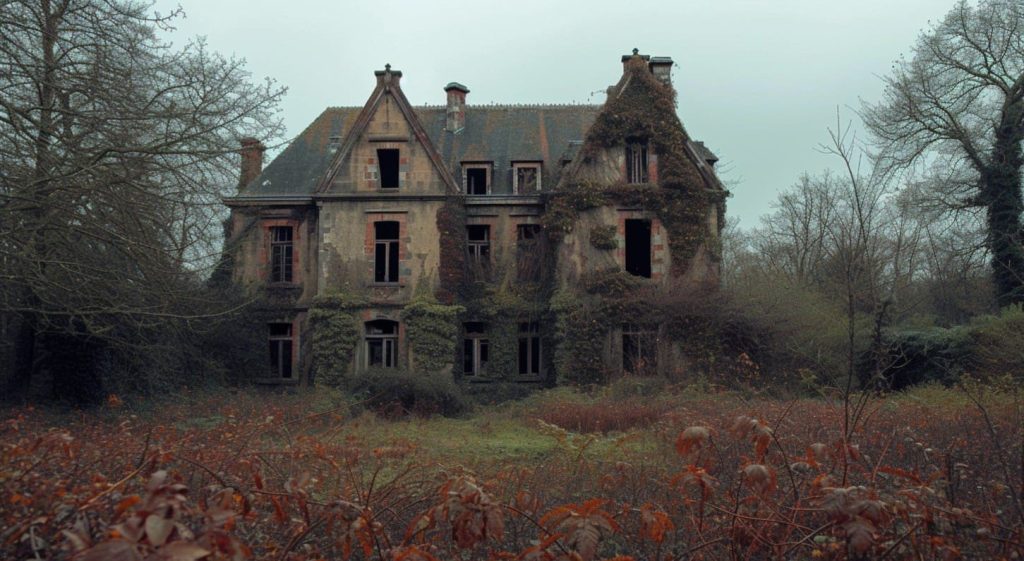
He checks into the Bilberry Woods Hotel in rural Ireland, claiming the trip is a bid for closure and artistic inspiration. This happens to be the exact hotel where his parents spent their honeymoon decades earlier, before everything in his family fell apart. Within about ten minutes of runtime, it’s obvious Ohm is carrying more emotional baggage than the hotel staff could ever help him unpack, and his defensive, frequently cruel attitude doesn’t win him many friends on arrival.
The staff itself feels like it stepped straight out of a horror trope handbook. There’s Cob, the hostile owner who clearly doesn’t want Ohm poking around; Mal, Cob’s son-in-law and the hotel’s front desk clerk, who is far more nervous than a guy running a front desk has any right to be; Fergal, the porter, a quiet presence who carries a crossbow for reasons nobody explains up front; Alby, the eager, awkward bellhop who Ohm treats like garbage almost immediately; and Fiona, the bartender, who ends up being the only person on staff with a functioning moral compass. They all orbit around one piece of local folklore that Ohm dismisses on sight: there’s a witch supposedly locked inside the honeymoon suite, and absolutely nobody is allowed to open that door.
Naturally, because Ohm is a cynical writer convinced he’s the smartest person in every room he enters, and because he has essentially zero horror-movie survival instincts, that locked door is exactly where his midlife crisis eventually leads him. What he finds inside sets off a chain reaction that turns his self-pitying weekend away into a literal fight for his life and his sanity.
So… Was the Witch Real, or Was It Just the Drugs?
This is the multi-page debate that’s been clogging up Reddit threads and film Twitter since release, and it’s worth being precise about it, because a common early misread got the answer backwards: the witch is real.
The twist most people remember from the film’s final scene is Alby’s hospital confession. He admits that he spiked Ohm’s whiskey flask with potent mushroom powder, made by Jerry, the homeless man living on the hotel grounds, as petty payback after Ohm publicly humiliated him and burned his hand with a hot spoon earlier in the film. Alby wasn’t out for blood, just a petty win against a guy who’d humiliated him, but once you know it happened, it recontextualizes a lot of what Ohm experiences in the film’s back half, from the elevator scene where he first hears the witch’s screams to the increasingly surreal texture of his descent into the hotel’s basement.
Here’s the part that’s easy to miss on a first watch, though: the film goes out of its way not to let that confession undercut everything Ohm went through. Right after Alby’s confession, Ohm looks down at his own wrists and sees actual bruising and rust marks left behind by the witch’s iron shackles. That’s physical evidence a hallucinogen can’t produce on its own. Jerry says as much earlier in the story, in a line that ends up being the thematic key to whole film: the mushrooms don’t invent the supernatural, they just strip away the mental filter that normally keeps ordinary people from perceiving something that was already there. In the world of Hokum, the spirit world isn’t a metaphor bolted onto a trauma drama. It’s presented as genuinely, physically present, just mostly invisible to people who haven’t had their minds cracked open.
So the mushroom reveal isn’t a last-second rug-pull that erases the horror movie you just watched, the way it would in a cheaper film. It’s the mechanism that explains how Ohm was able to see something that was there the whole time.
There is one genuinely hallucinated element in the film, and it’s worth separating out clearly so you’re not lumping everything together the way a lot of the initial internet discourse did. The bulgy-eyed creature that appears reflected in the honeymoon suite’s old television set, which McCarthy has confirmed in interviews is named “Jack the Jackass,” isn’t tied into the witch’s mythology or backed up by any physical evidence the way the shackle marks are. He’s the film’s one clear concession to pure hallucination, distinct from everything else Ohm encounters.
If you want to track what’s real versus imagined on a rewatch, the trick is apparently baked into the cinematography: keep an eye on Ohm’s glasses during his POV shots. When the camera cuts to a reverse angle, whether or not what he’s looking at shows up reflected in the lenses is reportedly the film’s built-in tell for what’s actually in front of him versus what’s only in his head.
The chalk circles, the witch herself, the sounds of chains rattling in the basement, all of that is presented as real. What’s cracked open and reinterpreted isn’t whether the supernatural exists in this story, but whether Ohm, specifically, is finally capable of perceiving it.
Where Does the Witch Even Come From?
The folklore Cob feeds to every guest is that there’s a witch trapped in the honeymoon suite, and that if you cross paths with her, drawing a chalk circle around yourself is your only real protection. The figure draws heavily on the Cailleach, a recurring “divine hag” figure from Irish mythology who’s sometimes depicted as a creator deity and sometimes, in darker folk traditions, as a harbinger of death who ushers souls into the underworld. Hokum leans hard into the latter interpretation, framing its witch less as a monster with a backstory and more as a kind of jailer, someone who chains people to the weight of their own worst memories until they either break free of them or get dragged down permanently.
That framing matters for how the ending plays out, because it means the witch isn’t really the villain of the piece in a conventional sense. She’s closer to a force of consequence. The people who end up genuinely destroyed by her, either physically or emotionally, are the ones who spent the film lying to themselves and everyone around them. The people who survive her are the ones who finally stop.
What Happened to Fiona, and What Was Mal’s Deal?
Fiona is the undisputed MVP of this movie, acting as the sole anchor of real human decency in a hotel otherwise stocked with weirdos and liars. Early on, she’s the only person who looks past Ohm’s abrasive exterior and clocks that he’s in the middle of a genuine mental health crisis, not just being a jerk for fun. She’s the one who saves him from a suicide attempt in his room, showing him a flash of real kindness at a point in the story when he’s done nothing to earn it.
Her disappearance from the bar partway through the film is what shifts the story into overdrive, forcing Ohm to stop feeling sorry for himself and start actually investigating the hotel’s locked doors. When Ohm eventually gets into the honeymoon suite himself, he finds her body, and the full picture of what’s been happening at the Bilberry Woods Hotel clicks into place. The witch legend gets blamed for a lot in this hotel, but what actually happened to Fiona is a very human betrayal that legend just happened to conveniently cover up.
The reveal is that Mal had been having a secret affair with Fiona behind his wife’s back. When she got pregnant and the situation threatened to blow up his comfortable life, Mal drugged her and locked her away in the “cursed” honeymoon suite rather than let the truth come out. The witch legend gave him the perfect cover story. Nobody was going to go looking for a missing bartender in the one room the entire staff was already too superstitious to enter, and Cob’s insistence on keeping the room permanently locked meant Mal barely had to work to keep anyone out.
Once Ohm figures this out, he rigs the room’s mechanical clock to buy himself time and heads down into the hotel’s basement to find proof, discovering a freezing stone corridor lined with old trinkets, including a lighter Alby had lost during his own long-ago encounter with the witch. That’s where he finally hears it: the rattling of heavy iron chains and a wailing that confirms the local folklore was never just a story to scare children.
Mal doesn’t get away clean, either, which is a meaningful departure from how a straightforward true-crime-style ending would usually play out. In the climax, with the truth unraveling around him, Mal sets a fire in a last, desperate attempt to silence Ohm and destroy the evidence, then heads down into the catacombs himself. Down there, he runs directly into the witch, who drags him into the underworld. It’s not a tidy courtroom conclusion, and Mal never faces the police or the community he’s been lying to for years. But it’s not the case that he simply vanishes into the Irish countryside and gets away scot-free either. The folklore he weaponized to cover his tracks ends up being exactly what catches up with him.
With the fire spreading and the hotel filling with smoke, Ohm makes it back up out of the catacombs but passes out before he can get clear of the building. That crossbow Fergal’s been quietly carrying around since the film’s opening stretch finally earns its keep here: he’s the one who goes back in and physically drags Ohm out, which is how Ohm ends up recovering in a hospital bed rather than becoming a third body pulled from the wreckage.
The Jerry Subplot: Not Subtle, But Effective
Let’s talk about Jerry, the eccentric man living out of a beaten-up van parked on the edge of the hotel grounds. Initially introduced as local color or a potential red herring, Jerry turns out to carry real narrative weight, and he’s the connective tissue between the film’s psychological layer and its supernatural one.
Jerry is the source of the mushroom powder Alby eventually slips into Ohm’s flask, and he’s also the character who explains, out loud, how the film wants you to understand the relationship between the drugs and the supernatural. Years earlier, Jerry euthanized his terminally ill wife out of mercy, and he’s been haunted by her memory ever since. He firmly believes her spirit has been trying to reach him, and he treats his homemade mushroom concoction less like a recreational habit and more like a way of keeping a line of communication open with her. In a roundabout, tragic way, Jerry isn’t actually delusional. His wife’s spirit isn’t literally guiding him around the hotel grounds, but his fixation on the honeymoon suite ends up being one of the threads that helps point Ohm toward the truth about what Mal did to Fiona.
By the film’s end, Jerry’s body is recovered from the hotel property alongside Fiona’s, another casualty of the Bilberry Woods’ buried history. The film doesn’t spell out the exact circumstances of his death in the same explicit detail it gives Fiona’s, but the throughline is clear enough: he’s a man who took a life out of love and mercy, spent years afterward unable to move past his own guilt, and never got the chance to do what Ohm eventually does by the film’s final scene.
The Conquistador Meta-Plot Is the Real Key
You know those sun-drenched desert sequences that bookend the movie, featuring a rugged conquistador and a young child wandering the dunes trying to smash open a bottle buried in the sand? Those aren’t a historical flashback or some kind of past-life vision. They’re literal visualizations of the ending Ohm has been stuck on for the final book in his Conquistador trilogy, the manuscript pages he can’t bring himself to finish.
Early in the film, Fiona reads Ohm’s original draft of that ending and flatly tells him it’s way too bleak. In that version, the conquistador kills the child in order to use their bones to break the bottle open, only to discover it’s empty, and then dies alone in the desert. It’s a brutal, nihilistic little parable, and it says everything about how Ohm views human nature and his own life at that point in the story.
By the film’s end, after surviving everything the hotel throws at him, Ohm sits back down at his typewriter and completely rewrites the scene. In the new version, the conquistador looks at the child, can’t go through with the violence, and offers himself up instead. The child, moved by that, throws the bottle away entirely rather than use it, and the two embrace in the sand instead of destroying each other over a prize that was never actually worth anything.
It doesn’t take a film degree to decode this one. The brutal, self-punishing conquistador is the adult version of Ohm, drowning in whiskey and cynicism. The child is the ten-year-old version of Ohm who accidentally shot and killed his own mother while playing with his father’s unsecured gun. Ohm has spent his entire adult life mentally beating up that kid. Rewriting the book’s ending is Ohm finally choosing to stop.
What Does the Mother’s Ghost Actually Represent?
Given that Hokum ultimately treats its supernatural elements as real rather than purely symbolic, it’s worth being careful about how you read Ohm’s visions of his dead mother. The film frames her the same way it frames the witch: as something the mushrooms allow Ohm to actually perceive, grounded in the story’s own supernatural rules rather than floating outside them as a loose metaphor.
That doesn’t make the emotional weight of those scenes any less real, though. She represents the exact moment Ohm’s life fractured, back when he was just ten years old. After the accidental shooting, his father spiraled into a depression that eventually drank him into an early grave, leaving Ohm entirely alone with a level of guilt no kid should have to carry. The two urns he hauls across continents throughout the film aren’t just a moody prop. They’re the physical manifestation of a boy who never figured out how to put down the ghosts that defined his childhood.
The act of scattering his mother’s ashes at the base of the giant redwood tree on the hotel property, the same tree visible in his parents’ old honeymoon photos, is the first real step Ohm takes toward healing, well before the hotel’s horrors fully kick in. Later, in the hospital, when he’s able to accept Alby’s photo of that same tree without flinching, without reaching for a drink to numb the moment, it registers as a quiet but massive shift. He’s not running from the grief anymore. He’s finally sitting with it.
The Ending: Learning to Stop Punishing Yourself
By the time the final hospital scene rolls around, most of the hotel’s dark secrets are out in the open. Fiona and Jerry’s bodies have both been recovered from the property, giving the local community at least some closure. Mal is gone, not off enjoying a quiet life somewhere but dragged into the underworld by the very folklore he spent the film using as cover. Cob’s once-quiet hotel business is thoroughly ruined by the scandal.
And then Alby shows back up, the awkward bellhop Ohm treated like garbage for essentially the entire first hour of the film. He doesn’t come looking for revenge, and he doesn’t bring more mushroom powder. Instead, he brings a genuine peace offering: the physical photograph of the redwood tree, and a shy, sincere request to finally be allowed to read Ohm’s finished book.
Ohm accepts both, in his own characteristically guarded, quiet way. He sits down in his hospital gown, rolls a fresh sheet of paper into the typewriter, and finishes his trilogy on his own terms. The final shot of the conquistador and the child embracing in the desert tells you everything you need to know about the film’s actual thematic core.
The Verdict: The witch was real, the shackles were real, and surviving them with help from people who had no reason to be kind to him is what finally gets Ohm to put the gun down and pick the pen back up.
About the Author.
Hi, I’m Vansh, the founder of Vibe On Cue. I track the absolute best ways to experience cinema, from the biggest Hollywood Blockbusters and upcoming release dates to the finest details of PVOD & Streaming and pristine Blu-ray & 4K physical media. And when the credits roll, I break down the narrative with deep-dive Ending explained guides. If you live for the full life cycle of film, stick around and explore the site!!!