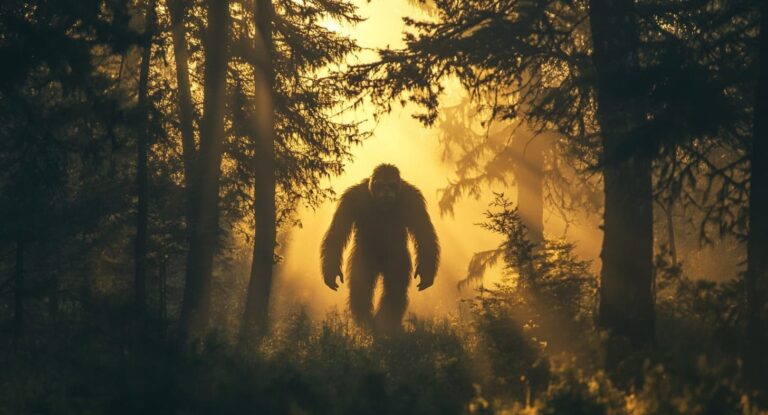

The Yeti Ending Explained: There’s a particular kind of magic to watching a monster movie that actually believes in its monster. Not a shadow that might be a bear, not a CGI blur glimpsed for half a second before the cut an honest-to-goodness, fully-built, rip-a-man-in-half-on-screen creature the filmmakers clearly built with love and a limited budget and no shame about either. “The Yeti” opens with exactly that kind of confidence, dropping us into the frozen dark of 1947 Alaska and letting its title character announce itself directly. It tells you immediately what kind of ride you’re in for: unpretentious, a little pulpy, and completely unbothered by restraint.
But underneath the fur and the practical gore, “The Yeti” is quietly doing something else. It’s a story about fathers who fail their children in different ways, about the arrogance of men who think nature exists to be conquered rather than respected, and about a daughter who spends the entire film being underestimated by every man around her right up until she’s the only one left standing. The monster is the hook. The family wreckage is the point.
If you just watched the film, or you’re trying to piece together what exactly went down in that last act before the credits rolled, you’re in the right place. There’s a genuine twist buried in the back half one that recontextualizes everything the tycoon told his investors plus a body count that thins out the cast in some genuinely brutal ways, and a final act that asks its heroine to do a lot of growing up in a very short window. Let’s walk through all of it.
Heads Up: We are jumping straight into the deep end of the plot twists now. If you hate spoilers, close your eyes and turn back. (Or, you know, go watch the movie and come right back)!
TL;DR, Quick Key Takeaways
- Oil tycoon Merriell Sunday Sr. and famed navigator Hollis Bannister vanish while on an expedition in the Alaskan wilderness in 1947
- Sunday Jr. assembles a rescue crew, including Bannister’s estranged daughter Ellie, to track them down
- The group is picked off one by one by a massive, ancient creature stalking the woods
- The reveal: Sunday Sr. was never looking for oil, he came to hunt and capture the Yeti as a trophy
- Bannister stole the Yeti’s infant to keep Sunday Sr. from slaughtering the whole family, then caged Sunday Sr. to stop him from finishing the job
- Ellie turns the tables on Sunday Sr. after he tries to use her as bait, stabbing him with a Yeti tooth in self-defense
- Bannister returns in the final stretch and sacrifices himself, luring the mother creature away so Ellie can escape by boat
- The film ends as a quiet redemption story for Bannister as much as a monster movie
Who’s on This Expedition Before It All Falls Apart?
The setup is classic pulp adventure scaffolding, and it wastes very little time getting there. Merriell Sunday Sr., an oil man with more ego than sense, has disappeared somewhere in the frozen north while supposedly scouting drilling sites. He’d been traveling with Hollis Bannister, a navigator with a reputation big enough that people just assume he can find anything, including apparently himself. When contact goes dark, it falls to Sunday Jr. to put together a team and go retrieve his father.
The crew he assembles is a fun little grab-bag of archetypes, which is very much the point; this is the kind of movie where everyone gets a defining trait and a job to do. There’s Leander Coates, a hardened veteran who’s survived two world wars and lost half his face doing it, now hiding the damage behind a painted mask that somehow reads as cool rather than campy.
There’s Dr. Margaret Lamb, an animal expert whose expertise turns out to be a lot more relevant than anyone initially expects. There’s Daniel “Dynamite” Hewitt, whose skillset is right there in the nickname, and Booker Marchmont, brought along to handle the radio equipment.
The wildcard is Ellie Bannister, Hollis’s daughter, who gets pulled into the expedition almost against her will. She’s spent her life resenting a father who was perpetually somewhere else, and her own claim to fame is a talent for cartography, the kind of skill that lets her map the world without needing to leave home first. It’s a nice bit of characterization, actually: she’s introduced as someone who believes you don’t need to chase adventure to understand the world, which makes her reluctant recruitment into the most dangerous adventure imaginable feel like a small, deliberate irony.
She agrees to guide the group north, dragged along by a young woman named Belle Parker, and the team heads into the wilderness hoping to bring Sunday Sr. and Bannister home alive.
Nobody in that group has any idea what’s actually waiting for them out there, and to be fair, neither do we yet. The film is patient about revealing its creature; we hear it before we see it, distant roars and cracking branches doing a lot of the early legwork and that patience pays off once the deaths start.
Part of what makes the setup work is how lived-in the group feels before anything starts hunting them. This isn’t interchangeable horror-movie fodder waiting for their number to come up; everyone has a reason to be there and a personality that clashes with someone else’s. Coates and Sunday Jr. bristle from the jump, one a career soldier who’s earned his caution the hard way and the other a rich man’s son used to giving orders without ever facing consequences for being wrong.
Dr. Lamb’s expertise gets treated as an afterthought early on, right up until it becomes the only thing standing between the group and total ignorance about what they’re dealing with. Even a small role like Belle’s, whose main function is convincing Ellie to come along, gets enough personality in her limited screen time that her fate later actually registers.
That groundwork matters because the back half of the film asks you to feel each loss individually rather than as an abstract rising body count, and the period setting helps this is a post-war group, full of people who’d already survived one kind of horror and assumed the worst was behind them. Coates carries visible scars from it, and Booker’s history on the Enola Gay hangs over him even though the film never dwells on it.
Everyone here signed up for danger already knowing what danger costs, which makes their overconfidence heading into Alaska feel less like idiocy and more like a specific, believable kind of hubris.
How Does Dynamite Dan Get Got?
Things go sideways fast once the group hits a snowstorm and Ellie’s compass starts spinning uselessly. Stranded and needing shelter, with permafrost too tough to dig through by hand, Dynamite Dan does what Dynamite Dan does and blasts out a space to hole up in. He spends most of this stretch needling Ellie for supposedly getting them lost, which, in the universal language of monster movies, is basically a death sentence. Sure enough, when he wanders off alone to relieve himself and ignores Ellie’s advice to stay tethered with a trail line, he doesn’t come back.
Ellie goes looking for him and gets separated when her safety line snaps. What follows is one of the film’s better unsettling beats: she spots what looks like Dan fiddling with his lighter in the dark, only to realize as she gets closer that it isn’t Dan at all it’s what’s left of him, bleeding out with a severed hand resting against his back. It’s a ghost-that-isn’t-a-ghost moment, more about the disorientation of grief and fear playing tricks on the mind than any actual supernatural element, and it works because it forces Ellie and us to sit in the horror before fully understanding it.
The Yeti itself looms nearby, and Ellie survives only by staying hidden until the rest of the group comes searching for her.
When Coates eventually finds Dan’s body half a mile off, half-eaten, the tonal split in the group becomes clear. Sunday Jr. wants to press on immediately, treating the loss as an inconvenience rather than a tragedy, a small but telling detail about how little he values anyone whose job isn’t directly serving his mission.
The soldiers among them push back, insisting Dan deserves a proper burial, and the compromise burying him on the way out rather than now becomes the group’s first real crack under pressure. Time is already the enemy here, and everyone knows it.
Who’s Next on the Yeti’s Menu?
The body count doesn’t slow down from there. When Belle Parker goes missing from the group, Dr. Lamb insists on joining Coates to find her not out of pure concern, but because she wants to see the creature responsible for all this up close. It’s a decision that pays off in information if nothing else: the pair stumble across a footprint massive enough to finally give the audience (and the characters) a real sense of scale for what they’re dealing with.
They find Belle just in time to watch her die. The Yeti drags her away in full view of Coates, who can do nothing but hold her as she bleeds out from a stomach wound, offering what comfort he can in her final seconds. It’s a genuinely somber beat amid the carnage. The film doesn’t play her death for shock value so much as for the helplessness of the moment, the specific horror of being close enough to see someone you’re supposed to protect and still be powerless to save them.
Meanwhile, tensions inside the group are fraying just as badly as the body count is climbing. Sunday Jr. keeps dismissing Ellie’s navigation instincts, at one point mocking her for using the moon to orient herself, right up until her instincts are the only reason they find Sunday Sr. ‘s cabin at all. Inside, they discover Dr. Lamb hiding in terror, having already had her own close encounter with the Yeti. Coates arrives soon after, determined to hunt the creature down before it finishes the job on the rest of them, a plan Sunday Jr. actively opposes, wanting Coates to stay behind and guard the group instead.
It’s a petty, ego-driven argument happening at exactly the wrong moment, because the Yeti chooses that pause to announce itself with a growl loud enough for everyone to hear.
Coates’ death is the film’s most brutal set piece. Positioned by the window as a distraction takes hold, he’s caught off guard when the creature crashes through and guts him on the spot. Ellie tries to hold onto him in the aftermath, only for what’s left of him to slip from her hands within seconds. It’s the kind of moment “The Yeti” does well visceral, sudden, and stripped of any sense that competence or toughness will save you once the creature decides you’re a target.
Booker doesn’t last much longer. With Coates gone, Ellie and Booker try to barricade the cabin and get the radio outpost working, and in a small, almost tragicomic detail, Ellie briefly loses herself in the music playing over the radio static, distracted just long enough for the Yeti to catch Booker off guard and kill him too. By this point, the rescue team that set out with such confidence has been reduced to a fraction of its size, and Ellie, the person everyone spent the film underestimating, is one of the only ones left capable of doing anything about it.
Okay, So Why Was Sunday Sr. Really in Alaska?
This is where the film really earns its twist, because everything that comes before gets recontextualized in one conversation. Fleeing deeper into the cabin, Ellie stumbles onto Sunday Sr. himself alive, but shackled inside a cage. She frees him and nurses him back to health, and what he tells her once he’s able to talk turns the entire premise of the expedition inside out.
Sunday Sr. was never in Alaska looking for oil. That was always the story he sold his investors and, apparently, his own son. What he actually wanted was the Yeti itself captured, killed, mounted, whatever it took to bring the creature home as a trophy proving he’d conquered something no other man had. He’d quietly sent men ahead to scout the area under the oil-drilling pretense, and once those men either vanished or reported back about the creature roaming the woods, Sunday Sr. saw an opportunity instead of a warning. He brought in Hollis Bannister the best navigator available specifically to help him track it down.
Somewhere along the way, the two men found something Sunday Sr. wasn’t prepared for: the Yeti’s infant. And that discovery is where Bannister’s entire arc pivots. Rather than help hand a baby animal over to a man who intended to slaughter its family for sport, Bannister stole the infant himself. To stop Sunday Sr. from finishing what he started, Bannister trapped him in that very cage Ellie later finds him in, which is also, grimly, exactly what allowed the adult Yeti to hunt down and kill the rest of Sunday Sr.’s crew, the massacre glimpsed in the film’s opening moments.
It’s a sharp piece of structural work when you sit with it. The film spends its first two acts asking us to sympathize with a grieving son trying to rescue his missing father, only to reveal that the father is the actual villain, a man whose ego and greed set every death in motion, including the deaths of people who trusted him. Ellie only understands the full scope of it when she spots a stash of morphine tartrate alongside sketches of the creature in Sunday Sr.’s belongings, proof that his plan to kill the Yeti never actually stopped, cage or no cage.
How Does Ellie Turn the Tables on Sunday Sr.?
Sunday Sr. doesn’t stay grateful for long. The moment he’s physically capable again, he strong-arms his own son into helping him finish the hunt, and their plan is as cold as anything else he’s done in the film: knock Ellie unconscious, cage her, and use her laced in morphine as bait to draw the Yeti in close enough to sedate it. Dr. Lamb gets tied up outside the cage as a second lure, blindfolded and equally drugged.
The plan half-works, in the sense that the Yeti does show up but instead of attacking Ellie, it flips her cage over, sparing her by accident or instinct. Sunday Sr. sends his son to check on the bait, giving Ellie the opening she needs. She breaks free and chokes Sunday Jr. unconscious, and as she tries to drag herself to safety, Sunday Sr. moves in with a tranquilizer, intent on finishing what his morphine plan started.
That’s when Hollis Bannister reappears alive, back at exactly the moment his daughter needs him most. His presence distracts Sunday Sr. just long enough for Ellie to grab a Yeti tooth they’d recovered earlier and use it as a weapon, stabbing him first in the foot and then, when he tries to get back up, in the neck. It’s not a clean, heroic kill, it’s messy and desperate, which fits a character who’s spent the entire film being dismissed as unqualified for exactly this kind of moment and is now improvising her way through survival with whatever’s in reach.
What Does Hollis Bannister Do at the End?
What follows is the emotional center of the film, and it’s worth slowing down for. Bannister finally gets his moment alone with his daughter, and he doesn’t waste it on excuses. He tells her plainly why he took the baby Yeti in the first place because he knew Sunday Sr. would have killed both the infant and its mother without hesitation if he hadn’t intervened. He acknowledges, without much softening, that he hasn’t been the father Ellie deserved, and that blaming her for her mother’s death only made an already difficult childhood harder. He doesn’t ask for forgiveness, exactly. He seems to understand it might not be owed to him.
What he does say, in effect, is that it’s too late for him to become a different kind of father but that it doesn’t matter as much as he once feared, because Ellie has already become exactly the kind of person he’d have hoped to raise anyway. She led an entire expedition through terrain that broke seasoned soldiers. She outsmarted and outlasted a man far more ruthless than she ever gave herself credit for. She didn’t need him to save her, and in a strange way, that recognition is its own kind of peace for him.
Then he does the one thing he can still offer her: he takes the baby Yeti and uses it to draw the mother’s attention away, buying Ellie the window she needs to reach the boat and escape. The mother creature kills him for it there’s no version of this where Bannister walks away but the film frames his death as a choice rather than a defeat. He dies having protected a species from being wiped out for one man’s vanity, and having given his daughter the one unambiguous act of protection he was ever able to offer her.
It’s a quiet way to close out a character who spent most of the runtime as an absence rather than a presence, and it lands with more weight than the film’s B-movie packaging might lead you to expect.
If you’re interested, you can check out our Hereditary Ending Explained!
What Does the Ending of “The Yeti” Actually Mean?
Strip away the practical-effects creature and the period-piece backdrop, and “The Yeti” is telling a focused story about legacy, the difference between the legacy men think they’re building and the one they actually leave behind. Sunday Sr. spends the film chasing a legacy built on conquest, on being the man who captured something no one else could.
What he actually leaves behind is a body count, a broken relationship with his own son, and a reputation built on a lie he told his investors. His version of legacy dies with him, ugly and unmourned.
Bannister’s arc runs in the opposite direction. He never gets the chance to rebuild his relationship with Ellie in any conventional sense; there’s no long reconciliation scene, no years of making up for lost time. What he gets instead is one honest conversation and one final act that proves, more than any apology could, what he actually valued.
His legacy isn’t a trophy on a wall. It’s a species that survives because he made a hard choice, and a daughter who survives because he made a harder one.
There’s a version of this theme that extends further if you want to sit with it: the film is, in its own pulpy way, tapping the same tension that shows up whenever hunters chase rare animals purely for the prestige of the kill rather than any practical need some men measuring their worth by what they can dominate rather than what they can protect. Sunday Sr. is that impulse taken to its most exaggerated, monster-movie extreme, and Bannister’s quiet sabotage of it is the film’s clearest statement about which impulse it actually respects.
And then there’s Ellie, who ends the film having grown into exactly the kind of capable, self-sufficient person her father predicted, without needing his validation to get there. Her arc isn’t really about proving her father wrong, it’s about realizing, somewhere in the middle of all that carnage, that she never needed anyone’s permission to be good at this. The film doesn’t linger long on her reaction to Bannister’s death; it trusts the moment to speak for itself, and trusts the audience to understand that grief and gratitude can occupy the same space at once.
There’s also a quieter thread about who gets believed and who doesn’t, and it’s mostly a story about Ellie being right the entire time about the trail line, about navigating by the moon, and eventually about Sunday Sr.’s true intentions, long before anyone hands her actual proof. The men around her mistake her caution for inexperience, and the film seems aware of the irony that the person best equipped to get everyone home alive is the one whose judgment keeps getting overridden. It’s not hammered into a message, it’s just baked into the plotting, since every time her instincts get ignored, someone dies shortly after.
The creature itself deserves a word too, because it would be easy for a film like this to treat the Yeti as pure force with no interior life. Instead, the reveal of the infant reframes the monster entirely. It was never hunting out of malice; it was defending territory and, eventually, defending a child, which puts it on roughly the same moral footing as Bannister himself.
Both are willing to kill to protect something small and helpless from a man who wanted to destroy it for sport, the mother creature and the human father, doing the same thing for the same reason, on opposite sides of a fight neither of them chose.
None of this reinvents the creature-feature wheel, and the film knows it. But it’s a reminder that even a modestly budgeted monster movie with a guy in a fur suit can find something genuine to say if it takes its human characters half as seriously as it takes its monster.
Wrapped Up
By the time Ellie’s boat pulls away from shore, the expedition that set out to bring two men home has claimed almost everyone who went looking for them and the two men it was actually searching for turn out to have been the whole problem in the first place. “The Yeti” earns that irony by keeping Bannister mostly offscreen until it matters, letting his absence do quiet work on Ellie’s arc long before he shows back up to explain himself.
What sticks with you afterward probably isn’t the creature, even though the film clearly wants it to be. It’s the shape of the trade the story makes in its final stretch: a father who spent Ellie’s whole life failing to show up, finally showing up exactly once, in the moment that counted more than all the ones he missed. It doesn’t erase anything that came before it.
But it gives Ellie something to carry out of that wilderness besides grief, and it gives the Yeti itself something this kind of movie doesn’t strictly need but is better for having: a reason, a family, and an ending where the thing everyone came to kill turns out to be the one worth protecting.
FAQ (Most Googled)!
Is Hollis Bannister dead at the end of “The Yeti”?
Yes. He sacrifices himself by luring the mother Yeti away with her baby so Ellie can escape, and the creature kills him in the process.
Why did Bannister steal the Baby Yeti?
He stole it to stop Sunday Sr. from killing the infant and its mother to claim them as trophies, then caged Sunday Sr. so he couldn’t finish the plan.
What was Sunday Sr. really doing in Alaska?
He was never looking for oil, that was a cover story for his investors. He came to hunt and capture the Yeti as a trophy.
How does Sunday Sr. die?
Ellie stabs him with a recovered Yeti tooth, first in the foot and then in the neck, after he tries to use her as sedated bait for the creature.
Does Ellie survive the Film?
Yes. She escapes by boat after her father draws the mother Yeti away, making her one of the few survivors of the expedition.
Is there a sequel to “The Yeti” planned?
Nothing has been confirmed. The story is largely self-contained, though the ending leaves some thematic room for a follow-up if one happens.
About the Author.
Hi, I’m Vansh, the founder of Vibe On Cue. I track the absolute best ways to experience cinema, from the biggest Hollywood Blockbusters and upcoming release dates to the finest details of PVOD & Streaming and pristine Blu-ray & 4K physical media. And when the credits roll, I break down the narrative with deep-dive Ending explained guides. If you live for the full life cycle of film, stick around and explore the site!!!