
Oculus Ending Explained: Hmmm ok, so you just watched Oculus, and you’re sitting there trying to figure out if you actually understood what happened or if the movie just spent 100 minutes messing with you the same way that mirror messes with the Russell family. Fair warning: it’s a little bit of both. Mike Flanagan built this thing to be genuinely disorienting, cutting between two timelines eleven years apart until you’re not entirely sure which one you’re watching at any given moment which, yes, is exactly the point, but it doesn’t make you feel any less lost when the credits roll.
Here’s the short version of your confusion, and it’s the same thing basically everyone asks after finishing this movie: Kaylie and Tim spend the whole film building this elaborate system specifically designed to prove the mirror is evil and destroy it safely. They’ve got cameras, timers, a giant swinging anchor rigged to smash the glass, dead man’s switches, the works. And then in the final ten minutes, all of that careful planning falls apart, and Tim ends up killing his own sister with the exact device that was supposed to save them.
If you’re wondering how a mirror, an object that can’t move, can’t touch anyone, can’t do anything physical at all, managed to turn a grown man into an unwitting murderer of the one person he came back to protect, you’re asking the right question. That’s the actual engine of this ending, and it’s worth walking through slowly.
We’ll also get into what happened to their parents back in 2002, what the deal is with the ghost woman with mirrors for eyes, whether Tim is actually guilty of anything, and what that last shot of the film is trying to tell you. Let’s get into it.
Heads Up: We are jumping straight into the deep end of the plot twists now. If you hate spoilers, close your eyes and turn back. (Or, you know, go watch the movie and come right back)!
TL;DR: If you’re short on time!
- The Lasser Glass is a supernatural mirror that’s been killing its owners for centuries by manipulating their perception of reality, not by any physical force.
- In 2002, the mirror slowly drove parents Alan and Marie Russell insane, leading to Marie’s death and Alan forcing his young son Tim to shoot him.
- Eleven years later, adult siblings Kaylie and Tim return to the house with cameras and a mechanical anchor rigged to destroy the mirror once and for all.
- The mirror spends the night making them hallucinate, swapping people and objects in their perception so nothing they see or remember can be trusted.
- In the climax, the mirror convinces Tim that Kaylie is a hallucination standing in for itself, so when he releases the anchor to “destroy the mirror,” he actually kills Kaylie.
- The police arrest Tim exactly as they did when he was a child, the mirror survives intact, and the final shot implies the cycle isn’t over.
Who’s Who in Oculus?
Before we get into the breakdown, here’s a quick cast rundown so you can keep track of who’s who between the two timelines, since the movie deliberately blurs them.
- Karen Gillan plays Kaylie Russell, the adult daughter who spends over a decade building a case against the mirror.
- Annalise Basso plays 12-year-old Kaylie in the 2002 flashbacks.
- Brenton Thwaites plays Tim Russell, the adult son who’s just been released from a psychiatric hospital.
- Garrett Ryan Ewald plays 10-year-old Tim in the flashbacks.
- Katee Sackhoff plays Marie Russell, the siblings’ mother.
- Rory Cochrane plays Alan Russell, the siblings’ father, who buys the mirror in the first place.
- James Lafferty plays Michael Dumont, Kaylie’s fiancé, who shows up partway through the night to check on her.
- Kate Siegel plays Marisol Chavez, the ghostly woman who haunts the mirror and appears to its victims.
- Miguel Sandoval plays Dr. Graham, Tim’s psychiatrist.
Wait, What Exactly Is the Lasser Glass?
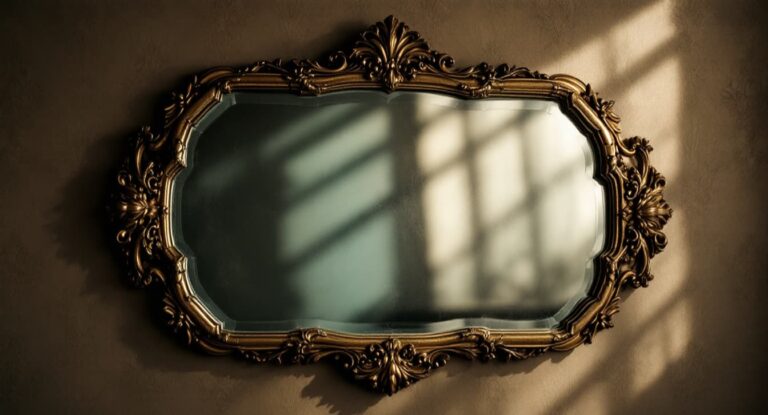
The mirror at the center of Oculus is called the Lasser Glass, and the movie is deliberately stingy with backstory on it, which is honestly one of its smarter choices. Flanagan has talked about wanting the mirror to feel like a Lovecraftian force, something so far outside normal comprehension that trying to fully explain it would undercut the dread. So instead of an origin story, you get fragments: past owners who died under mysterious circumstances, a trail of destruction stretching back decades, and a pattern where anyone who keeps the mirror around long enough starts to lose their grip on reality.
What we do know is how it operates, and this is the part that actually matters for understanding the ending. The Lasser Glass doesn’t move objects or attack people directly. It gets inside your head. It makes you see things that aren’t there, hear things that aren’t happening, and this is the crucial bit to forget things that did happen.
It edits your memory in real time. Kaylie describes it almost like a virus for your perception, and once it’s got a foothold, you genuinely cannot trust your own eyes anymore. It also seems to feed off proximity, gradually weakening plants, sickening the family dog, and, in the film’s darkest logic, slowly poisoning the people who spend the most time near it.
If you’ve ever been in a relationship or a family situation where someone kept insisting your version of events was wrong, where you started to doubt your own memory of something you were sure happened that specific kind of disorientation is basically what the mirror is doing to this family, just literalized into a horror movie. It’s less “haunted object jump-scares you” and more “haunted object slowly convinces you that up is down,” which is a much scarier idea once it clicks.
What Actually Happened to Their Parents Back in 2002?
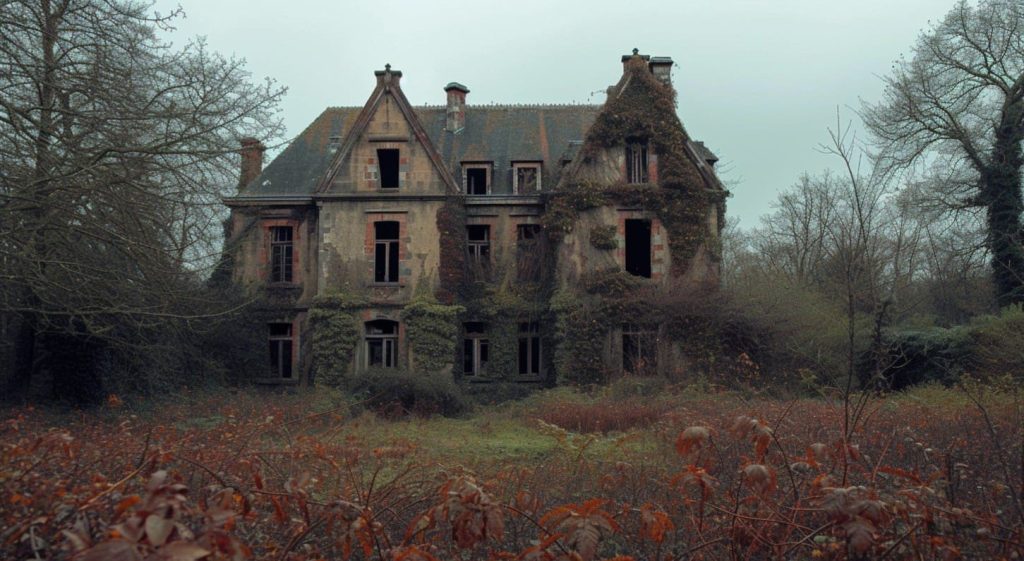
This is the flashback timeline, and it’s honestly just as brutal as anything happening in the present day. Alan Russell, a software engineer, buys the Lasser Glass as an antique for his home office, completely unaware of what it is. Almost immediately, things start to unravel. The family dog gets sick and disappears. The houseplants die. Alan starts seeing a woman named Marisol Chavez, a ghost tied to the mirror who seduces and manipulates him, while Marie starts hallucinating that her body is decaying, becoming withdrawn, paranoid, and eventually convinced that Alan is having an actual affair.
The kids, Kaylie and Tim, start noticing their parents changing, but nobody around them believes what’s happening. One night, Marie tries to destroy the mirror and ends up fully possessed by it instead. Alan locks her in a room like she’s dangerous, which, by that point, she genuinely is. The family starts running out of food because Alan’s stopped functioning entirely, the phone lines seem to be cut off from any outside help, and eventually Alan arms himself and unchains Marie, and both parents turn on their own children.
Marie has one last moment of clarity, just enough to beg for help, before Alan shoots her. Then, in the single most gutting moment in the film, Alan has a flash of lucidity too, realizes what he’s become, and forces young Tim to shoot him rather than let the mirror keep using him.
It’s suicide by proxy, essentially, and it’s the reason Tim spent the next eleven years in a psychiatric facility. The official story the world settled on was that Tim killed his father and his mother died some other way nobody believed the mirror was real, including, eventually, Tim himself.
Why Does Kaylie Set Up This Whole Elaborate Trap in the First Place?
By the time we catch up with adult Kaylie, she’s spent essentially her whole adult life building a case. She works at an auction house specifically so she can track the mirror’s ownership history and eventually get her hands on it again. She’s documented dozens of previous owners who died or disappeared under similar circumstances. And when Tim finally gets released from the hospital, having been convinced by years of therapy that none of it was supernatural, Kaylie brings him back to the house with a plan.
That plan is genuinely clever, at least on paper. She sets up cameras throughout the room to record everything, so there’s an objective record that can’t be edited by memory or hallucination the way a human witness can be fooled. She rigs a mechanical anchor to a timer, so that if either of them stops checking in, the device automatically swings down and shatters the mirror without a human having to get close enough to be manipulated in the moment.
She sets up “fail-safes” people who are supposed to check on them if they don’t hear back, including her own fiancé, Michael. Every part of this system is designed around one specific vulnerability: you can’t trust a person’s perception once the mirror gets to them, so she’s trying to build something that doesn’t rely on perception at all.
It’s a genuinely good plan against a genuinely bad problem. The tragedy of the film is watching, piece by piece, how the mirror still finds a way through it.
Why Can’t They Just Leave the House?
This comes up a lot, and it’s one of those moments where the film is doing something subtler than it first appears. At multiple points, Kaylie and Tim try to physically walk out the front door, and the mirror keeps pulling them back in through hallucination making them think they’ve stepped outside when they haven’t, walking them in a loop back to the same room, or convincing them the exterior world simply isn’t reachable from where they’re standing.
Tim even reaches a point where he’s ready to just go, no more proving anything to anyone, and Kaylie is the one who insists they stay and finish what she started, a decision that reads very differently on a rewatch once you know how the night ends.
It’s the same escape-room-that-isn’t trick countless horror movies use, but here it lands harder because of the thematic parallel to the parents’ story. The 2002 timeline shows Kaylie and Tim as kids literally unable to get anyone outside the house to help them: phone calls intercepted by that same unexplained voice, neighbors who hear their story and simply don’t believe two frightened children over two seemingly normal adults.
Eleven years later, as adults with resources, a plan, and outside fail-safes lined up specifically to avoid repeating that isolation, they’re still trapped by the same object in the same house, unable to leave once things start going wrong. The mirror isn’t just reusing a supernatural trick for convenience. It’s reusing the exact isolation tactic that already worked once on this family, because it already knows it works.
What’s Going On With Michael Dumont and the Stabbing Scene?
This is the moment where the wheels really start coming off Kaylie and Tim’s plan, and it’s worth breaking down because it’s easy to miss exactly what happens if you’re watching it in real time. Michael, Kaylie’s fiancé, is one of the fail-safes he’s supposed to come check on them if they go dark for too long. When the houseplants in the room start wilting rapidly (a visual cue the film has already established means the mirror’s influence is intensifying), Michael shows up to check in, just as planned.
But by this point, the mirror already has enough of a grip on Kaylie that her perception can’t be trusted. She sees a hallucination of her long-dead mother approaching her, and in what she believes is self-defense, she stabs the figure in the neck. It’s actually Michael.
This is the mirror weaponizing the very fail-safe system designed to protect them, turning “a person will check on you” into “a person will die because you can no longer tell them apart from a ghost.” It’s the first real proof that their entire system has a fatal blind spot: cameras can record objective reality, but the humans inside the room are still vulnerable, and eventually those humans have to act on what they think they’re seeing.
What’s the Deal With the Phone Calls and the Doppelgangers?
There’s a small detail that trips a lot of people up, so it’s worth pausing on. Twice in the film once with the kids in 2002, once with the adult siblings in the present someone tries calling for outside help, and the call gets picked up by the same unidentified male voice both times, eleven years apart. It’s never explained who or what that voice belongs to, and that’s almost certainly intentional.
It functions as proof that the mirror’s influence extends beyond just visual and auditory hallucination inside the house; it can apparently intercept and control how the outside world responds too, at least from the perspective of anyone trapped in its orbit. Whether that’s literally true or just another layer of hallucination convincing them their calls aren’t getting through, the effect is the same either way: total isolation.
The doppelganger moment is similar in function. Late in the film, Kaylie and Tim see versions of themselves already standing inside the house in front of the mirror, which is the moment they fully commit to going back inside instead of escaping. It’s the mirror showing them a version of events that’s already decided, almost fatalistic, as if to say their fate was locked in the moment they brought it back into the house. You don’t need a literal explanation for what the doppelgangers “are” to get the emotional logic: the mirror is telling them, visually, that leaving was never actually an option.
How Does the Mirror Actually Trick Tim Into Killing Kaylie?
Here’s the part everyone comes looking for, so let’s slow all the way down.
As the night collapses further, the past and present timelines start visually and narratively merging. Flanagan literally cuts between adult and child versions of Kaylie and Tim as if they’re occupying the same space, which mirrors what’s happening to the characters’ minds. They’re reliving their childhood trauma while simultaneously living through its adult repeat. At a certain point, they get separated. Tim wakes up alone in the room, and simultaneously, we see a hallucination of young Kaylie being lured toward the mirror by a vision of her dead mother, calling to her the same way the mirror lured their parents years earlier.
The critical detail is this: the anchor device is designed with a very specific fail-safe. If Tim doesn’t reset a timer, the anchor automatically swings down. But by this point in the night, the mirror has spent hours manipulating both siblings into distrusting reality including making them see the room and the mirror shift and reset when it hasn’t. When Tim finally moves to trigger the anchor himself, believing he’s about to destroy the mirror once and for all, he cannot perceive that Kaylie is physically standing directly in the mirror’s place.
His mind has been convinced, through cumulative hallucination, that what’s in front of him is the mirror and nothing else. He releases the anchor. It swings down and kills Kaylie instantly.
This is the whole thesis of the film condensed into one moment: the mirror never had to lift a finger. It just had to make one person unable to tell the difference between a threat and the person he loved most, at exactly the moment that distinction mattered. It’s the same fundamental trick it pulled on their parents in 2002 Alan, at the very end, also loses the ability to perceive Tim as his son rather than as an instrument, forcing him to pull a trigger. The mechanism is identical eleven years apart. Different tools, same manipulation: make someone destroy what they love while believing they’re doing the opposite.
Is Tim Actually Guilty of Anything?
Not in any meaningful sense, no and this is where the film gets genuinely tragic rather than just twisty. Tim didn’t want to kill Kaylie. He loved her, he came back specifically because she convinced him the mirror was real, and the entire reason he was hesitating throughout the film was his fear of losing his grip on reality the way he had as a child. He becomes a killer here through no fault of his own decision-making; he’s the victim of a manipulation so total that “guilt” doesn’t really apply to him in a human sense.
That said, the world doesn’t see it that way. The police arrive to find the exact same tableau as eleven years earlier: Tim standing over a dead family member, hysterical, insisting a mirror did it. As a child, this got him committed.
As an adult, it’s implied to lead him right back into custody and disbelief, because the surveillance footage the one piece of “objective” evidence the whole plan hinged on presumably shows exactly what appears to have happened: Tim releasing the anchor onto his sister. The camera system that was supposed to prove the mirror’s existence instead becomes the evidence that convicts him a second time.
Is the Mirror Ever Actually Destroyed?
No, and this is deliberate. The anchor kills Kaylie, but nothing in the film indicates the mirror itself is ever shattered or destroyed. In that final struggle the entire device Kaylie built exists to smash the glass, and instead it ends up smashing a person. Cracks appear on it earlier in the story, most notably a small one that formed back in 2002 during Alan’s death, but that damage is cosmetic at best; it clearly didn’t stop the mirror from claiming Marie, Alan, and now Kaylie.
Even during the children’s escape attempt in the flashback, they land what should be solid hits directly on the glass, only to later realize they’d actually been swinging at the wall the entire time. The mirror was never in real danger in either timeline.
By the end of the present-day storyline, it’s implied to be recovered as evidence from the crime scene, the same way it presumably was after the parents’ deaths back in 2002. Given that it previously sat untouched in storage for over a decade before resurfacing at Kaylie’s auction house, there’s every reason to think the pattern repeats: it gets logged, forgotten, and eventually resold to someone with no idea what they’re bringing home.
The film’s ambiguous final shot, Tim being led away in restraints while his adult self sees Kaylie’s ghost standing alongside their parents in the house, drives that home. Nothing here actually resolves. The mirror doesn’t need to win a physical fight; it just needs to outlast whoever’s trying to stop it, and so far, across two generations, it always has.
Why Does This Ending Actually Work (Even Though It’s Bleak)
It would be easy for this ending to feel like a cheap gut-punch just for shock value, and a few critics did feel that way at the time. But structurally, it earns the bleakness because it’s not really a twist, it’s a repetition. The whole film has been building the argument that trauma doesn’t get solved just because you grow up, gather evidence, and come back with a plan. Kaylie and Tim do everything “right” by any rational standard: they document, they prepare, they build redundancy into their safety systems.
And it still isn’t enough, because the thing they’re up against doesn’t play by rational rules. It plays by the rules of trauma, which is to say it repeats, it distorts memory, and it convinces you that the version of events you’re certain of might not be true at all.
Think about how the two timelines mirror each other on purpose, right down to small details. In 2002, it’s the parents’ marriage that weaponizes Marie’s jealousy, Alan’s guilt, both of them turning against each other until neither can trust the other. Eleven years later, it’s the sibling bond that gets weaponized instead, the one relationship that survived the first tragedy intact.
The mirror doesn’t repeat the same attack twice; it finds whatever bond is strongest in the room and turns that into the weapon. That’s a nastier idea than “haunted mirror kills people,” because it means preparation was never really the variable that mattered. Kaylie assumed the danger was believing the mirror wasn’t real.
The actual danger was trusting anyone too completely while standing anywhere near it. If you’ve ever watched someone get pulled back into a pattern they swore they’d broken free of, there’s something uncomfortably familiar in watching Kaylie and Tim get pulled back into the exact same house, the exact same room, and the exact same tragedy, no matter how prepared they thought they were.
Wrapping It Up
At its core, Oculus isn’t really about a killer mirror, it’s about how thoroughly trauma can rewrite what you’re able to trust, including your own senses and the people you love most. The Lasser Glass never needed brute force to destroy the Russell family twice over. All it needed was enough time and enough proximity to convince one person, at exactly the right moment, that the person standing in front of them wasn’t who they thought it was.
Tim didn’t fail his sister. He was made incapable of recognizing her, and that’s a far scarier idea than any jump scare the film could have thrown at you. The mirror gets packed away as evidence at the end, just like it did eleven years before, patient as ever, waiting for whoever’s unlucky enough to buy it next.
If you’re interested, you can check out our Hereditary ending explained here!
FAQ: Most Googled Ones!
Does Kaylie survive the Ending?
No, Tim accidentally kills her with the anchor device after the mirror convinces him she’s a hallucination standing in the mirror’s place.
Is Tim guilty of murdering his sister?
Not morally, since he was manipulated into it, but the surveillance footage makes it look that way to the police, echoing his childhood arrest.
Was the mirror ever destroyed?
No, it survives the film intact and is implied to be recovered as evidence, likely to resurface again later.
What happened to Tim and Kaylie’s parents?
The mirror drove them both to violence, resulting in Marie’s death and Alan forcing young Tim to shoot him.
Who is Marisol Chavez in Oculus?
She’s a ghostly figure tied to the mirror who appears to past victims, including Alan, as one of its manipulation tactics.
About the Author.
Hi, I’m Vansh, the founder of Vibe On Cue. I track the absolute best ways to experience cinema, from the biggest Hollywood Blockbusters and upcoming release dates to the finest details of PVOD & Streaming and pristine Blu-ray & 4K physical media. And when the credits roll, I break down the narrative with deep-dive Ending explained guides. If you live for the full life cycle of film, stick around and explore the site!