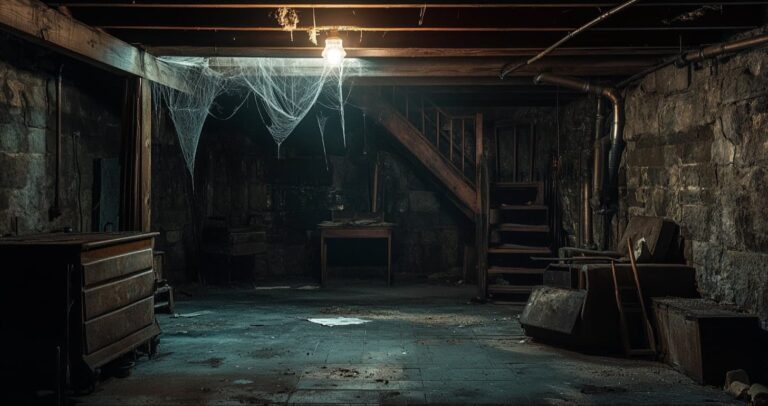

Frewaka Ending Explained: Okay, so you just finished Frewaka and you’re sitting there like… what did I just watch? A ghost story? A breakdown? Some kind of two-hour panic attack about being Irish? Honestly, kind of all three. Nobody hands you a bow on this one. You get a bleeding pair of eyes, a missing girlfriend, a wedding dress that shows up out of nowhere, and an old woman who’s apparently been guarding a locked basement door since 1973, and then the credits just roll like that’s a completely normal Tuesday.
And the annoying part is, the movie never actually tells you what any of it means. Peig mutters about “them” and “they” the whole runtime like she’s scared saying the real name out loud will summon it. Nobody ever sits down and explains the rules. You’re basically figuring it out the same way Shoo is a little too late, a little too reluctantly, mostly by accident.
So let’s actually sit down and do that. Because once you go back through it, none of the ending is random. It’s all connected to stuff planted way earlier that’s easy to miss on a first watch. The title itself is even a clue. Fréwaka is an anglicized spelling of fréamhacha, the Irish word for “roots.” Once that clicks, the whole movie’s obsession with dragging its characters backward instead of forward starts making a lot more sense.
Heads Up: We are jumping straight into the deep end of the plot twists now. If you hate spoilers, close your eyes and turn back. (Or, you know, go watch the movie and come right back)!
TL;DR: Quick Takeaways
- Shoo’s girlfriend Mila disappears into the basement of Peig’s house, which hides a passage to a folkloric “otherworld”
- Shoo finds Mila’s ring and car left behind and takes it as proof she’s been taken
- She puts on a waiting wedding dress and walks into the basement herself
- On the other side, a masked group crowns her while a horned figure watches, and her eyes start bleeding
- The film reveals Peig is actually Shoo’s biological grandmother her husband Daithí struck a bad bargain with “them” decades earlier and secretly gave up their baby to get Peig back, and that baby grew up to become Shoo’s mother
- A mid-credits scene shows Mila alive, still begging for Shoo’s return meaning something in the house let one of them go, and kept the other
- The film never fully confirms whether any of this is real or a shared breakdown between two grieving, unmedicated women, and that’s intentional
Quick Answer: What Happens At The End Of Frewaka?
In the final stretch, Shoo’s girlfriend Mila goes missing after entering the basement of Peig’s house, which conceals a passage into a folkloric otherworld tied to “them” ambiguous fairy or demonic entities rooted in Irish rural belief. Shoo hears Mila’s voice calling for help but can’t find her outside the door. Instead she finds Mila’s engagement ring and her car still parked outside, which she reads as proof that Mila has been taken. Left with no other option, Shoo puts on a white wedding dress she finds waiting for her and descends into the basement herself.
She emerges into an open field where a masked group crowns her like a sacrificial bride, and a horned, antlered figure watches from a nearby hill. Her eyes begin to bleed as the film cuts to black. It’s staged as both a wedding and an initiation and it directly mirrors the 1973 wedding-day flashback that opened the film, where a younger Peig fled her own ceremony after encountering a goat and a group of masked men.
The film closes on a mid-credits scene of Mila, distraught, still begging “them” to give Shoo back which tells us she survived whatever happened to her, even if Shoo may not have.
So Who Is Shoo, And Why Is She Even At This House?
Siobhán everyone calls her Shoo is a home care worker training in palliative nursing, which is its own quiet detail the film wants you to notice. She spends her days sitting with the dying. Then she comes home to a mother she barely spoke to, who has just taken her own life, found hanging in her apartment days after the fact, surrounded wall-to-wall with Catholic religious icons.
That estrangement isn’t vague, either. The film fills in, piece by piece, that Shoo’s mother locked her in a cupboard as a child and made her repeat prayers over and over, burning her arm if she got them wrong. So the icons crammed into that apartment aren’t just set dressing they’re a portrait of exactly the kind of household Shoo grew up trying to survive. No wonder she doesn’t grieve the way you’re “supposed” to. Grief usually assumes you lost someone safe.
Shoo doesn’t grieve so much as flee. She takes a live-in care assignment for an elderly stroke patient named Peig out in rural Ireland, leaving her pregnant girlfriend Mila behind in the city. It’s presented as a practical decision: someone needs the work, someone needs the care but it plays like avoidance. Shoo would rather look after a stranger’s crumbling house than sit with her own.
That avoidance matters later, because Frewaka keeps hinting that Shoo has quietly gone off her psychiatric medication. It’s never dramatized as a big moment; it’s just there, mentioned in passing, the kind of detail you’d miss on a first watch. Once you know it, though, everything strange that happens to her afterward gets a second possible explanation running parallel to the supernatural one.
Okay, But What Is The Actual Connection Between Shoo And Peig?
Here’s the reveal the whole film is quietly building toward, and it’s bigger than “they’re both dealing with trauma.” Partway through, Peig goes through a box of her late daughter’s belongings that Mila mailed to the house of Shoo’s mother’s things, including a birth certificate and realizes exactly who Shoo is. Not a random care worker sent by an agency. Her granddaughter.
Decades earlier, on her wedding night, “they” took Peig. Her husband Daithí struck a bargain to get her back, and the price was their unborn child. Rather than actually hand the baby over, Daithí cheated the deal he had the child quietly given up for adoption instead, letting “them” believe the debt was paid when it wasn’t. That baby grew up with no idea where she came from, eventually becoming the deeply religious, deeply damaged woman we see locking young Shoo in a cupboard and forcing her to pray. Shoo’s mother was Peig’s stolen, unpaid-for daughter the entire time.
Which reframes basically everything. Shoo’s job placement wasn’t some coincidence of a nursing rotation; the film strongly implies the calls and texts arranging it never actually came from her employer at all. They came from “them,” quietly steering her back to the exact house her grandmother has spent fifty years guarding, to finally settle a debt her great-grandfather welched on before she was even born. Peig wasn’t just caring for a random client’s granddaughter. She was watching the last unpaid installment of her own worst night walk in through the window.
What’s Going On Between Shoo And Mila?
It’s worth slowing down on Mila for a second, because the film treats her almost like Shoo’s counterweight, the version of a future Shoo could still choose if she’d let herself. Mila is expecting a baby and actively trying to put down solid roots, but she’s stuck with a girlfriend who constantly looks for an excuse to be literally anywhere else. She doesn’t get a huge amount of screen time early on, but every scene she’s in underlines the same point: she’s asking Shoo to stay, to talk, to actually be in the relationship instead of managing it from a distance.
Shoo, instead, takes the live-in nursing job. On paper it’s about money and professional experience. Emotionally, it plays like she’d rather care for a hostile stranger in a falling-down house than sit still long enough to process her mother’s death or prepare for the baby she and Mila are about to have. That avoidance is the emotional engine of the whole film. Shoo keeps running toward death work and away from the people who are actually alive and asking for her.
That’s part of what makes Mila’s arrival at the house in the final act so hard. She doesn’t come because something supernatural draws her there. She comes because her girlfriend has gone quiet for too long and she’s worried, and she loves her, and that’s it that’s the whole reason. No omen, no vision, nothing dramatic. Just a partner who’s had enough silence and decides to go check.
It’s such an ordinary, human reason to walk into a folk horror ending, which is almost worse, because it’s exactly the kind of threshold moment the film has been warning you about the entire runtime: love, worry, showing up for someone. Apparently that’s more than enough of an opening for “them.”
What’s The Deal With Peig, And Why Won’t She Let Anyone In?
Peig, played by Bríd Ní Neachtain, is not an easy patient. She’s hostile, paranoid, and living in a house that looks less like a home and more like a fortress somebody built to keep something out. She doesn’t want Shoo in her house at all Shoo has to break a windowpane just to get inside on her first visit, and what she finds isn’t reassuring: a mirror kept draped in fabric that Peig insists must never be uncovered, a bright red door at the end of the hallway with a horseshoe nailed above it, and a woman who demands her nightgown be worn inside out before she’ll agree to sleep.
None of it is explained. It’s just presented as a ritual, the kind of quiet protective magic someone keeps up long after they’ve stopped expecting anyone to ask why.
The house sits near an old fairy tree strung with scissors and bones, a local landmark the bus driver actually warns Shoo away from before she’s even arrived. And it turns out Peig’s fear isn’t purely folkloric, either; there are strong hints she spent time institutionalized in a Catholic asylum at some point in her life, the kind of place Ireland used to quietly file away women it found inconvenient. So when Peig talks about being watched, judged, and punished, she’s not only talking about fairies. She’s talking about two systems that both did exactly that to her, one supernatural and one depressingly real.
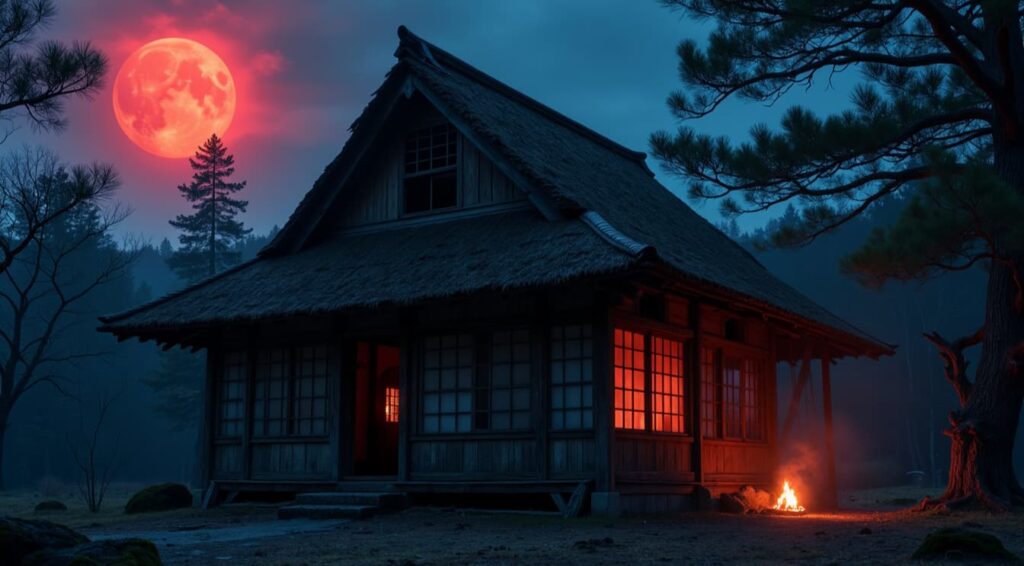
The wariness isn’t random. We saw the seed of it in the film’s cold open: 1973, Peig’s own wedding; she’s already visibly pregnant by Daithí as the ceremony happens, detached and uneasy through most of it. Out of nowhere, a bunch of men wearing retro suits and straw masks show up at the wedding party, casually leading a goat decked out in flowers. Peig wanders out sick, sees the goat, and by the time Daithí comes looking, she’s left nothing left behind but her wedding ring. We don’t get the full story immediately.
Clarke doles it out slowly, the same way Peig doles out trust but it becomes clear that whatever happened that night is the reason Peig has spent decades treating her own home as a siege line. Daithí struck some kind of bargain to get her back, and Peig has been living with the consequences of what that bargain actually cost and who it cost ever since.
By the time Shoo arrives, Peig isn’t just an old woman recovering from a stroke. She’s a survivor standing watch over a door she believes leads somewhere it shouldn’t and she’s been doing that job alone, in an isolated house, for longer than most of us have been alive. Of course she doesn’t trust a stranger climbing through her window. As far as Peig’s concerned, letting someone in has never once gone well for her and she doesn’t yet know that the stranger climbing through her window is the one person with more right to be there than anybody.
There’s also a care-agency supervisor, Deirdre, circling the edges of the story, pushing to inspect Peig’s home in person no matter how much Peig resists a small but pointed reminder that even now, an elderly woman living alone and behaving “oddly” gets treated as a case to be managed rather than a person to be trusted.
Who Or What Are “They”? Breaking Down Frewaka’s Folklore
This is the part of the movie that frustrates some viewers, because Clarke deliberately refuses to define it. Peig talks about “them” and “they” the way you’d talk about something you’re afraid will hear its own name. There’s no lore-dump, no exposition scene where a wise local explains the rules.
What the film gives you instead are fragments rooted in real Irish folk belief: the Sídhe, fairy folk tied to the land itself, older than Christianity and resentful of the people who settled on ground that was once theirs. They’re drawn to thresholds, the liminal moments in a human life where the veil between worlds gets thin.
Births. Weddings. Deaths. Peig says it plainly at one point: this kind of work, the death work, the birth work, has always fallen to women, and that’s exactly why women are the ones “they” come for.
That’s why the timing of the story isn’t a coincidence. Shoo has just lost her mother. Mila is pregnant. Peig herself is edging toward death after her stroke. Every woman in this story is standing in one of those doorway moments the folklore is obsessed with, and the film uses that to build a slow, creeping dread that never needs a jump scare to land.
Whether “they” are literal supernatural beings or a shared delusion passed between two vulnerable, unmedicated women is a question Frewaka never fully answers and honestly, that ambiguity is the whole point.
There’s also a quieter, more political layer folded into all this vagueness. The way the villagers around Peig’s house behave toward “them” isn’t fear exactly; it’s closer to a resigned, uneasy coexistence. They don’t talk about it, they don’t fight it, they just accommodate it, the way a community might learn to live alongside something painful it doesn’t have the language or the will to confront directly.
The film seems to be suggesting that this land has been fought over, colonized, and reshaped so many times that nobody’s entirely sure anymore whether the “curse” belongs to the fairies, to history, or simply to the people who’ve inherited both.
What Actually Happened To Peig In 1973?
The wedding-night flashbacks fill in gradually, and by the time you reach the ending you understand this isn’t abstract folklore to Peig, it’s the single defining event of her life. “They” took her the night she was married, and Daithí, desperate to get his new wife back, agreed to a trade: their unborn child, in exchange for Peig’s return.
Except he didn’t go through with it. Rather than actually surrender the baby, Daithí quietly arranged for the child to be given up for adoption once she was born, letting “them” believe the debt had been settled when it hadn’t. Whether out of guilt, fear, or both, that lie apparently caught up with him by the time the film’s present-day story picks up, Daithí is long dead, and the implication is that whatever hounded Peig for the rest of her life hounded him first, straight into taking his own life.
It’s why she’s so hostile to outsiders. It’s why the house feels less like a home and more like a barricade, mirrors covered, a door under permanent watch. And it’s why, once she works out exactly who Shoo is, everything shifts so she’s not guarding against a stranger’s curiosity anymore. She’s watching an unpaid debt walk back through her front door in the shape of her own granddaughter, grieving a mother neither of them ever really got to have.
The two women start the film as near-opposites: one old, rural, Irish-speaking, and consumed by superstition; the other young, urban, bilingual, and dismissive of all of it. But Frewaka is careful not to make Shoo a total outsider discovering an exotic foreign belief system, the way a lot of folk horror does. Shoo is Irish.
This is her culture too, whether she wants it or not and as it turns out, it’s her family too, whether she knew it or not. That’s the “roots” of the title again; she can’t actually escape this any more than Peig could, because it was never really a stranger’s house she walked into.
Breaking Down The Final Scene: The Door, The Dress, And The Crowning
By the film’s last act, Mila has come looking for Shoo and vanishes into the house herself. Shoo hears her voice, muffled, coming from somewhere near the basement door, the same door Peig has spent the entire film treating as sacred and forbidden. Shoo’s first instinct is disbelief; she assumes it’s a trick, “them” imitating Mila’s voice to lure her in, the same way the folklore has always warned about.
But then she checks outside and finds two things that break her resolve: Mila’s engagement ring, left behind, and Mila’s car, still parked in the drive. No note, no goodbye, no sign of anyone actually leaving under their own power. To Shoo, that reads as confirmation. Mila didn’t walk away; she was taken. And if she was taken, there’s only one way to go get her back.
Waiting near the basement is a white wedding dress, seemingly left for exactly this purpose, echoing the dress from Peig’s own interrupted wedding decades earlier and the dress her own mother died in. Shoo puts it on and descends.
What’s on the other side isn’t a basement anymore. It’s an open field under open sky, a threshold crossed into whatever the “otherworld” of this folklore actually is. A circle of robed, masked figures waits for her, and rather than attacking her, they crown her, almost ceremonially, like she’s being married into something rather than punished by it.
On a rise above the gathering stands a horned, bearded figure, watching in silence an image that lines up with old depictions of Cernunnos, a Celtic figure tied to fertility, the wilderness, and the underworld, which fits Frewaka’s whole preoccupation with life, death, and the thresholds between them.
Then Shoo’s eyes start bleeding, and the screen cuts to black. No struggle, no scream, no last-second escape. It happens almost gently, which somehow makes it land harder than if the film had gone for something more violent like this was always the ending waiting for her, and all the running just delayed it a couple of decades.
Wait, Was Any Of This Real? Or Was Shoo Just Having A Breakdown?
Here’s where the film deliberately keeps both doors open. Frewaka spends a lot of quiet time establishing that Shoo has stopped taking her psychiatric medication, and that Peig whose paranoia the film treats with real sympathy but never fully validates has her own history of untreated mental distress layered under decades of grief. It’s entirely possible to watch the ending as two traumatized, unmedicated women feeding each other’s delusions until the line between memory, guilt, and hallucination collapses completely.
But the film doesn’t let you fully write off the supernatural reading either. The detail that tips it hardest toward “real,” at least for me, is the job placement itself the strong implication that the calls and texts sending Shoo to this specific house never actually came from her care agency, but from “them,” quietly maneuvering their unpaid debt back into position decades after Daithí tried to cheat his way out of it. That’s not the kind of detail a purely psychological reading explains easily.
Add in that Mila genuinely disappears, the dress genuinely appears with no clear origin, and the mid-credits scene shows Mila alive and desperate, pleading with something for Shoo’s return which only makes sense if there’s an actual “them” on the other side of that plea.
Clarke isn’t interested in resolving that tension for you. The ambiguity is the design, not a loose end. Frewaka wants the folklore and the psychology to be the same story, because generational trauma and inherited superstition genuinely do behave the same way in real families passed down, half-explained, and impossible to fully separate from what’s “real.”
What Happened To Mila? Breaking Down The Mid-Credits Scene
After the main story ends on Shoo’s bleeding eyes, Frewaka tacks on one more image before the credits fully roll: Mila, alone, clearly shattered, begging whatever took Shoo to bring her back. It’s brief, and it’s easy to miss if you’re already reaching for the remote, but it’s an important piece of information. It confirms Mila is alive and free; she wasn’t sacrificed the way Shoo seems to have been. Whatever the basement takes, it apparently didn’t take her, or it released her once Shoo took her place.
That detail retroactively reframes the ending as a trade rather than a rescue. Shoo didn’t get Mila back through some act of triumph. She got her back or Mila got herself back by Shoo walking into that door and staying there, the same way Peig once got herself back by Daithí promising a child he never actually surrendered. It’s a bleak, almost folkloric kind of justice: the debt gets paid by somebody, eventually, one way or another, and the story simply decides it’s going to be Shoo this time.
And there’s a genuinely unsettling wrinkle sitting under that: Mila is pregnant. If this family’s story really has been one long unpaid bargain passed down the line from Daithí to Peig, Peig’s stolen daughter to Shoo there’s nothing in the film’s internal logic that says it stops with Shoo. The debt didn’t originate with her. There’s no guarantee it ends with her either.
The Bigger Themes: What Is Frewaka Actually About?
Underneath the fairy folklore, Frewaka is telling a very specific, very Irish story about inherited pain almost literally. Peig’s trauma doesn’t stay Peig’s. It passes into the daughter she never got to raise, who becomes Shoo’s mother, who passes her own damage straight into Shoo.
Some critics have described the film’s logic as basically epigenetic, the idea that your grandmother’s trauma can live on in your own body, decades and a generation removed from the event that caused it, whether or not you ever knew the story behind it. That’s a genuinely unsettling idea dressed up as folk horror, and it’s arguably the film’s sharpest one.
Clarke has spoken about wanting the film to sit with the ghosts of Irish history rather than just Irish mythology the legacy of the Magdalene Laundries, the institutional cruelty inflicted on women in the name of religion and respectability, and the way colonization left its own kind of psychic wound on the land and the people who stayed on it. Peig’s superstitious dread of “them” isn’t just fear of fairies. It reads as the accumulated weight of a country that has spent generations being told its own beliefs, language, and traditions were something shameful to bury.
That’s why the religious iconography plastered across Shoo’s mother’s apartment lands as more than set dressing. It’s the other belief system competing for space in this story: institutional Catholicism sitting right alongside older, pre-Christian folk terror, both of them equally capable of controlling women through guilt, silence, and fear of judgment.
Shoo is caught between two inherited systems that both demand obedience and neither of which she ever chose. Her mother tried to bury the old fear under crucifixes and holy water. Peig never buried it at all. Neither approach saved either of them.
And then there’s the throughline the whole film keeps circling back to: women doing the “death work.” Nursing the dying. Keening the dead. Carrying pregnancies. Frewaka treats these as the exact moments when the folklore’s “them” comes looking which is really just the film’s way of saying that women have always been left to carry the heaviest, most liminal burdens in a family and a culture, often completely alone, often without anyone else in the room even acknowledging what it’s costing them.
Shoo’s arc isn’t really about fairies at all. It’s about a woman who spent her whole life running from her mother’s care work, her own son being forced to do it, at the worst possible cost.
It’s also worth sitting with how deliberately the film pairs Peig and Shoo instead of pitting them against each other. A lesser version of this story turns Peig into a red herring villain or a cackling warning sign the young heroine should have listened to sooner. Frewaka refuses that shape. Peig is difficult, guarded, and occasionally cruel, but she’s also the only person in the entire film who takes Shoo’s inherited fear seriously instead of medicating it away or ignoring it.
By the time the two of them actually start talking honestly to each other, late in the runtime, you can feel the film arguing that connection real, uncomfortable, generational connection might have been the actual antidote all along, and that isolation is what let “them,” in whatever form they take, get as close as they did.
The 1973 wedding-crash imagery deserves one more look, too, because it’s doing double duty. On a folklore level, it’s the moment “they” first marked Peig’s family line, setting up everything that eventually reaches Shoo.
On a historical level, it’s staged like an intrusion into one of Ireland’s most tightly controlled social rituals: a wedding, complete with the Church looking on, getting violently disrupted by something older and less controllable than the institutions standing around it.
The film keeps circling back to that image of order interrupted by something ancestral, because that’s essentially its whole thesis: the past doesn’t ask permission before it shows back up.
If you’re interested, you can check out our Hereditary Ending Explained!
Okay, So What’s The Actual Takeaway Here?
Honestly? I don’t think Frewaka wants you walking away with a neat theory you can explain to a friend in one sentence. That’s kind of the trap with a movie like this: you start hunting for the “correct” reading, fairies versus psychosis, real versus imagined, and you miss what Clarke is actually doing, which is holding both at once and refusing to let go of either.
What sticks with me isn’t the horned figure on the hill or even the bleeding eyes. It’s that shot of Mila in the credits, still pleading, still hoping, after everyone else in the story has already given up and accepted the trade. That’s the emotional core Frewaka keeps circling back to underneath all the folklore: somebody always pays, somebody always keeps asking for them back, and the story doesn’t pretend that’s fair or that it ends cleanly.
Peig spent fifty years doing exactly what Mila is doing in that final image begging, waiting, unable to let it go. The film just hands the role down to the next woman in line.
That’s really what “roots” means here. Not soil, not ancestry as heritage roots as something that keeps growing back no matter how deep you think you’ve buried it. Frewaka isn’t asking you to solve its ending. It’s asking you to notice how familiar that ending feels, even with all the fairy-folklore dressing on top.
If you’ve made it this far, you already know Frewaka isn’t the kind of horror movie that wants to scare you and send you home. It wants you to sit with Shoo, with Peig, with every woman in this story who was handed a debt she never agreed to and told to pay it quietly. That’s a much harder thing to shake than a jump scare, and honestly, that’s exactly why we’re still talking about that basement door.
Frewaka FAQ: Most Googled!
Is Peig actually Related to Shoo?
Yes, Peig is Shoo’s biological grandmother. Her daughter was given up for adoption decades earlier after Peig’s husband tried to cheat a bargain with “them,” and that child grew up to become Shoo’s mother.
Is Frewaka Based on a True Story?
No, but it’s built directly on real Irish folklore about the Sídhe and draws heavily on real historical trauma, including the legacy of the Magdalene Laundries and institutional cruelty toward women in Ireland.
What does the title Frewaka Mean?
It’s an anglicized spelling of fréamhacha, the Irish word for “roots,” referencing how the story’s trauma is passed down through generations of the same family.
Did Shoo die at the End of Frewaka?
The film doesn’t confirm it outright, but the crowning, the bleeding eyes, and the black cut to credits strongly imply she’s been claimed or sacrificed in some form, while Mila is shown alive afterward.
What language is Frewaka in?
Frewaka is predominantly in the Irish language, with English used in several scenes, reflecting the divide between Shoo’s urban life and Peig’s rural, Irish-speaking world.
Is Frewaka scary, or is it more of a drama?
It leans much closer to slow-burn atmospheric dread than jump scares or gore; critics and viewers alike have described it as more unsettling and sad than outright frightening.
Where can I watch Frewaka?
Frewaka is streaming on Shudder.
About the Author.
Hi, I’m Vansh, the founder of Vibe On Cue. I track the absolute best ways to experience cinema, from the biggest Hollywood Blockbusters and upcoming release dates to the finest details of PVOD & Streaming and pristine Blu-ray & 4K physical media. And when the credits roll, I break down the narrative with deep-dive Ending explained guides. If you live for the full life cycle of film, stick around and explore the site!!!