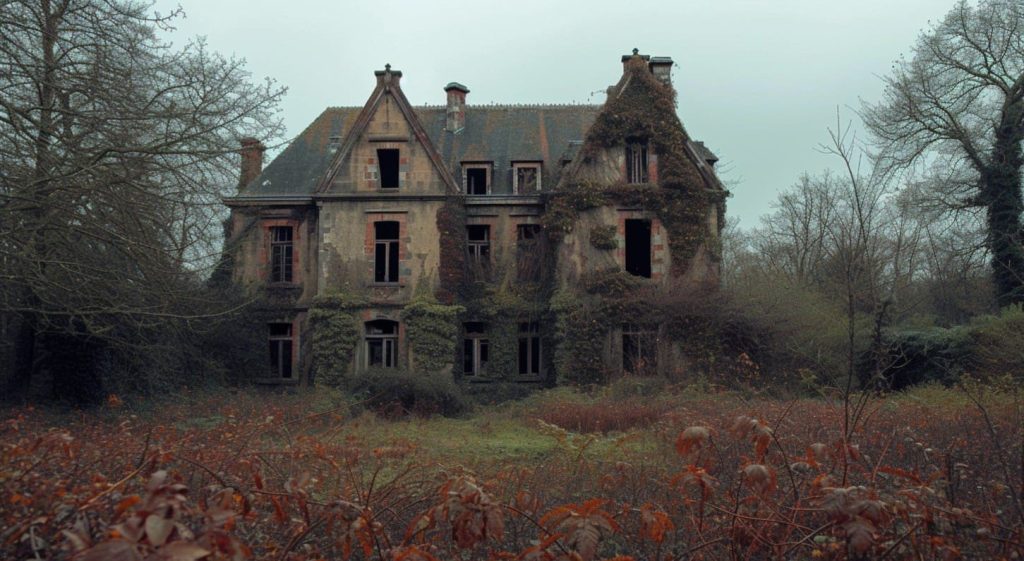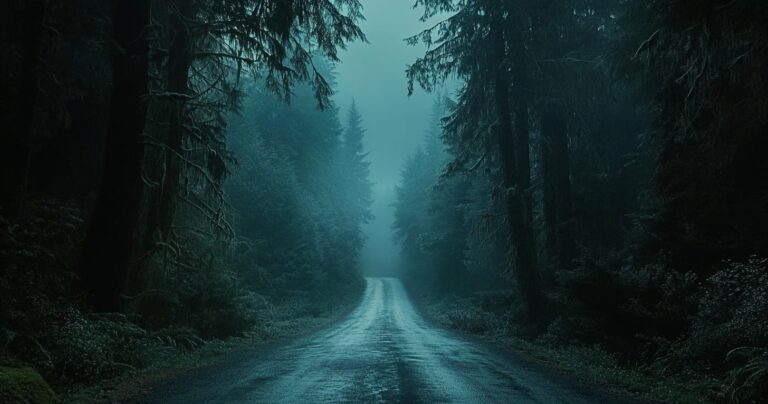

It Ends Ending Explained: Hmmm Ok, so if you just watched It Ends and you’re currently sitting there staring at your ceiling instead of going to bed, that’s a completely normal reaction. This is not a movie that hands you a clean answer and lets you move on with your night. You watched four friends get stuck on a road that refuses to end, you watched them slowly come apart in totally different ways, and then the whole thing closed in a moment that’s somehow both a gut punch and weirdly comforting at the same time. If you’re now Googling “is it purgatory,” “did James escape,” or “what was up with that guy he picked up,” you’re in the right place.
Here’s the thing about this movie, and it’s worth saying up front: it’s not really a horror movie about a monster. There’s no creature, no killer, no jump-scare gimmick you can point to and say “that’s the bad guy.” The road itself is the threat, sure, but the real horror is watching James, Day, Fisher, and Tyler slowly figure out who they actually are once every distraction of normal life gets stripped away. It’s a small, cheap, incredibly personal film, and once you know a little about where it came from, that personal quality makes a lot more sense.
We’re going to walk through what actually happens on that road, what each character’s choice means, and yes, we’re going to dig into whether this is literally purgatory or something else entirely. Fair warning: this movie deals pretty directly with depression and suicidal thoughts, not as a plot twist to shock you, but as the actual emotional engine of the story. So we’re not going to be cracking a ton of jokes here. Let’s get into it.
Heads Up: We are jumping straight into the deep end of the plot twists now. If you hate spoilers, close your eyes and turn back. (Or, you know, go watch the movie and come right back)!
TL;DR: Quick Version!
- Four friends: James, Day, Fisher, and Tyler get trapped on a road that never ends. No exits, no fuel loss, no hunger, and a horde of desperate people who swarm the car if they stop for more than about 90 seconds.
- The group openly wonders if they’ve died and this is Hell, or purgatory, or some kind of punishment. The movie never confirms this one way or the other.
- Tyler gives up first and stays behind in the woods. Day and Fisher eventually give up too, taking the keys from James and accepting there’s no way out.
- James refuses to quit. He gets the car started again through sheer will (and a prayer), drives off alone, and eventually reaches the literal end of the road, a dead-end circle marked by a sign that just says “ROAD ENDS.”
- Instead of staying there, James turns the car around and drives back, picking up another lost person along the way. The film ends on him restarting the same dumb conversation he had with Fisher back at the beginning.
- The ending is intentionally ambiguous about the “why,” but it leans hopeful: the road doesn’t have a finish line, and that’s not actually the tragedy the film thinks it is.
Who’s Who In It Ends?
James (Phinehas Yoon) is the de facto main character, the one who refuses to accept that the road doesn’t end, and who spends the entire movie searching for a logical explanation for what’s happening to them.
Day (Akira Jackson) is the emotional center of the group. She’s the one who eventually admits, deep into the film, that she attempted suicide the year before, which reframes a lot of the group’s “why are we being punished” conversations.
Fisher (Noah Toth) is the group’s designated goofball, the one who keeps the mood light early on, but who’s also quietly dealing with guilt over telling his religious mom he doesn’t believe in God anymore.
Tyler (Mitchell Cole) is the friend who picks the other three up at the start of the film. He’s blunt, a realist, and the first person in the group to decide he’s done fighting the road.
What’s Actually Happening On This Road?
Let’s set the scene, because the setup matters more than it seems like it should. James, Day, and Fisher are recent college grads. Tyler, a friend they haven’t seen in a year, picks them up for a late-night food run one last hangout before everyone scatters into “real” adult life. It’s such a mundane, specific kind of night. You’ve had this exact drive with your own friends: someone’s driving, someone’s got a dumb hypothetical going (in this case, which animals would win in a fight against each other), and nobody’s really thinking about anything beyond where you’re getting food.
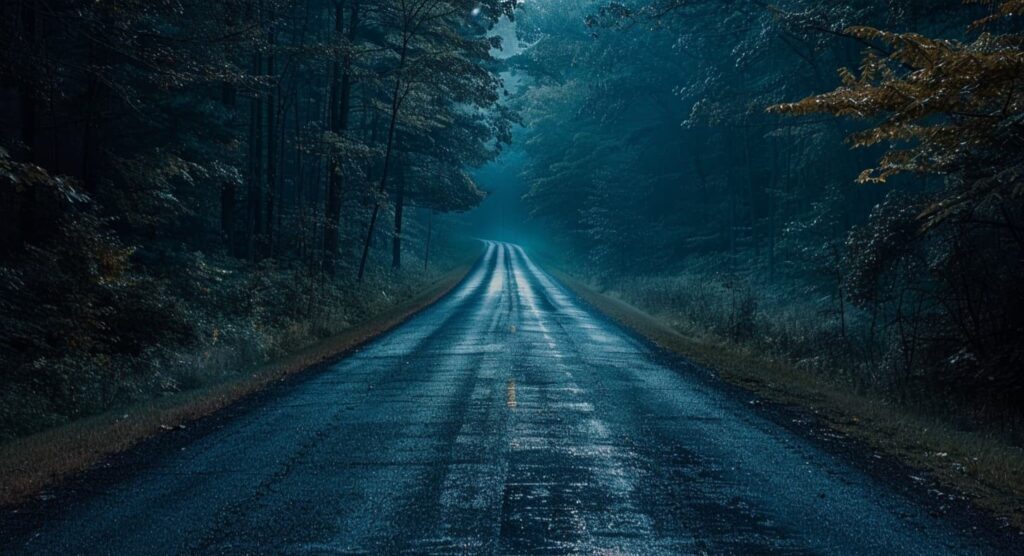
Then Tyler realizes he’s missed a turn. He tries to double back, and the road behind them is just… gone. Blocked by a wall of trees that wasn’t there a second ago. When Tyler gets out to investigate, a crowd of frantic, screaming people rushes out of the woods and swarms the car, clawing at the windows and begging to be let in. They peel out. Fisher gets scratched in the chaos. And that’s when they notice the road just keeps going, mile after mile, with no exit, no turnoff, nothing.
Over the next stretch of the film, they piece together the rules of wherever they are. The gas gauge never moves. Nobody gets hungry or tired. Fisher’s wound heals but never quite fully closes. And if they stop the car for more than about a minute and a half, the people from the woods come running again. It’s less a monster movie and more a slow, grinding survival situation where the real enemy is time itself, and what an unlimited amount of it does to four people who have absolutely nothing to distract themselves with.
This is actually where the movie gets its real teeth, and honestly, it’s relatable in a way that sneaks up on you. Strip away your job, your phone, your plans, your next meal, your next milestone, what’s actually left of you? That’s the question the road is asking, and it’s not subtle about it, but it doesn’t need to be, because it’s a genuinely uncomfortable question.
So Wait, Is This Actually Purgatory?
This is probably the biggest “wait, what” moment for a lot of people, so let’s tackle it head-on. Deep into the film, once the group has been driving long enough to lose track of any normal sense of time, James starts floating the theory that they’ve died and this is some kind of afterlife specifically, that they’re being divinely punished for something. He goes around the car asking everyone to confess anything they’ve done that might warrant that kind of consequence.
This is the moment Day admits she tried to take her own life the year before. It’s not played as a twist or a gotcha, it’s quiet, and it clearly rattles the group, because it recontextualizes everything they’ve been going through. If this is punishment, what exactly are they being punished for, and by whom? Fisher, for his part, brings up his own guilt about telling his devout mother he’d stopped believing in God, worried it means he’s damned.
Tyler doesn’t really buy any of it. James, meanwhile, is the one most desperate for the “we’re being punished, and there’s a reason” explanation, because a punishment at least implies rules, and rules mean there’s a way to eventually make it stop.
Here’s the honest answer, though: the movie never tells you whether this is literally Hell, purgatory, some kind of shared delusion, or something else entirely. It’s left open on purpose. The people in the woods, the frozen fuel gauge, the healing-but-not-quite-healed wound none of it gets a tidy mythological explanation. What the film is actually interested in isn’t the “what,” it’s the “how do you keep going when there’s no explanation at all.” That ambiguity is the point, not a cop-out.
The road works as a real place if you want to read it literally, and it works just as well as a metaphor for depression, grief, or that specific kind of directionless dread that hits right after you finish school and the future stops having a shape. Both readings hold up at the same time, which is honestly a pretty impressive trick for an indie movie made on a shoestring budget.
Why Does Tyler Give Up First?
Tyler’s the first domino to fall, and it says a lot about the movie’s whole thesis that he’s the most grounded, no-nonsense guy in the group who breaks first. Tyler’s a realist. He doesn’t do false hope, and once he’s run the numbers literally hundreds of thousands of miles with no end in sight he decides continuing to drive is just prolonging something that isn’t going to change.
There’s a small, easy-to-miss detail earlier in the film that actually explains a lot about Tyler: he mentions breaking up with his girlfriend because she wanted to do something as simple as go pumpkin picking together, and he couldn’t bring himself to commit to it. Tyler struggles with small, ordinary commitments even in his regular life, so it tracks that he’s the one who can’t commit to an endless, purposeless drive either. He gets out, stays behind in the woods with the others who’ve given up before him, and tells James to let him know if he ever actually finds an end.
It’s tempting to read Tyler’s choice as simple defeat, but the film doesn’t frame it quite that harshly. His decision is presented as understandable, even sympathetic, a very human response to a situation with no discernible finish line. The tragedy isn’t that Tyler is weak. It’s that the road offers him nothing to hold onto that would make continuing feel worth it.
What Happens With Day And Fisher, And Why Do They Take The Keys?
Day and Fisher’s arc is the quiet, slow-burn heart of the movie, and it’s honestly the section that hit hardest for a lot of viewers. Unlike Tyler’s clean break, Day and Fisher stick it out much longer, and they adapt. They start raiding abandoned cars on the roadside for stuff to keep themselves entertained. They fall into routines, the same conversations, the same rest stops, even a daily ritual where they just scream to let out the frustration of the situation. It’s coping, and for a good stretch of the film, it actually seems to be working for them.
But there’s a difference between coping and hoping, and eventually that gap becomes too much to ignore. Well over 800,000 miles in, Day quietly slips the keys out of the ignition while the car’s stopped. She and Fisher tell James they’ve accepted the truth: there’s no escape, and watching him keep searching for one isn’t determination, it’s self-torture. They’re not trying to hurt him. They genuinely believe they’re being kind by asking him to stop.
James doesn’t see it that way. He wrestles the keys back, and in a moment that’s easy to read as pure desperation, he prays out loud, begging for the car to start. It does. He drives off without them. Day and Fisher are left behind, and the film gives them one small, wordless moment of comfort holding onto each other before it cuts away.
It’s not framed as a betrayal on either side. It’s two completely different, equally human responses to the exact same impossible situation, and the film refuses to say one of them was right and the other wrong.
So What’s Actually Waiting At The End Of That Road?
After James drives off alone, the film starts to feel even more untethered. It begins raining at one point, which genuinely spooks him, since it’s the first thing that’s changed about the environment in what feels like forever. Eventually, after a stretch of driving so long it’s honestly hard to picture, he comes across dozens of abandoned cars blocking the road ahead of him.
He gets out and walks. And there it is: the actual end of the road. Not a gate, not a portal, not some grand reveal, just a dead-end loop of asphalt, ringed by cars from what looks like decades of people who made it this far before him, and one plain sign that reads “ROAD ENDS.”
James doesn’t celebrate. He sits there on the ground for what’s implied to be days, absorbing the fact that he found the thing he’d been chasing this entire time, and it’s just… nothing. No answer, no explanation, no way home. He finally breaks down and eats the Clif Bar the group had all agreed to, way back near the beginning of the film, never to touch a small detail, but one that lands hard, because it’s James finally letting go of one of the last rules he’d been clinging to. Then he starts screaming, gets back in the car, and starts driving again.
Why Does James Turn Around Instead Of Staying?
This is the choice the whole movie’s been building toward, and it’s worth sitting with, because it recontextualizes everything that came before it. James spent the entire film believing that reaching the end would fix something that there was a solution waiting for him if he just refused to quit. And when he gets there, he finds out the end doesn’t fix anything at all. There’s no way out. There never was.
And yet, instead of staying at the dead end or giving up the way Tyler, Day, and Fisher did, James turns around and drives back into the endless road, this time picking up another lost, defeated person from the roadside on his way. As they drive, James starts up the exact same lighthearted “which animals would win in a fight” conversation he was having with Fisher at the very start of the film, and the other man, who’d clearly given up on everything, starts to come back to life a little as he engages with it.
It’s a genuinely optimistic ending dressed up as a bleak one, and that’s kind of the whole trick of the movie. James doesn’t get his answer. He doesn’t get to leave. What he gets instead is the realization that the point was never going to be found at the end of the road, because there isn’t one the point is always going to be who you choose to keep driving with. Reaching the actual end frees him, weirdly, from needing to reach it. He’s not trying to beat the road anymore. He’s just trying not to let someone else get left behind in it, the way Tyler, Day, and Fisher were.
That reframes the whole “punishment” theory from earlier, too. If this is some kind of divine test, it was never a test about escaping. It was a test about what you do once you accept you’re not going to.
Who Is The Passenger James Picks Up At The End?
The man James pulls off the roadside in the final scene is never named, and the film doesn’t explain who he is, how long he’d been out there, or what happened to him before James found him. He’s simply another person who’d reached his breaking point and stepped out of his own car at some point, just like Tyler, just like the countless people swarming out of the woods throughout the movie.
That anonymity is the point. He’s not meant to be a specific character with his own arc; he’s a stand-in for anyone who’s given up, and the ending suggests James is going to keep doing this, over and over, for however long the road goes on. It’s a small, cyclical detail, but it’s the thing that pushes the ending from merely “James survives” into something closer to “James found a reason to keep going, and that reason is other people.” The road hasn’t changed. James has.
There’s a neat little wrinkle here too: that passenger is played by Ullom himself, in a quiet cameo as the writer-director. Given everything he’s said about writing James as a version of his younger self and building the whole film out of his own experience with feeling stuck and hopeless, that casting choice reads less like a fun Easter egg and more like the movie’s final thought made literal the person James pulls back from the edge is, in a sense, Ullom, being handed a reason to keep going by the part of himself that refused to quit.
It’s also worth connecting this moment back to that earlier scene where Tyler and James drag one of the roadside people into the car to interrogate him, and he just sits there, blank and unresponsive, no matter what they ask. That attempt to reach someone failed completely, because it came from force and frustration rather than actual care.
The ending mirrors that exact setup another lost, unresponsive person pulled off the road and into the car but this time it works, because James isn’t trying to extract answers out of him. He’s just talking to him like a person, the same dumb animal-fight conversation from the very start of the film, and that’s enough to bring him back. The difference between those two scenes is basically the entire emotional argument of the movie.
The Depression Metaphor, And Why It’s Not Just Subtext?
It’s worth being direct about something the movie itself is pretty direct about: this isn’t a loose, “if you squint” reading. The road’s rules mirror depression almost point for point, the total loss of a sense of time or progress, the way everyone around you seems to be either enduring or quietly disappearing, the constant pull toward just stopping and letting whatever’s chasing you catch up.
Day’s disclosure isn’t a random gut-punch reveal; it’s the moment the film stops being subtle about what it’s actually built to represent. Tyler, Day, and Fisher stepping out of the car reads less like “giving up on an endless highway” and more like giving up, period. That’s clearly intentional.
What keeps the film from being purely bleak is that it doesn’t treat James’s persistence as inherently superior to the others’ surrender. Nobody in this movie is written as weak for stopping, and nobody’s written as a hero for continuing. The film’s real argument seems to be that the difference between the two isn’t willpower, it’s whether you’ve got someone in the seat next to you.
Day and Fisher survive by having each other. Tyler doesn’t have that, and he’s the first to break. James spends most of the film isolated in his own head, chasing a solution, and it’s only once he stops chasing an answer and starts looking for a companion instead that the movie lets him find something like peace.
It’s the kind of ending that could’ve felt cheap or falsely uplifting in a lesser movie, but because it earns the bleakness that comes before it, the hope at the end actually means something.
If you’re interested, you can check out our Disclosure day ending explained here!
Wrapped It Up!
It Ends isn’t interested in giving you a mythology to decode so much as it’s interested in what happens to people when every distraction gets stripped away and all that’s left is time, each other, and the choice to keep going or not. Whether the road is literally purgatory, a shared delusion, or just a very elaborate metaphor for the specific dread of finishing school and realizing adulthood doesn’t come with a map, the movie is smart enough to never force you to pick one. Both readings work, and honestly, that’s probably the point the not-knowing is the whole experience, for the characters and for you.
What sticks with you afterward isn’t the mystery of the road, though. It’s James, at his absolute lowest, choosing to turn around and pick someone else up instead of sitting alone at the end of the world feeling sorry for himself. That’s a small gesture, but the film builds an hour and a half of dread specifically so that gesture can land as hard as it does. The road never ends. That’s not really the tragedy the title wants you to think it is.
FAQ: Most Googled Ones!
Is It Ends a Sequel or Spinoff of It Follows?
No, the two films are completely unrelated aside from the similar-sounding title.
Does James ever actually escape the Road?
No, he reaches the literal end of it, discovers there’s nothing there, and chooses to turn around and keep driving.
What happens to Tyler, Day, and Fisher by the end of the movie?
All three eventually give up and step out of the car, staying behind in the woods rather than continuing the drive.
Is the Ending of It Ends meant to be happy or sad?
It’s intentionally ambiguous, but it leans quietly hopeful rather than purely bleak.
About the Author.
Hi, I’m Vansh, the founder of Vibe On Cue. I track the absolute best ways to experience cinema, from the biggest Hollywood Blockbusters and upcoming release dates to the finest details of PVOD & Streaming and pristine Blu-ray & 4K physical media. And when the credits roll, I break down the narrative with deep-dive Ending explained guides. If you live for the full life cycle of film, stick around and explore the site!