
The Last House Ending Explained: Hmmm Okay, so you just finished The Last House and you’re sitting there a little stunned, right? Same. I watched this one expecting a fairly straightforward “family fights monsters” Netflix thriller, and what I actually got was five years of one family’s life compressed into under two hours, a dog death that hit way harder than it had any right to, and an ending that trades a big action payoff for something much quieter and, honestly, a lot more interesting.
Louis Leterrier directs this one, and if you know him mostly from the Fast & Furious movies, this is going to feel like a completely different filmmaker. There’s no big chase, no explosion-heavy third act. Instead you get a family, a house that slowly turns into something between a prison and a lifeboat, and a species of ocean creature that’s apparently been waiting a very, very long time for humans to notice we’re not the only ones with a claim on this planet. And once the credits hit, you’re probably left with a handful of questions the movie didn’t quite spell out for you.
So let’s actually dig into it properly. Not the dry, plot summary wearing an explainer costume version you’ll find on a lot of sites right now, I read a bunch of those before writing this, and most of them tell you what happened without really getting into why it lands the way it does. We’re going to cover what the creatures actually are, why that dog’s arc quietly wrecks people, what Ruth figured out before anyone else in the house did, and what that last “Hello” on the radio is really doing there.
Heads Up: We are jumping straight into the deep end of the plot twists now. If you hate spoilers, close your eyes and turn back. (Or, you know, go watch the movie and come right back)!
TL;DR, Quick Key Takeaways
- The Delgado family: Jason, Ann, and their two kids get completely sealed inside their home when an endless, mysterious storm cuts off their whole neighborhood.
- The culprits are ancient, ocean-dwelling creatures, not aliens. They’ve reclaimed the surface after humans polluted and overheated the oceans for generations. The massive bait-and-switch is that these monsters aren’t invading our world at all; we’ve just been squatting on theirs this whole time.
- The family survives more than five years inside the house by farming under the floorboards, “chimney fishing” small animals through a crack in the chimney, and rationing supplies down to nothing.
- Their dog, Cassidy, dies when her heart medication runs out. Jason euthanizes her, and the family uses her body as trap bait rather than let her death be for nothing.
- In the climax, the family captures one of the creatures and threatens to kill it to force their way out but Ruth begs her father to show mercy instead, and that choice is what finally ends the standoff.
- Instead of going in for the kill, the creature actually gives them a pass. It calls off the rest of the pack, buying the Delgados just enough time to scramble out before their home completely caves into the watery sinkhole below.
- They sail off on a renamed boat “Cassidy,” after the dog and pick up a single staticky “Hello” on the radio, leaving the door open for other survivors and a possible sequel.
Okay, But What Actually Happens?
Quick refresher before we get into the “why” of it all. Jason (Wagner Moura) and Ann (Greta Lee) are living an unremarkable life in Seattle with their two kids, Graham and Ruth, when a strange storm rolls in and never leaves. Within hours, every door and window in the house seals shut like it’s been vacuum-wrapped. They quickly realize it’s a block-wide nightmare, with every neighbor’s house getting vacuum-sealed just like theirs. Across the neighborhood, the family watches two very specific deaths play out at a distance Mrs. Richardson, the dentist’s wife from across the street, and a woman who gets caught outside just as the seal locks into place. Nobody explains what killed them exactly. The movie doesn’t need to. You just watch the family’s faces as they realize this isn’t a storm they’re going to wait out.
Weeks become months become years. Jason, an engineer by trade, figures out that a loosened chimney cap gives them a narrow gap to the outside world not big enough to climb through, but big enough to run traps, snares, and makeshift pipes through. On set they apparently called this “chimney fishing,” which is a phrase I did not expect to need in my vocabulary, but here we are. Ann tears up the flooring and plants a garden in the exposed dirt underneath the house, because apparently when society ends, home improvement just gets extremely literal. Between the two of them, they turn a normal suburban house into something closer to a submarine that’s forgotten how to submerge.
Then the film does something ballsy: it jumps five years forward without much warning. The kids are older, played by different actors to sell the time jump. The house is unrecognizable, stripped down to its studs in places, repurposed piece by piece into whatever the family needed it to be that week, bike parts turned into pulleys, vacuum cleaner tubing turned into irrigation lines, furniture broken down for scrap. And the family, understandably, is fraying, running on five years of rationed food and rationed patience in equal measure.
So What Exactly Are These Creatures?
Here’s where the film earns some real credit, even if the explanation stays intentionally hazy. These aren’t aliens. The movie sets you up to think they are mysterious silhouettes in the rain, water bending to their will, doors sealing shut with no visible mechanism but the twist is that they’re an ancient species that’s lived in the unexplored depths of Earth’s oceans this entire time, long before humans showed up to start naming things. Once climate change and pollution pushed ocean temperatures past whatever threshold they’d been quietly tolerating for millennia, they surfaced.
Speaking to Netflix’s Tudum, director Louis Leterrier described the premise almost like a home invasion in reverse: it looks like we’re the ones under siege, but the movie wants you to sit with the idea that we’re the invasive species here, not them.
It’s a big swing thematically, and it doesn’t fully explain how exactly a deep-sea creature learns to seal a door, or summon rain on command, is left comfortably vague. The film leans on the same trick as Jaws or Alien: show you just enough of the creature to unsettle you, and let your imagination fill in the terrifying blanks. There’s something almost old-fashioned about that restraint, in an era where CG monsters usually get their own full-body reveal within the first act.
Thematically, though, the metaphor is not subtle, and it’s not meant to be. Humans warmed the planet, choked the oceans, and treated the natural world like an inexhaustible resource and the film’s answer is a species that finally got fed up and started acting like a landlord who’s done waiting on rent. It’s the kind of premise that could feel preachy in less capable hands. Whether it fully sticks the landing is a fair thing to debate, but the intent is clear: this is a monster movie where the monsters have arguably the better argument.
The Practical Creature Work Deserves a Mention
One thing worth knowing if you’re the type who likes to peek behind the curtain: according to Netflix’s own Tudum feature on the film, the creature you see clawing at windows and slithering through flooded hallways wasn’t purely a computer-generated effect. Production built a functional practical suit, operated by a puppeteer, that could actually move through the cramped, waterlogged sets including fully submerged scenes filmed in real water tanks rather than against a blue screen.
The murky, greenish tint of that flooded water wasn’t a color-grading trick either; the crew reportedly used broccoli to cloud the tank water for a suitably ominous, algae-choked look, Honestly, it’s either a masterclass in old-school movie magic or just the most unhinged catering request in Netflix history.
That commitment to physical filmmaking is part of why the creature reveals land as unsettling as they do. You mostly get fragments of a limb, a shadow, a shape moving wrong for something in water rather than a full, well-lit monster reveal, and that restraint does a lot of quiet heavy lifting for a film that could’ve easily leaned on more CGI spectacle instead.
Cassidy the Dog Deserved Better (Let’s Talk About It)
If you’ve made it to the end of this movie, you already know which scene actually broke you, and it probably wasn’t a creature attack. It was the dog.
Cassidy Cass, to the family, is Delgados’ golden retriever, and for the first stretch of the film she’s just… there, the way a family dog is always there, background noise you don’t think about until she’s gone. When her heart medication finally runs out with no way to refill it, she gets sick fast, and Jason is left with the kind of decision nobody should have to make alone in a flooded house with no vet for a hundred miles: let her suffer, or end it himself. He chooses mercy, euthanizes her, and then because five years of scarcity strips away the luxury of sentiment the family makes the brutal call to use her body as bait for the animal traps rather than let her death serve no purpose at all.
It’s genuinely one of the more quietly devastating survival-movie choices in recent memory, and it works precisely because the film doesn’t dwell on it or milk it for shock value. It just happens, the way real loss during real crises often does: fast, practical, and then everyone has to keep functioning anyway. Anyone who lived through the early stretch of a prolonged crisis, a lockdown, a natural disaster, any situation where the normal rules of daily comfort just stopped applying will recognize that specific numbness. You don’t get to grieve properly in real time. You grieve in the gaps, later, if you’re lucky enough to get gaps at all.
It’s also the film’s clearest emotional throughline, which is why the ending pays it off the way it does. When the family finally escapes and claims a dead neighbor’s abandoned boat, they rename it Cassidy. It’s a small gesture, borderline understated for a movie that otherwise goes fairly big with its ideas, and it lands harder than almost anything else in the third act. She didn’t just help them survive she became the vessel, literally, that carries them into whatever comes next.
Ruth Understood the Assignment Before Anyone Else Did
Here’s a question worth sitting with: why does an eight-year-old figure out what her engineer father and resourceful mother can’t?
Throughout the film, Ruth is the one insisting the creatures “seem nice,” an opinion nobody else in the house shares and, frankly, one the movie doesn’t give you much hard evidence to support until the very end. She draws them. She watches them. She seems to intuit something about their intentions that the adults are too busy surviving to notice. It would be easy to write this off as movie shorthand for “kids see things clearly,” but there’s a more grounded read available too: Jason and Ann spend five years in pure threat-response mode, and that kind of sustained survival stress narrows your focus down to the next immediate danger.
Ruth, meanwhile, has the strange luxury if you can call anything about this situation a luxury of processing the disaster the way a child processes anything unfamiliar: with curiosity instead of pure fear.
It’s not that she has secret knowledge. It’s that she’s the only one in the house not fully consumed by the job of keeping everyone alive, which leaves her room to actually watch. That distinction matters a lot once you get to the ending, because her read on the situation ends up being the correct one not because she’s magic, but because she was paying attention to something other than the next threat.
You really can’t overlook the unspoken reality tucked into her character development. When everything hits the fan, kids usually become the emotional sponges of the house, making sense of the trauma while the parents are entirely consumed with just keeping everyone alive. Ruth isn’t written as precocious or unrealistic; she’s written as a kid who’s had five years to get curious about the thing everyone else has only had time to fear, and the film trusts that curiosity enough to let it be the thing that saves them.
The Ferret Bite That Almost Ended Everything
Somewhere in the back half of those five years, the film slows down for what might be its most quietly stressful stretch, and it doesn’t involve a single creature. Ruth gets bitten by a ferret caught in one of the chimney traps, the bite gets infected, and suddenly the family is facing a threat none of their engineering ingenuity can trap or outsmart: basic infection, with zero access to a hospital, a pharmacy, or so much as a working phone line.
Jason’s answer is to dig. Literally, he tears into the ground beneath the bathroom to expose the old sewer line running under the neighborhood, theorizing it might connect to a former neighbor’s house. It’s a desperate, filthy, borderline unhinged plan, and it works: Ann crawls through it to reach the home of a dentist who used to live across the street, scavenges antibiotics, and gets back in time to save her daughter. Jason, meanwhile, nearly kills himself trying to ram the family car through the garage door during the chaos of the same night, which is either the bravest or the dumbest thing he does in the entire film, and the movie doesn’t really pick a side on that one.
It barely eats up any screen time, but honestly, this little detour delivers the most grounded, terrifying tension in the whole movie. Monsters are scary in the abstract. A sick kid with no antibiotics and no way to call for help is scary in a way that doesn’t require a single tentacle on screen. Anyone who’s ever been stuck somewhere remote with a medical scare and no easy way out will feel that particular flavor of panic in their chest a little.
Five Years Under One Roof Will Test Anyone
It’s worth pausing on something the film gets quietly right that a lot of “family survives together” stories skip over: surviving a disaster with the people you love doesn’t automatically make you closer to them. Sometimes it’s the opposite. As the years drag on inside the house, the strain shows up less in big dramatic arguments and more in the small, exhausted friction of people who’ve been stuck in the same few rooms for half a decade, rationing food, rationing patience, rationing hope.
If that dynamic feels oddly familiar, it’s probably because a lot of us got a much smaller, much less monster-infested taste of it during extended lockdowns the way even people who love each other start fraying at the edges when the walls of the house become the entire radius of your world for long enough. The Last House takes that very human, very relatable tension and stretches it across five years and a genuine extinction-level threat, and the family dynamic sells the horror just as much as anything with tentacles does.
The Ending: Why Do the Creatures Finally Let Them Go?
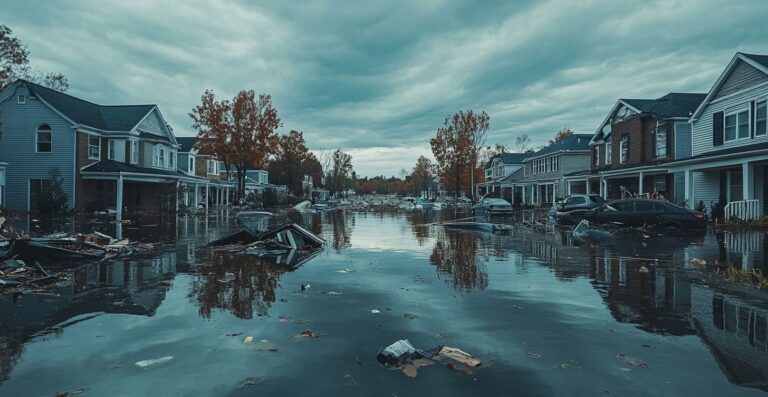
By year five, the house is barely holding together. The ground beneath it has been steadily hollowed out by years of relentless rain, and the whole structure is sinking toward a growing crater that opens straight down to the ocean below. It’s here that the Delgados decide they’re done waiting to be let out; they’re going to force the issue.
Using a harpoon rigged up by Graham, the family manages to trap one of the creatures inside the house. Jason, who has spent the entire film in problem-solving mode, fixes it, traps it, controls it, protects the family by force if necessary, holds the harpoon and makes it clear he’s willing to kill the thing unless it opens the door. It’s the most straightforward the film ever gets about Jason’s whole arc: he’s a man who solves problems with his hands, and for five years that instinct has kept his family alive. But it’s also, the film argues, exactly the instinct that’s kept humanity in conflict with the natural world in the first place.
Ruth begs him not to do it.
And Jason, for the first time in the entire film, listens to someone else’s read on a threat instead of trusting his own. He lowers the harpoon. He lets the creature go.
That single choice is what actually ends the standoff not force, not a clever trap, not violence, but the family finally proving, in a moment that mattered, that they were capable of something other than domination. The creature doesn’t just flee. It signals to the others gathered outside and there are a lot of them, surrounding the house in a moment that plays almost like a stand-off from a heist movie to let the family pass unharmed.
The rain stops. The creatures retreat. The house, its foundation long since ruined, finally gives up entirely and collapses into the crater as the family scrambles clear.
Is it a slightly convenient resolution to five years of hostile, one-sided conflict? Sure, a little. But thematically it’s consistent: the film has been building toward the idea that coexistence, not conquest, is the only way this ends peacefully, and it commits to that idea all the way through the final scene rather than undercutting it with a last-minute action beat.
What’s With the “Hello” at the End?
The Delgados escape onto a neighbor’s abandoned boat, rechristened Cassidy, and set out across what used to be their neighborhood, now fully submerged. Right before the credits roll, Ruth picks up the radio and asks the open air if anyone else survived out there.
A single, static-drenched voice answers: “Hello?”
We never find out whose voice it is. Netflix has been cagey about it on purpose, teasing that it belongs to someone recognizable without confirming a name which, functionally, means it’s a hook for a sequel more than a genuine mystery with an answer baked in right now. Combined with the film’s insistence that other pockets of humanity likely survived elsewhere in high-rises, on higher ground, anywhere people could work together instead of scattering the ending is less a resolution than an invitation.
The Delgados made it. Somebody else, out there, apparently did too. The movie just isn’t ready to tell you who yet.
Why “Day 1” Matters More Than You’d Think?
Here’s a small detail that’s easy to miss if you’re focused on the radio call: the movie has been counting days on screen since almost the very beginning. Using those title cards to count the days isn’t just a stylistic choice. By ticking off Day 1, Day 40, and eventually bridging that half-decade gap, the film uses a quiet visual cue to make a seemingly endless quarantine feel grounded, heavy, and exhausting for the audience.
So when the family finally escapes, gets on the boat, and that same title card system resets back down to “Day 1,” it’s not a throwaway detail. It’s the film making a very deliberate distinction: this isn’t day one thousand-something of survival. It’s day one of something entirely new. The counting doesn’t just stop, it starts over, on their terms, for the first time since the rain began.
It’s a small, almost easy-to-miss choice, but it does a lot of quiet work. Everything up to that point has been about endurance getting through each individual day just to reach the next one. That reset signals the family isn’t just enduring anymore; they’re starting fresh, with all the uncertainty and possibility that comes with an actual “day one” instead of just another number tacked onto a five-year tally. It’s the same instinct behind renaming the boat Cassidy, a small, symbolic gesture that says more about where the family’s headed than any dialogue in the scene does.
Are There Other Survivors Out There?
The film goes out of its way to suggest the Delgados aren’t the last people left on Earth, even if it never confirms exactly how many others made it. The implication throughout is that survival was possible anywhere people had enough elevation, enough shelter, or enough cooperation to outlast the creatures’ campaign high-rises, hillside communities, anywhere the flooding couldn’t fully reach. It’s a detail that matters more than it might seem on first watch, because it reframes the ending’s mystery voice from “a random miracle” into “a plausible outcome the film has been quietly setting up the whole time.”
That single “Hello” on the radio isn’t meant to feel like an isolated fluke. It’s meant to feel like the first thread of a much bigger, mostly untold story: other households, other families, other versions of the Delgados’ five years, scattered across whatever’s left of the map. Whether the film ever gets to tell those stories depends entirely on whether Netflix greenlights more of this world, but the door has very clearly been left open on purpose.
The Real Question the Movie’s Actually Asking
Strip away the tentacles and the flooded suburbs, and The Last House is doing something a lot of good creature features have quietly done before it: using the monster as a mirror. The “invasion” framing is a bait-and-switch. These aren’t visitors from somewhere else, forcing their way into a world that belongs to us. They’re the original tenants, and humanity has been the disruptive presence the whole time polluting, overheating, and expanding into a home that was never solely ours to begin with.
That’s not a wildly original thesis for a monster movie to have, but the execution is what makes it land: five years of one family learning, the hard way, that control and conquest weren’t actually keeping them safe. Growth was. Adaptation was. And ultimately, mercy was. It’s a survival story that ends not with the family winning a fight, but with them finally choosing not to have one which, considering how much of the runtime is spent on Jason’s instinct to fix everything by force, feels like the actual point the film’s been building toward the whole time.
Is This Actually a Happy Ending?
Here’s a question worth chewing on after the credits roll: did the Delgados win, or did they just get permission to leave?
The story actively avoids serving up the kind of clear-cut, feel-good win you usually expect from this genre. Nobody defeats the creatures. Nobody figures out how to reverse whatever caused the storms in the first place. The family doesn’t get their old life back, their house is gone, their neighborhood is a flooded ruin, and they’re setting out into an unknown, half-submerged world with no real idea what’s left of civilization out there.
What they get instead is something smaller and, honestly, a little more interesting than a conventional victory: permission to keep existing, granted by the very thing that spent five years trying to starve them out.
That’s a deliberately uncomfortable note to end on, and it’s very much the point. A more conventional creature feature would’ve had the family fight their way to freedom, maybe blow something up on the way out. This one insists that the fighting was never going to work, and that the only way through was for the most powerful person in the house Jason, the engineer, the protector, the guy who solved every previous problem with force and ingenuity to admit that his daughter understood the assignment better than he did.
It’s a quiet ending for a movie built almost entirely around loud, relentless survival tension, and that mismatch is going to divide viewers. Some will find it earned. Others will find it a little too neat for five years of trauma to resolve around one act of mercy. Both reactions are fair.
The House Is Basically Its Own Character
It’s worth pointing out how hard the film leans on the house itself as more than just a setting because by the end, it functions as a prison, a farm, a workshop, a graveyard, and finally an ark, all inside the same four walls. Early on it’s just a normal suburban home, the kind you’d scroll past in a real estate listing without a second thought. By year five it’s been so thoroughly cannibalized for parts and purpose that it barely resembles a house at all anymore; it’s a life-support system the family built with their bare hands, one desperate improvisation at a time.
That transformation is doing more narrative work than it might seem like on a first watch. The same walls that trap the family in the first act are the ones protecting them by the third. The chimney that should be a liability, a crack in their only line of defense becomes their single most valuable resource. Even the ending plays on this: it’s only once the house physically gives out, sinking into the crater beneath it, that the family is finally forced into the water and toward whatever comes next.
The house has to die for the story to move forward, almost like the family had to fully exhaust what safety could offer before they were ready to risk anything else.
How This Fits Into Netflix’s Whole “Trapped Family” Wave?
If the setup here felt a little familiar, that’s not an accident; Netflix has quietly built out a whole subgenre of “ordinary family, extraordinary confinement” thrillers over the past few years, and The Last House is clearly aware it’s part of that lineage. What sets it apart from a lot of its siblings in that space is the timescale. Most trapped-family thrillers resolve their crisis in days or weeks. This one stretches the ordeal across five full years, which changes the entire emotional texture of the story, it’s less about the initial panic of the threat and much more about what prolonged, grinding uncertainty does to people who love each other.
That’s really the thing that separates The Last House from a more conventional creature feature. The monster is almost secondary to the slow-burn character study happening underneath it: what happens to a marriage, a parent-child relationship, a family’s whole internal hierarchy, when the crisis doesn’t end in an afternoon but just becomes the new, permanent shape of daily life. It’s a smart choice, and it’s probably the reason the film sticks with people longer than the “guys, there are sea monsters” premise alone would suggest it should.
If you’re interested, you can check out our Disclosure Day Ending Explained here!
So, Wrapping It Up!
Look, at the end of the day this isn’t really a monster movie. It’s a movie about a dad who spends five years trying to fix everything with his hands, and the one time that actually works is the one time he stops and listens to his kid instead. That’s it. That’s the whole thing.
And honestly, nobody “wins” here in any normal sense. The house is gone. Five years are gone. Cassidy’s gone. They’re sailing off into a flooded world with basically no idea what’s out there. But they made it, and they made it because they chose mercy over force when it counted, which is a weirdly quiet way for a creature movie to end. Is that resolution actually satisfying after watching this family endure absolute misery? You could easily argue both sides.
But there is no denying it leaves an impression, and that cliffhanger broadcast at the very last second ensures you won’t stop theorizing anytime soon.
FAQ: Most Googled Questions; Answered!
Does the Entire family survive the Ending of The Last House?
Yes. Jason, Ann, Graham, and Ruth all make it out alive and escape together on the boat.
What Happens to the Family Dog in The Last House?
Cassidy, the family’s golden retriever, dies when her heart medication runs out. Jason euthanizes her, and the family later uses her body for trap bait rather than let her death go to waste.
Are the Creatures in The Last House Aliens?
No. They’re revealed to be an ancient species native to Earth’s unexplored ocean depths, not extraterrestrials; the film frames humanity as the actual intruders on their territory.
Why do the Creatures finally let the Delgado family go?
Because Jason chooses to spare a captured creature instead of killing it, at Ruth’s urging. That act of mercy convinces the creature to let the family go and signal the others to stand down.
Who says “Hello” on the radio at the end of the movie?
It’s never revealed. Netflix and the filmmakers have kept the identity intentionally vague, leaving the door open for other survivors and likely a sequel.
Is there going to be a sequel to The Last House?
Nothing has been officially confirmed, but the open-ended final scene, combined with the filmmakers’ comments about other survivors existing elsewhere, strongly suggests the story isn’t necessarily finished.
About the Author.
Hi, I’m Vansh, the founder of Vibe On Cue. I track the absolute best ways to experience cinema, from the biggest Hollywood Blockbusters and upcoming release dates to the finest details of PVOD & Streaming and pristine Blu-ray & 4K physical media. And when the credits roll, I break down the narrative with deep-dive Ending explained guides. If you live for the full life cycle of film, stick around and explore the site!!!