
The 2018 theatrical release of Hereditary did far more than deliver standard theater scares; filmmaker Ari Aster forced audiences to confront a deeply rooted, existential dread that lingers long after the credits roll. While lesser horror films rely on sudden, earsplitting jump scares and cheap prosthetic makeup, Hereditary builds its foundational dread on an inescapable, terrifyingly human foundation: the crushing weight of family history, unaddressed grief, and inherited psychological trauma.
By the time the final credits roll, the supernatural horrors depicted on screen merge seamlessly with the quiet, devastating realities that many families face in secret. It operates as a masterclass in atmospheric tension, forcing the viewer to confront the terrifying notion that our worst enemies might not be monsters waiting in the dark, but the very bloodlines that run through our veins.
The film’s final act remains one of the most polarizing, discussed, and haunting finales in modern cinematic history. It isn’t a chaotic, disorganized mess of blood and violence; instead, it functions as a meticulously engineered trap of preordained fate, total manipulation, and ancestral legacy. In this comprehensive Hereditary Ending Explained, we will strip away the layers of the Graham family’s tragic, inevitable descent, decode the absolute occult mechanics of the Cult of Paimon, and analyze the hidden visual details that reveal how this entire nightmare was locked in from the very first frame of the film.
Spoiler Alert: Seriously, if you haven’t watched this movie yet, close this tab immediately. We are diving into full, unfiltered details, and you absolutely do not want to find out what a “human bear-kabob” looks like from a random corner of the internet. Go watch it firstwe promise to keep the lights on and the cliffs clear until you get back.
The Domestic Prison: Generational Decay as a Psychological System
From the opening sequence, the Grahams are structurally positioned not just as a standard grieving household, but as a deeply fragile, claustrophobic psychological system completely incapable of protecting itself. Annie Graham (Toni Collette), an avant-garde artist specializing in hyper-detailed miniature models, is forced to navigate the complex, unspoken emotional landscape of mourning her secretive, estranged mother, Ellen. As the narrative unfolds, we realize that Ellen didn’t leave behind a traditional void; she left behind a multi-generational legacy of severe mental illness, systemic manipulation, and ritualistic abuse. The architecture of the home itself reflects this confinement, acting less like a sanctuary and more like an active cage where secrets are weaponized across generations.
The crushing inevitability of the film’s climax becomes completely clear when you examine the dark, historical pattern of Annie’s maternal lineage. Long before the events of the movie, her teenage brother struggled with severe psychological torment, ultimately ending his life in his mother’s room. He left behind a disturbing final note pointing directly at Ellen, accusing her of attempting to force external entities into his body.
This pattern of destruction extended to Annie’s father as well, who succumbed to a severe fatal depression driven by psychosis. This grounding in genuine psychological decay and genetic vulnerability is exactly what makes Hereditary feel so devastatingly real to the audience. The supernatural events aren’t random external forces striking an innocent household; they are literal, physical manifestation of inherited family curses, both psychological and occult festering beneath the floorboards for decades.
The Roadside Execution: The Catastrophic Breaking of the Bloodline
The true descent into the abyss begins with the horrifying, unexpected decapitation of Charlie (Milly Shapiro). Paralyzed by an acute allergic reaction to nuts at a high school party she was forced to attend, In the dead of night, her panicked older brother, Peter (Alex Wolff), desperately speeds down the road in a frantic race to reach the nearest emergency room. In a moment of pure, blinding panic, Charlie sticks her head out of the car window for air just as Peter swerves to avoid a dead animal in the road, resulting in her instant decapitation against a telephone pole. The sheer brutality of this sequence shifts the film from a slow-burn family drama into a visceral, inescapable nightmare.
This sequence is crucial because it highlights Aster’s absolute mastery over the portrayal of human suffering. The camera, operated by cinematographer Pawel Pogorzelski, purposefully refuses to cut away from Peter’s frozen, catatonic shock as he sits in the dark, unable to look back, eventually driving home and leaving his sister’s headless torso in the backseat for his mother to discover the following morning. This catastrophic loss completely shatters the family’s remaining psychological defenses. By creating an agonizing emotional vacuum of raw grief, immense guilt, and structural vulnerability, the coven successfully orchestrates the exact conditions required to execute the final phase of their master plan.
The Dollhouse Illusion: Miniatures as a Blueprint of Determinism
One of the most brilliant visual and thematic motifs in Hereditary is Annie’s absolute obsession with creating miniature dioramas of her own domestic life. At first glance, her painstaking work appears to be a therapeutic outlet; a quirky, meticulous hobby designed to help her process her complicated, traumatic family history. In reality, these models serve as a terrifying visual metaphor for the complete illusion of free will, reinforcing the idea that the Grahams are entirely powerless over their own destinies.
Production designer Grace Yun actually constructed the full-sized interior home sets on a soundstage specifically to give the film a manufactured, hyper-controlled “dollhouse” aesthetic. Walls were built to be entirely removable, allowing the camera to frame the real actors from extreme, straight-on distances just like Annie’s models. When Annie meticulously replicates her family’s private traumas, the sterile hospice room of her dying mother, the tense family dinner arguments, and eventually, the grotesque roadside accident itself, Aster is signaling to the audience that these characters are nothing more than helpless plastic figures trapped inside a box. Every choice they believe they are making independently has already been pre-constructed and painted for them by an unseen creator.
The Living Room Seance: Invitation to the Abyss
Driven by a raw, unadulterated desperation to find a sense of resolution and bridge the impossible gap left by her daughter’s death, Annie falls victim to Joan (Ann Dowd), a seemingly compassionate woman from a local grief support group. Joan subtly introduces Annie to the practice of spiritualism, demonstrating a terrifying parlor trick where she seemingly conjures her deceased grandson’s spirit using a basic chalkboard and a collection of personal toys. This interaction exploits Annie’s maternal guilt, pulling her deeper into an invisible web.
Fueled by this desperate hope, Annie forces her deeply reluctant husband Steve and deeply traumatized son Peter to participate in an impromptu midnight seance in their living room. This sequence marks the structural point of no return for the entire household. Grief completely distorts Annie’s internal logic; her frantic attempt to “fix” what is broken and communicate with the dead explicitly acts as the vehicle that invites the demonic presence directly into the core of their home. She believes she is seeking emotional closure, but she is actually signing the eviction notice for her family’s souls, opening a doorway that cannot be shut.
The Lesser Key of Solomon: The Systemic Architecture of the Coven
The film’s third act pulls back the curtain to reveal the terrifying, centuries-old architecture behind the family’s structural collapse: Annie’s late mother, Ellen, was the high priestess of a deeply entrenched, highly organized occult coven. The group operates under a singular, ancient objective: to successfully summon King Paimon, one of the powerful demonic monarchs listed in the 17th-century grimoire The Lesser Key of Solomon. This realization recontextualizes every single interaction in the film, transforming strange family quirks into calculated steps of a ritual.
According to authentic demonological lore, King Paimon is fiercely loyal to Lucifer, possesses immense hidden knowledge of the sciences, arts, and secret things, and can bestow vast wealth and earthly dignities upon those who worship him. However, a spirit of this magnitude requires a human host to fully manifest his consciousness in the material realm and he explicitly demands a male vessel.
The cult’s actions across generations were never random; they spent decades systematically engineering the isolation, psychological fracturing, and total emotional vulnerability of the Graham bloodline to prepare Peter’s body to receive the demonic king.
The Coven’s Blueprint: Unmasking the Invisible Symbols and Demonic Traces
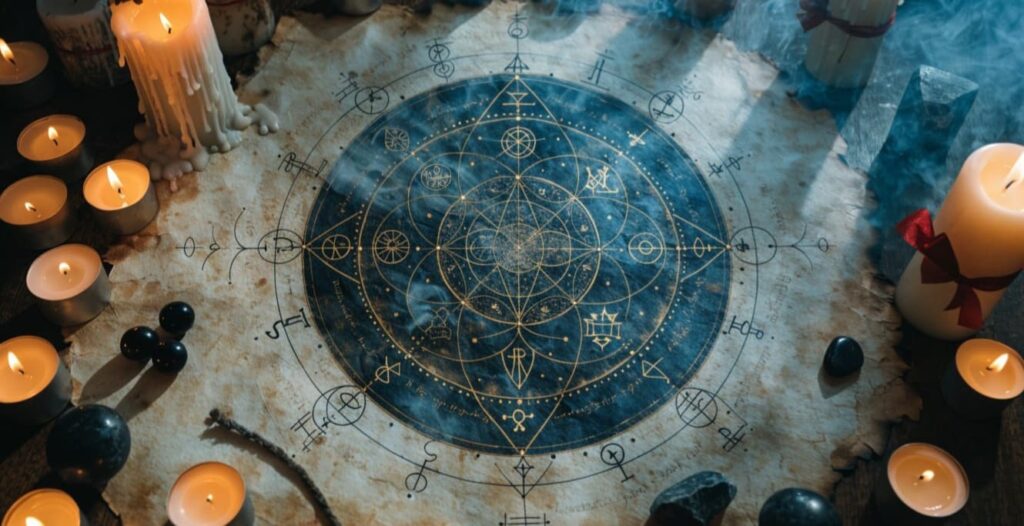
Aster populates the background and sound design of Hereditary with authentic occult symbols that prove the Grahams never stood a chance against their automated fate. The most prominent of these visual markers is the Sigil of Paimon, an intricate geometric symbol that appears engraved on Ellen’s necklace, painted in blood on the attic walls, and carved directly into the wooden telephone pole that decapitated Charlie. It serves as a constant reminder that the environment itself has been branded by the coven.
Furthermore, Paimon’s presence is heralded by specific, unholy calling cards carefully woven into the film’s texture:
- The Tongue Click: Charlie’s distinct, unsettling tongue-clicking habit isn’t a human tic; it is a demonic signature. The film heavily implies that Charlie was never truly a normal girl; she was born with Paimon’s consciousness already partially bound to her body, waiting for a suitable male host to be cleared by the cult.
- The Ethereal Blue Light: The strange, glinting beam of blue light that darts across the walls and actively guides the characters toward horrific discoveries is Paimon’s spiritual energy manipulating their visual field.
- The Words of Command: Words like SATONY, ZAZAS, and LIFTOACH are painted directly onto the walls of the home. In classical occult rituals, these are words of command used to loosen the boundaries between the physical world and the abyss, systematically dissolving the home’s spiritual protection.
Hollowed Out: The Systematic Eviction of Peter’s Consciousness
To truly grasp how the movie’s final trap snaps shut, you have to dissect the deliberate, painful unraveling of Peter’s mental stability. Paimon cannot simply possess a healthy, balanced, and secure human mind; the human ego and sense of self must be completely shattered, emptied, and cleansed of its original identity before the demonic entity can assume total control. The coven doesn’t just attack the body; they systematically assault Peter’s sanity.
Following Charlie’s accident, Peter experiences a brutal downward spiral of severe panic attacks, terrifying waking hallucinations, and crippling, isolating guilt. The psychological horror peaks in his high school classroom when his body is violently contorted by an unseen force, physically forcing him to slam his face into his wooden desk until his nose breaks. This public, terrifying mental breakdown represents the final, irrevocable fracturing of his consciousness.
The terrified teenager is completely hollowed out by fear and despair, leaving his physical body an open, defenseless vessel ready for immediate occupancy.
The Triple Beheading: The Decoupling of the Final Ritual
The final sequence of the film moves at a breakneck, nightmare pace that mimics a sudden panic attack. After discovering her husband Steve’s charred corpse in the living room, Annie becomes completely possessed by the entity, losing all remaining human agency. Peter awakens in the dark to find his home transformed into a silent temple of doom, populated by the shadows of the coven. In a sequence that has deeply traumatized viewers worldwide, a naked, possessed Annie chases her son up into the dark attic, where she proceeds to levitate and mechanically decapitate herself using a piano wire.
This horrific act carries a massive, layered symbolic and ritualistic weight. The ritual demands a specific sequence of maternal beheadings; beginning with Ellen’s unburied remains, moving to Charlie, and culminating with Annie, serving as the essential spiritual triggers to finalize the coven’s spell. In demonology, three specific maternal beheadings are required to sever the familial, genetic chains of the host line and crown the new monarch. Annie’s desperate, tragic fight across generations to protect her children from her mother’s shadow ends in total structural defeat. She didn’t just fail to break the cycle; her physical form was actively weaponized to complete it.
The Golden Crown: The Tragic Coronation of King Paimon
In the final, deeply haunting frames of the movie, Peter leaps out of the attic window to escape the ghosts chasing him, knocking himself unconscious on the ground below. When his eyes open, his human spirit is entirely gone. He is now completely inhabited by the entity. Guided by the bizarre, ethereal blue light, his body walks slowly across the sunlit lawn and climbs the ladder into Charlie’s wooden treehouse, which glows with an unnatural, expressive red light.
Inside the treehouse, the full, grotesque reality of the coven’s victory is laid bare. Surrounded by the kneeling, naked members of the cult and the headless, worshipful corpses of his mother and grandmother, Peter is crowned with a golden diadem by Joan. Joan bows before him, explicitly addressing him as King Paimon, declaring that they have successfully purged his male host of its original identity and corrected his alignment.
Ultimately, Hereditary balancing horror and profound human tragedy is what makes its finale so enduringly heartbreaking. Peter’s transformation into a literal vessel for an ancient entity is deeply existential, yet profoundly sad. The crown resting on his head, the terrifying levitation of the headless corpses, and the silent presence of his family all serve as a bleak meditation on the inescapability of ancestral grief.
The film refuses to grant the audience any form of standard Hollywood comfort, redemption, or traditional catharsis. It leaves us staring into a cruel, deterministic mirror, reminding us that the scariest forces in existence aren’t always monsters hiding under the bed, they are the silent, inherited struggles we carry within our own bloodlines, shaping who we become in ways we might never fully understand.
About the Author
Hi, I’m Vansh, the founder of Vibe On Cue. I track the absolute best ways to experience cinema, from the biggest Hollywood Blockbusters and upcoming release dates to the finest details of PVOD & Streaming and pristine Blu-ray & 4K physical media. And when the credits roll, I break down the narrative with deep-dive Ending explained guides. If you live for the full life cycle of film, stick around and explore the site!!!